



ESPN+
Player safety is of utmost importance in college baseball. As a result, some plays once deemed legal are now subject to penalty.
Brown baseball was involved in one of these instances during a rivalry series with Cornell. A vicious collision resulted in an ejection, which was quickly followed by an online debate.
Was the decision warranted? Was a run unfairly wiped from the scoreboard? Let’s dive in.
Cornell baseball flattened Brown.
After dropping Game 1 of the three-game series, the Big Red bounced back with back-to-back wins. The first came in extra innings, with Cornell pushing the go-ahead run across in the 13th frame.
Game 3 wouldn’t be as close, but there would be dramatics.
The Big Red led 4-3 in the seventh with a chance to add to its lead. With one out and a runner on third base, Owen Carlson stepped up to the dish.
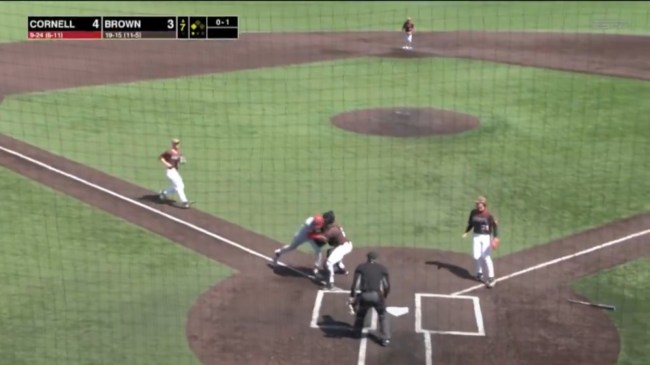
He’d hit a groundball to the third baseman, who caught baserunner Caden Wildman in a pickle. The ball was relayed to home where a collision ensued.
Good ol’ fashioned Ivy League catcher truck stick yesterday 🔥
Disappointed no one from Brown got a retaliation lick in, but understandable as they are busy competing for an Ivy League title. pic.twitter.com/1kdRMjUEKn
— 11Point7 College Baseball (@11point7) April 27, 2026
Wildman lowered his shoulder into the Brown catcher, jarring both the ball and the backstop’s helmet loose from his body. Despite the loss of possession, Wildman was ruled out and immediately ejected from the contest.
It was the right call.
Questions surrounding play quickly emerged on social media. Some were related to the out ruling. Others referenced the ejection.
“Catcher dropped the ball. Runner should be safe,” one follower said.
“Get out of the basepath,” wrote another.
“This used to be a normal baseball play,” commented this baseball fan.
The rule change regarding collisions was adopted in 2014. If avoidable, contact between a baserunner and catcher is illegal.
The NCAA Rulebook clearly outlines collision scenarios. This particular play violated each of the predetermined criteria.
The runner may not attempt to dislodge the ball from the fielder. Contact above the waist shall be judged by the umpire as an attempt by the runner to dislodge the ball.
The runner must attempt to avoid a collision if they can reach the base without colliding.
A runner attempting to score may not deviate from their direct pathway to the plate in order to initiate contact with the catcher.
The runner’s lowering of the shoulder… would support a determination that the runner deviated from the pathway in order to initiate contact with the catcher in violation of the Collision Rule 8-7.
The catcher was not in the basepath. He had control of the baseball. It was the runner that initiated contact as opposed to sliding to the outside of the plate.
Violations of the collision rule result in the baserunner being called out immediately ejected, which was seen in the Brown-Cornell baseball game.
Fifteen years ago, that might not have been the case. On Sunday, the umpire got it right. Wildman earned the ejection. His run did not count.
It would not prevent the Big Red from picking up the victory. Cornell still won the rubber match 8-3 to clinch the series.