


Vincent Carchietta-Imagn Images
There are over 350 college basketball teams that compete at the DI level, and most of them have fairly generic nicknames. However, there are more than a few schools that really stand out thanks to unorthodox monikers with some interesting backstories.
Here’s how the college basketball teams with the most interesting names got their moniker in the first place
“Bulldogs” is the most played-out nickname at the DI level thanks to the 15 college basketball programs that have adopted it in some capacity; “Tigers” takes the silver medal with a dozen schools, and Wildcats and standalone “Eagles” tie for third at 10 apiece (although the second rises to if you consider the Golden, Screaming, and Purple variations).
There are also a number of schools that have a monopoly on their moniker, and here’s a look at the backstory behind some of the most unique ones.
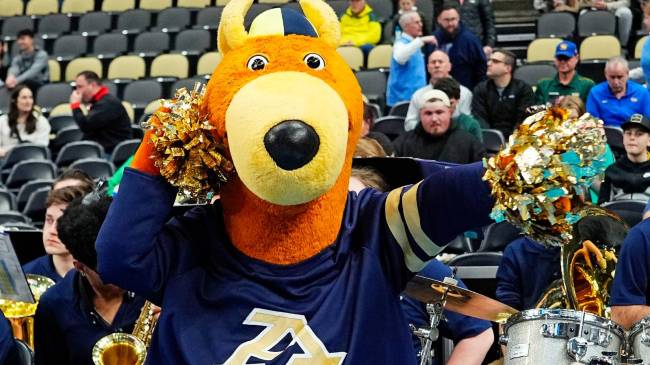
Akron Zips
Gregory Fisher-Imagn Images
Akron’s mascot may be a kangaroo, but “Zips” refers to the zippers—rubber boots that were secured with, you guessed it, zippers— that the B.F. Goodrich Company was making in the city when they inspired the nickname that was embraced after a vote in 1925 (it was formally shortened to its current length in 1950).
Coastal Carolina Chanticleers

Amber Searls-Imagn Images
This one is quite the deep cut, as Coastal Carolina was originally the Trojans before there was a movement on campus in the 1960s that pushed for the school to take a rooster-themed cue from the University of South Carolina (which it was affiliated with until 1993).
Gamecocks was taken, but Chanticleers—a nod to the rooster in “The Nun’s Priest’s Tale” from Chaucer’s Canterbury Tale’s—was firmly still up for grabs, and the rest is history.
Evansville Purple Aces

MaCabe Brown / Courier & Press, MaCabe Brown
There are a few nicknames on this list that can be traced back to a sport other than basketball, but that’s the pastime responsible for this one.
During the 1924-25 campaign, Evansville’s team, which was then known as the Pioneers, handed Louisville a 59-39 loss. The coach for the Cardinals gave props to John Harmon, the opposing skipper, by remarking, “You didn’t have four aces up your sleeve, you had five!”
That exchange made its way to a reporter who took a liking to Aces, which eventually became the “Purple Aces” due to the school’s color scheme.
Furman Paladins

Ben Solomon/NCAA Photos via Getty Images
“Paladin” was originally used to refer to the dozen knights who comprised the court of the Frankish emperor Charlemagne, but it eventually became a somewhat generic term used to describe a noble warrior.
Furman’s basketball team has been known as the Paladins since the 1930s courtesy of a sportswriter who coined the term. However, it wasn’t a universal nickname at the school—the football team was the Hurricanes and the baseball team was the Hornets before students voted to make Paladins universal in 1961.
Georgetown Hoyas

Daniel Kucin Jr.-Imagn Images
Most of the schools on this list are tiny and largely overlooked programs, but we also have a handful of blue bloods.
The first is Georgetown, which can trace its nickname back to the “Hoya Saxa!” chant—a combination of the Greek word for “What” and the Latin word for “Rocks,” respectively—that students pulled at during an era when they were required to study both languages and teams at the school were known as the Stonewalls.
That means the Hoyas are literally the “Whats,” which is a question many of their fans have been asking themselves on a regular basis while watching the team play under Patrick Ewing and Ed Cooley.
Manhattan Jaspers

Daniel Kucin Jr.-Imagn Images
Manhattan is responsible for one of the most straightforward explanations on this list, as the team is named after Brother Jasper of Mary, an Irish native who was ordained in St. Louis before moving to New York City.
He began serving as the prefect at the university in 1861 and was responsible for introducing a number of programs—including its first baseball team. He is also credited (possibly apocryphally) with being the person who dreamed up the idea of the seventh-inning stretch when he told antsy spectators to get up and move around during a game.
Purdue Boilermakers
Gregory Fisher-Imagn Images
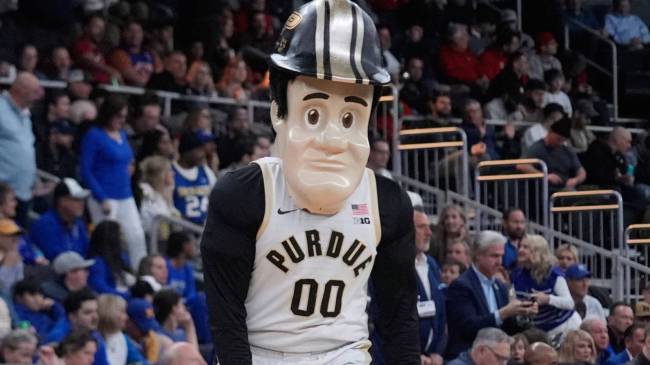
Purdue definitely deserves a spot on this list, and while I was putting it together, I discovered a BroBible colleague who will remain unnamed was under the impression they were named after the drink order involving a beer and a shot of whiskey.
If you were (somehow) also under the impression that was the case, you should know it stems from a newspaper reporter who referred to their football team as “the burly Boiler Makers from Purdue” while praising their toughness during a win over Wabash College in 1891.
Presbyterian College Blue Hose
Mark Zaleski / The Tennessean / USA TODAY NETWORK
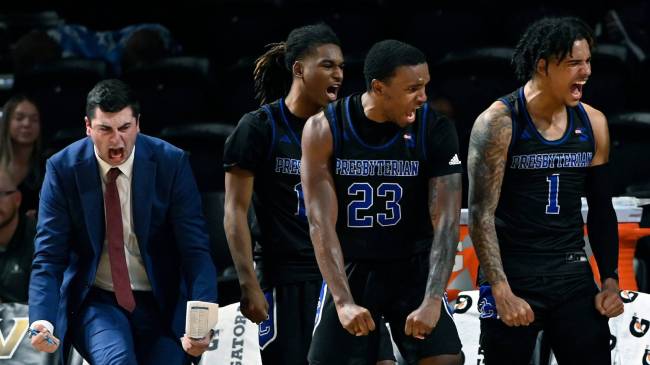
For my money, there isn’t a stranger entry on this list than Presbyterian College, which has opted to adopt the Blue Hose.
The team’s actual mascot is a Scottish Highlander warrior, but the origin of their nickname is a bit less intimidating: players were originally referred to as the “Blue Stockings” due to the color of their socks, and that was shortened to “Blue Hose” before it was officially embraced as the moniker in the 1950s.
Saint Peter’s Peacocks
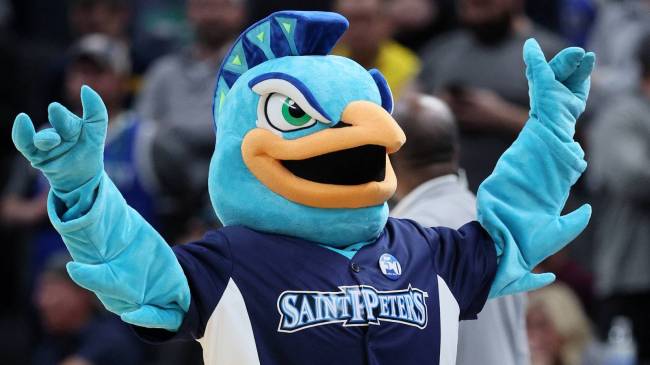
Andy Lyons/Getty Images
Saint Peter’s was responsible for one of the most memorable Cinderella runs in recent history when they made it to the Elite Eight as a 15-seed while putting the “madness” in March Madness in 2022.
World War I resulted in the university shutting down for 12 years starting in 1918, and its dean, Robert Gannon, adopted the Peacock as its mascot when it was “reborn” in 1930 due to the phoenix-like abilities the bird has long been linked with in Christian art (it was also a nod to the name the Dutch originally gave to Jersey City, the school’s home: “Pavonia,” which translates to “Land of the Peacock”).
Southern Illinois Salukis
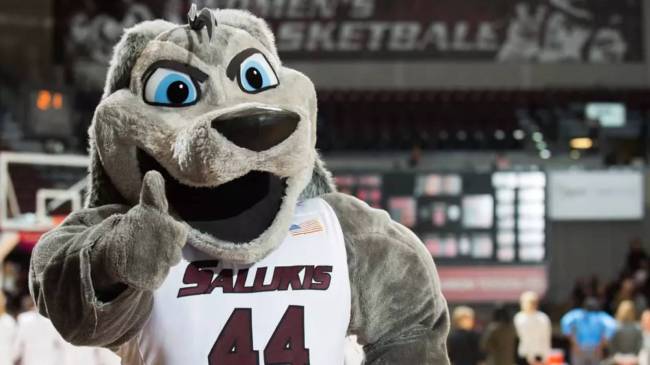
Southern Illinois University
Southern Illinois was originally a school that made the uninspired decision to adopt a color as its mascot, but in 1951, students at the school located in a region known as “Little Egypt” got the chance to vote on a new name to replace the Maroons.
They opted to pay tribute to that moniker by going with the Salukis, the long-haired dog breed that can be found painted on some Egyptian tombs and is known for speed that can rival a greyhound.
Stetson Hatters

Porter Binks/Getty Images
Stetson University was originally known as DeLand Academy when it was founded in that city in Florida in 1883.
The school got off the ground thanks to a generous donation from cowboy hat magnate John B. Stetson (the founding trustee who also played a key role in the formation of Temple University), and its nickname is a nod to the headwear responsible for his fortune.
St. Louis Billikens

G Fiume/Getty Images
I’m not sure if there’s a more nonsensical nickname on this list than the one brought to us by St. Louis.
I had no idea what a billiken was before I looked it up, and I can’t say I have a better idea after learning it refers to a “mythical good-luck figure who represents ‘things as they ought to be.” That figure was created by Florence Pretz, an art teacher from Missouri who patented the design for one in 1908 after she set out to “make an image which embodied hope and happiness to sort of live up to.”
That leaves me with even more questions than I had before I started researching, but St. Louis has been embracing the billiken since 1910.
UNC Tar Heels

Bob Donnan-Imagn Images
This is the last big name on this list, and there’s a good chance you’ve gone out of your way to research the origins before.
If you haven’t (or you’ve simply forgotten), Tar Heels can be traced back to poor laborers who supported the tar, pitch, and turpentine industries fueled by North Carolina’s pine trees. It was originally viewed as a derogatory term, but it was eventually reclaimed by people in the state and, in turn, its flagship university.
USF Dons

Matthew Huang/Icon Sportswire via Getty Images
At first glance, you might think USF is named after the head of an Italian crime family or a guy with a plumbing business in the Chicago suburbs.
That first explanation is actually pretty close to the real one, as it references the Spanish title of “De Origen Noble” that was used as an honorific in the country that first colonized the area the school calls home; they were originally the Grey Fog before it was replaced by the name that’s stuck since 1932.
VMI Keydets

Michael Thomas Shroyer-Imagn Images
If you know that VMI stands for “Virginia Military Institute,” the fact that their nickname is derived from “Cadets” is not really a surprise. However, it is spelled (and pronounced) “Keydets,” and there’s no official explanation as to why that’s the case.
There are a couple of theories. The first is that “keydet” was used to refer to the gray color of the uniforms cadets were outfitted with, and the second asserts it stems from the way that word was pronounced by students with a Southern accent.
Western Illinois Leathernecks
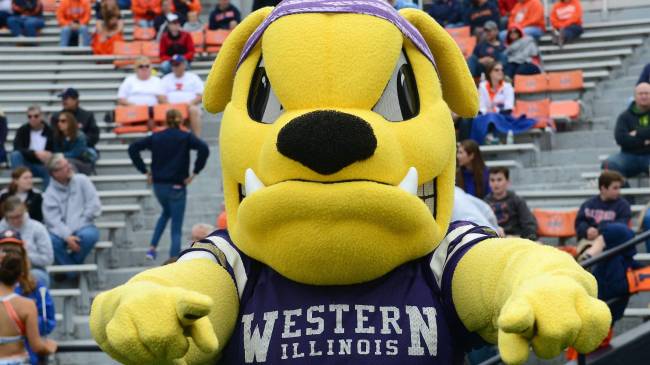
Keith Gillett/Icon Sportswire/Corbis via Getty Images
Western Illinois may not be a military school like VMI, but its name and mascot can be traced back to the armed forces.
Ray “Rock” Hanson served in the Marine Corps and earned multiple medals—including the Navy Cross and Silver Star—for saving a fellow soldier who was injured by gunfire in the Battle of Château-Thierry during World War I.
He spent time coaching under Knute Rockne before heading to Western Illinois to serve as their football coach and athletic director (he also oversaw the baseball and basketball teams). In 1927, he petitioned the United States Navy to adopt the Marine Corps’ bulldog mascot and “Leathernecks” nickname, and the school has been permitted to use them ever since.
Wichita State Shockers
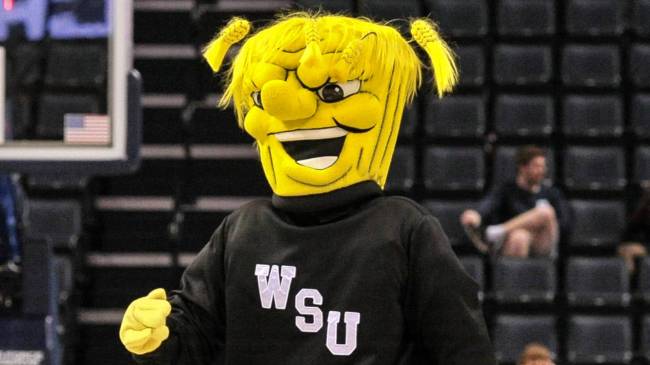
Justin Ford-Imagn Images
Wichita State’s nickname will always get a chuckle out of people who associate the Shockers with a certain hand gesture, but it’s a reference to the students who worked as “Wheat Shockers” (the original nickname) to earn money for tuition by harvesting the biggest cash crop in Kansas.
Youngstown State Penguins

Frank Jansky/Icon Sportswire via Getty Images
I’m not sure if there’s a single mascot in college sports that I adore more than Youngstown State’s, as adopting an angry-looking penguin as the symbol for a school located in an industrial city in Ohio is absurd to the point where I have to respect it.
The nickname can be traced back to 1933, as the school was widely referred to as the “Locals” when they traveled to West Liberty State Teachers College for a game in the middle of the winter.
The lack of heat on the bus and in the locker room when they arrived inspired frigid players to start flapping their arms and jumping around to try to stay warm, which inspired the “Penguins” moniker that’s stuck ever since.