



iStockphoto / Marc Lebryk-USA TODAY Sports
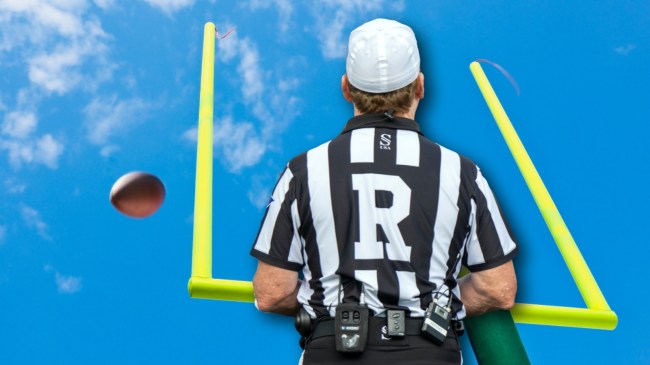
College football referee in front of field goal post
College football is adding a rule that sounds like something invented by a kid losing in Madden. Beginning in 2026, a team that makes a fair catch can choose a fair catch kick, an uncontested field-goal attempt from the spot of the catch with the defense forced to stand at least 10 yards away.
The college football version arrives after the NCAA approved the change in March, bringing the sport in line with a rule that has existed in the NFL and high school football for years. It will almost never matter, which naturally means the first coach who remembers it at 11:47 p.m. on a Saturday is going to look like a genius.
College Football Has A New Way To Steal Three Points
Here is how the weirdness works.
A returner has to complete a fair catch on an opponent’s punt or free kick. Instead of putting the offense on the field, the receiving team can attempt a field goal from that spot, or from the succeeding spot if a penalty changes it.
There is no normal snap-and-rush setup. The defense lines up 10 yards away, the kick must be a place kick with a holder and no tee, or the kicker can attempt a drop kick if the coaching staff has temporarily lost its mind.
If it goes through the uprights, it is worth three points.
The sneakiest part comes at the end of a half. If the fair catch happens as time expires, the team still gets an untimed down to attempt the kick. That means a punt that appears to end the second quarter could suddenly turn into a 60-plus-yard field goal attempt against a defense that is not allowed to rush.
This is exactly the kind of rule everyone laughs about in August until somebody loses a rivalry game because the special-teams coordinator actually read the manual.
NFL Fans Recently Got A Reminder This Rule Exists
The professional version is so obscure that Cameron Dicker’s 57-yard kick for the Chargers in December 2024 was the NFL’s first successful attempt since 1976.
Los Angeles got the opportunity after Denver committed fair-catch interference on a punt as the first half expired. Jim Harbaugh knew the rule, sent Dicker out for the untimed kick and watched him drill it.
Harbaugh later called it his “favorite rule in football.”
Of course he did.
The NFL went 48 years between successful fair-catch kicks, so college football is not about to become a weekly festival of 70-yard field goals. But the NCAA oversees far more games, features a wider range of special-teams chaos and employs coaches who would absolutely attempt something ridiculous if three points are available.
The rule also creates a new late-game consideration for punters.
Pinning an opponent deep is still the goal, but a bad punt or a fair-catch interference penalty near midfield could suddenly hand a team a free shot at the uprights. With no rush coming, a strong-legged kicker can use a longer approach than he would on a traditional field goal.
That does not make a 70-yarder easy. It makes it slightly less insane.
Most fans will probably go months without seeing one. Some might make it through the entire season.
Then one Saturday, a returner will wave for a fair catch with one second left, the offense will stay on the sideline and a kicker will start backing up like he is taking a kickoff.
Half the stadium will have no idea what is happening.
One extremely prepared coach will.