



Adam Cairns/Columbus Dispatch / USA TODAY NETWORK via Imagn Images / Petre Thomas-Imagn Images
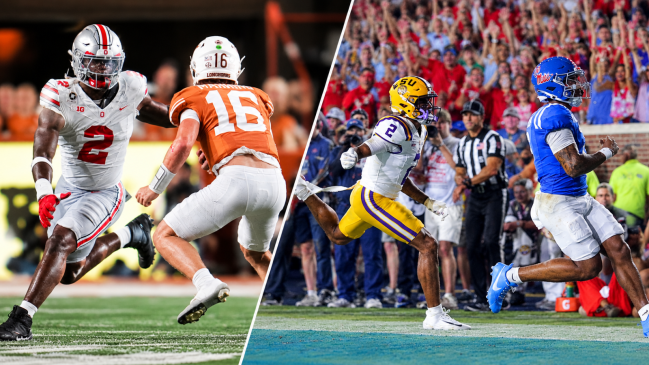
Ohio State Buckeyes defensive end Kenyatta Jackson Jr. (2) pursues Texas Longhorns quarterback Arch Manning (16) during the NCAA football game at Darrell K Royal–Texas Memorial Stadium in Austin, Texas on Sept. 12, 2026. Sep 19, 2026; Oxford, Mississippi, USA; Mississippi Rebels quarterback Trinidad Chambliss (6) runs the ball for a touchdown during the fourth quarter against the LSU Tigers at Vaught-Hemingway Stadium.
A recent article showing a significant dip in college football television ratings through the first month of the season caused a major stir across the sports world.
But do the numbers tell the whole story? Not everybody agrees.
The article, written by David Rumsey of Front Office Sports, stated that viewership of college football across all Nielsen-rated networks was down a whopping 11 percent throughout September compared to the same four weeks in 2025.
That is a massive difference.
Some fans pointed to the lack of marquee matchups due to conferences moving to a nine-game schedule and, as a result, avoiding out-of-conference showdowns. But the opening weeks of the season also included a pair of massive games between Ohio State and Texas as well as LSU and Ole Miss in perhaps the most-hyped regular-season game of the season.
On top of that, powerhouses Michigan and Oklahoma squared off, while Ole Miss traveled to Florida. So the lack of quality games argument doesn’t exactly hold up.
Although there is a catch.
Technically, More People Are Watching College Football Than In 2025
I would advise everyone reading this here to consider the source. However, Michael Mulvhill, the President of Insights and Analytics at Fox Sports, notes that, across all outlets, total time viewing college football is up 0.2 percent compared to last year.
Meanwhile, the same number is down 0.7 percent for the NFL.
Through September, total time spent viewing football versus last year on all outlets:
College Football – Up 0.2%
NFL – Down 0.7%
— Michael Mulvihill (@mulvihill79) September 30, 2026
However, when you apply context, that number becomes less important. There is a larger inventory of viewable games than ever before, which inherently drives up the number. As does the number of people gambling on those games.
Meanwhile, the number of viewable NFL games is unchanged from year to year. Additionally, a close game may keep fans engaged longer, but that does not mean that more of them are watching.
It’s not the first time that Mulvhill, perhaps disingenuously, has spun numbers to reflect his preferential point of view. He did the same previously to defend Fox’s “Big Noon” game of the week.
Perhaps as conference play begins, viewing ratings will trend upward. But with more fans than ever before saying they’re disaffected by the current state of college athletics, it’s not a great sign to see viewership ratings reflect those sentiments.