



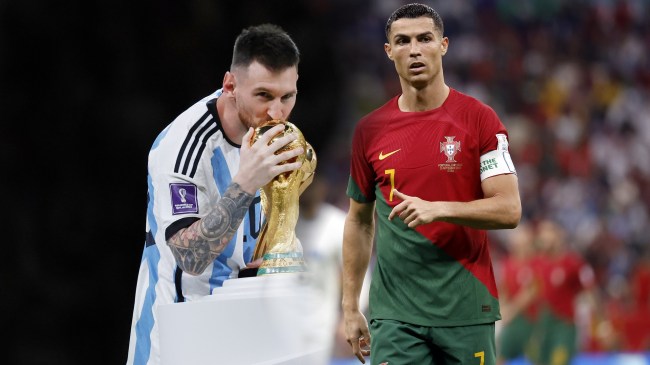
Yukihito Taguchi-USA TODAY Sports
There is no greater stage in all of world soccer, or even all of sports, than that of the FIFA World Cup.
The global event, which will celebrate its 100th anniversary in 2030, is the peak of any player’s career, and representing your country is considered the highest honor in the sport. Some of the sport’s greatest players of all-time, such as Alfredo Di Stéfano, George Best, and George Weah, never had the honor of playing in the world.
Others, however, are World Cup mainstays. In this piece, we’re taking a look at which players have played in the most FIFA World Cup matches in the event’s nearly 100-year-old history.
Most Matches Played At The FIFA World Cup
To be on this list, you can’t just be good; you have to be great. But you also have to be lucky. Because the event occurs only every four years, you have to hope that you’re good enough to play for your country at a young age, and then extend the peak of your career well into your 30s.
Beyond that, your country not only has to qualify every four years, but they need to make deep enough runs in at least one or two World Cups in order to rack up a good number of matches played.
In fact, only 14 players all-time have played in at least 20 matches in the FIFA World Cup, and only these eight players have played in more than 20 matches.
T6) Władysław Żmuda – Poland – 21 Matches
Perhaps the least-recognized name on this list, Władysław Żmuda was an absolute superstar for the Polish national team from 1974-86.
He debuted with the team at the 1974 FIFA World Cup in what was then West Germany, and led the Poles to a third-place finish, the best in their history at that point. Żmuda, who played a center back, was also named the tournament’s best young player.
He then appeared in the 1978 and 1982 World Cups, lifting Poland to another third-place finish in the latter in Spain. What makes Żmuda’s career even more impressive is that he played his club soccer in Poland throughout the prime of his career, only leaving for Italy in 1982, where he played for Hellas Verona up until the 1984 FIFA World Cup in Mexico, which was his last.
T6) Uwe Seeler – Germany – 21 Matches
Uwe Seeler is the oldest player on our list, having passed away in 2022 at the age of 85. Seeler, a striker, was a superstar for powerhouse West Germany.
He appeared in the 1958, 1962, 1966, and 1970 World Cups, scoring nine goals across the four tournaments and leading West Germany to a runner-up finish in 1966 in England, and a third-place finish in 1970 in Mexico.
Seeler, who made the FIFA All-Star Team at the 1966 event, was also a member of Pele’s famed FIFA 100, which came out in 2004 and featured a list of who the Brazilian superstar believed to be the 100 best living players at the time.
T6) Diego Maradona – Argentina – 21 Matches
Before Lionel Messi, Diego Maradona was undeniably the greatest player in the rich history of Argentine soccer, and one of, if not the greatest player, in all of soccer.
The diminutive attacker first appeared in the 1982 FIFA World Cup in Spain for La Albiceleste, but scored just one goal as Argentina was eliminated in the group stage.
Four years later in Mexico, however, it was a far different story. Maradona, who had established himself as perhaps the world’s best player, was an absolute superstar. Though he scored just three goals in the tournament, Maradona pulled all the strings for Argentina with the ball, leading them to their second World Cup championship in the country’s history and winning the Golden Ball as the tournament’s best player.
Maradona then appeared at both the 1990 World Cup in Italy, where Argentina finished as the runner-up to West Germany, and the 1994 World Cup in the U.S., where he made his final appearance for the national team in a 3-2 loss to Romania in the round of 16.
5) Cristiano Ronaldo – Portugal – 22* Matches
In a matter of days, both Cristiano Ronaldo and Lionel Messi will become the only men in history to appear in six FIFA World Cup finals.
The five-time Ballon d’Or winner as the world’s best player first appeared in the 2006 World Cup in Germany, where he scored his first World Cup goal in the group stage against Iran.
Come 2010, Ronaldo had become one of the world’s best players and made the move from Manchester United to Real Madrid. However, he scored just one goal in the tournament as Portugal was disappointingly knocked out in the round of 16 by eventual champion Spain.
2014 in Brazil provided even more disappointment, as Portugal failed to advance from the “Group of Death” with Germany, Ghana, and the United States. Ronaldo scored just once in three matches, and his country went crashing out on a tiebreaker with the U.S.
Four years later in Russia, he had his best FIFA World Cup to date, scoring four goals, including a memorable hat trick against rival Spain. But the Portuguese again went out in the round of 16, this time to Uruguay.
Things improved for Portugal in 2022, when they reached the World Cup quarterfinals in Qatar. However, Ronaldo scored just once in the tournament, and the Portuguese were upset by Morocco in the quarterfinals, 1-0.
Perhaps 2026 will be the year things turn around for Portugal. But at 41 years old, there are plenty of questions about Ronaldo’s spot in the team.
4) Paolo Maldini – Italy – 23 Matches
Anybody who knows anything about the Italian national team knows that Gli Azzuri are famed for their stout defence, and perhaps no player better embodies that sentiment than Paolo Maldini.
The legendary center back was the heart of the Italian team in the 1990, 1994, 1998, and 2002 World Cups. However, he never hoisted the World Cup trophy.
Maldini helped lead Italy to a third-place finish in their home World Cup in 1990, where the Italians failed to reach the final despite allowing just two goals across seven matches.
Four years later in the U.S., Italy finished as the runner-up to Brazil in heartbreaking fashion, losing 3-2 on penalty kicks. Italy’s results fell off a bit from there, reaching the quarterfinals in 1998 in France, before being knocked out in the round of 16 in 2002.
Ironically, the Italians reclaimed the World Cup in 2006. However, Maldini’s name is still revered as one of the greatest players in his country’s history.
3) Miroslav Klose – Germany – 24 Matches
Nobody – not Ronaldo (Cristiano or R9), not Messi, not Maradona, nor Pele, – has scored more goals in the FIFA World Cup than German legend Miroslav Klose.
Klose, who broke onto the scene at the 2002 World Cup with five goals as the Germans reached the finals before falling to Brazil, appeared in four World Cups for Germany from 2002-2016.
He won the Golden Boot as the tournament’s top scorer with five more in his home country in 2006, when Germany finished third.
Klose then scored three goals in both the 2010 World Cup in South Africa, and the 2014 World Cup in Brazil at the age of 36. Klose ended his career with the German national team by lifting the World Cup trophy in 2014, with Germany defeated Argentina, 1-0 in extra time.
2) Lothar Mathaus – Germany – 25 Matches
Klose was far from the first superstar to play for Germany, as evidenced by Seeler’s inclusion earlier on this and our No. 2-ranked played, Lothar Matthaus.
The legendary midfielder played first for West Germany in the 1982, 1986, and 1990 World Cups, winning the latter, and then for a unified Germany in both 1994 and 1998.
In 1990, he was named the tournament’s Silver Ball winner as the second-best player behind Italy’s Salvatore Schillaci, and was named to the FIFA World Cup All-Star team that year as well.
Matthaus was the shining star of the German national team for nearly two decades, and remains as the German player with the most FIFA World Cup games played.
1) Lionel Messi – Argentina – 26* Matches
While Klose holds the record for most goals scored in the FIFA World Cup, he may not hold it for long.
Lionel Messi sits just three goals behind, and leads Argentina into what will likely be his final World Cup appearance in 2026. Messi, whose 26 matches played are already a record, will add to that record this summer, and perhaps by a good margin as Argentina, the defending champion, is expected to make a deep run through the expanded 48-team field.
Messi first appeared in the World Cup as a teenager in 2006, where he scored a goal in the group stage against Serbia and Montenegro in a 6-0 victory.
Shockingly, he failed to score in the 2010 World Cup despite the Argentines making the quarterfinals. But he more than made up for it in 2014, scoring four goals and winning the Golden Ball as Argentina made the finals.
2018 was a different story, as he’d score just once and Argentina went out in the round of 16 to eventual champion France. He’d get his revenge next time around, however, scoring seven goals and winning the Golden Ball yet again as Argentina avenged its loss to France, defeated Les Bleus on penalty kicks in the final.
Now, he’s back for a record sixth World Cup, and seemingly looks to be an integral player yet again for La Albiceleste.