



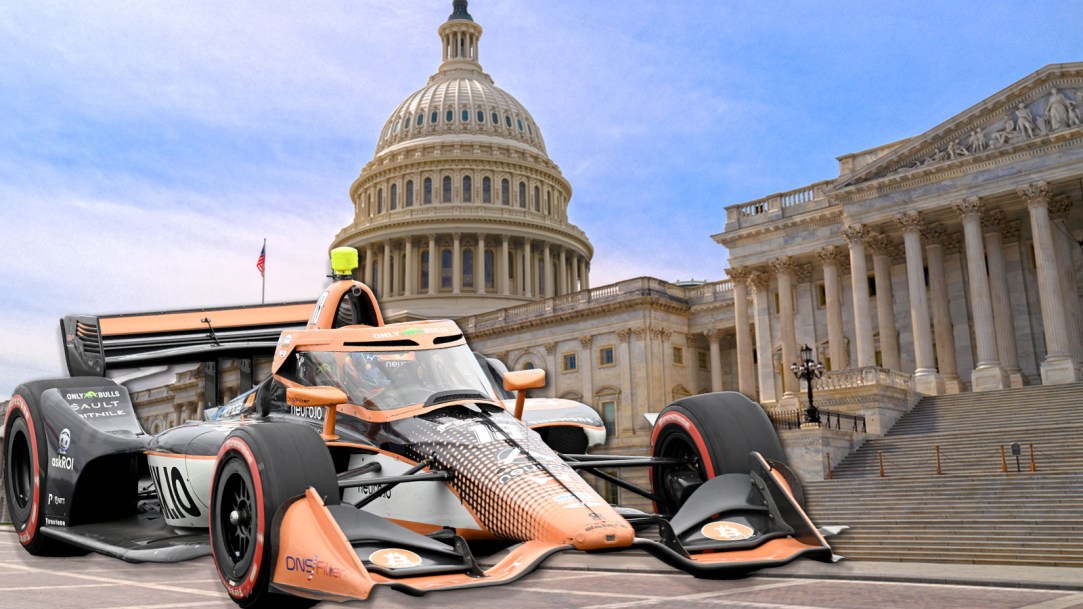
President Donald Trump signed an executive order to clear nearly two miles of road for IndyCar to race the Freedom 250 Grand Prix. The track will race more than 150 miles per hour down Pennsylvania Avenue, and past iconic American landmarks like the U.S. Capitol, the National Archives, the National Gallery of Art and the National Air and Space Museum.
However, the roads appear to be much bumpier than expected.
Although it is not uncommon for an IndyCar street court to be uneven in spots, the lack of turns on this track adds a unique wrinkle. Drivers will be going much faster in Washington D.C. than they do at other racing circuits.
IndyCar took over Washington, D.C. for the Freedom 250 Grand Prix.
If all things go according to plan, and the weather cooperates, IndyCar’s Freedom 250 Grand Prix will run 147 laps on Sunday. The 1.7-mile course will start and finish on 3rd Street. The start/finish line is aligned with the center of the Capitol and the National Mall. Drivers well then take a left turn onto the straightaway on Pennsylvania Ave and accelerate to speeds of 170 miles per hour.
Turns 2, 3 and 4 are tight. Drivers will slow way down to take two ~90º degree lefts and one ~90º right. They will wind around three sides of the National Archives with the Department of Justice right across the street.
From there, drivers will pick up speed down the 1/3-mile straightaway on 7th street. That leads them to another 90-degree left turn onto Independence Avenue past the Smithsonian building. The final turns of the race are not as sharp. And then it’s back down 3rd.
This is neither the longest or shortest street course on the IndyCar series. Petersburg, Florida and Long Beach, California run 1.8 and 1.986 miles, respectively. Detroit runs only 1.645 miles. The Freedom 250 Grand Prix track in Washington, D.C. runs 1.7.
However, this newest course has a lot less corners and a lot more straightaways. The Freedom 250 will feature only seven turns. St. Petersburg and Long Beach have 14 and 11, respectively.
It will also be the longest race of the year. IndyCar does not typically run street course races this long. There will be 147 laps to create a 250-mile race in honor of the 250th birthday. It is the longest street race in IndyCar since 1983.
To compare, Indy Car’s race at AT&T Stadium went 191 miles and the Detroit race went 164 miles. Even F1’s Las Vegas Grand Prix ends at 192.6 miles and NASCAR’s Chicago street race at 165.
The 1.7-mile street course track is bumpy.
Preparations for the race got underway at the beginning of the month. Crews put the finishing touches on the course this week with the Freedom 250 Grand Prix scheduled for Sunday.
NEW: Preparations underway for The Freedom 250 Indycar Grand Prix to be held in Washington DC August 22-23
— Oliya Scootercaster 🛴 (@ScooterCasterNY) August 20, 2026
Multiple streets have been closed ahead of the event, causing heavy traffic backups for locals. "Do not drive downtown" reddit user warned, "Took a taxi from the airport… pic.twitter.com/WeuYeziCer
Pace cars took the first few laps on the new track on Friday morning.
While on track action for the Freedom 250 hasn’t officially kicked off yet, engines are roaring around the Streets of D.C., with pace cars putting in some laps.#INDYCAR #Freedom250 @MtrsprtsToday pic.twitter.com/P4wMvDLjsF
— Jeffrey Hrunka (@JeffreyHrunka) August 21, 2026
A POV video from inside the vehicle revealed a rather bumpy ride. The cars were bouncing like crazy throughout the entire test drive.
Buckle up for a lap around the nation’s capital.
— Fox News (@FoxNews) August 21, 2026
Ride along the 1.7-mile Freedom 250 Grand Prix track, feeling every turn as you fly down Pennsylvania Avenue and past the Washington Monument, U.S. Capitol and Smithsonian museums.
The first-ever INDYCAR race around the National… pic.twitter.com/bXUexjIeFG
Although conditions are not ideal, the potholes and cracks in the road are not as big of an issue as they might seem. First and foremost, the IndyCar vehicles are designed differently than the pace cars. They will not feel the full impact of the road. They are much lighter in terms of how they hit the ground below them.
Plus, street courses are always pretty bumpy. Detroit might be the worst offender.
With that being said, one particular crosswalk is causing legitimate issues in D.C.
Even if the bumpy roads are not new to the drivers, never before have we seen them drive this long of a distance on a track of this caliber with this many straightaways. I am more worried about potential issues in laps 100+ than I am about the start of the race. Something to monitor!