



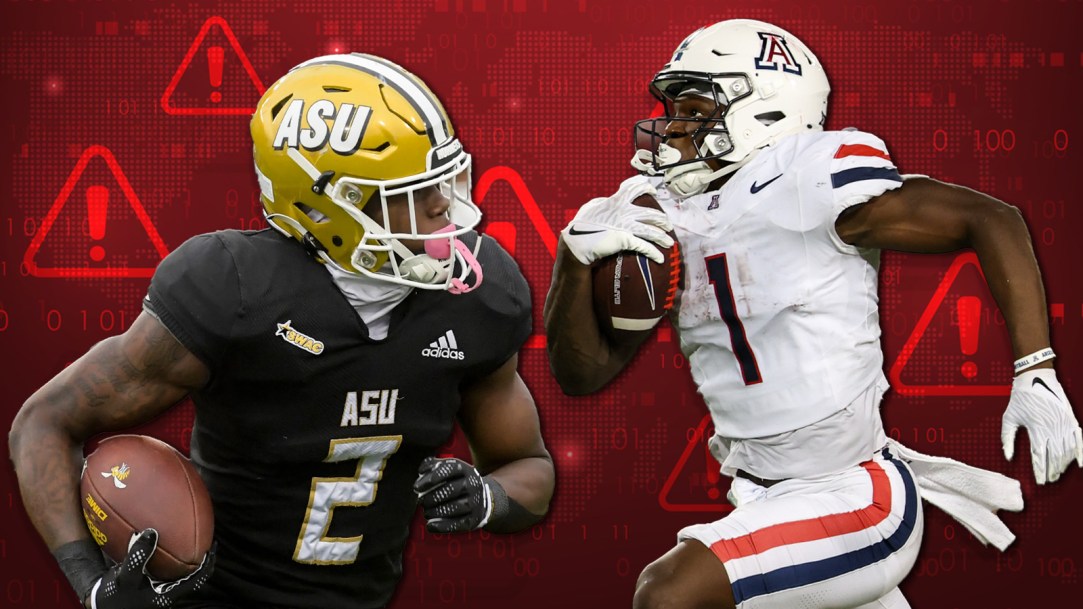
Alabama State received a mitigated Level 1 infraction related to the bizarre eligibility saga involving Jacory Croskey-Merritt. The Hornets question why the NCAA was not as hard on Arizona when the Wildcats were equally as involved in his certification.
Neither program will fight the ruling.
This unusual college football saga dates back to 2024. Meanwhile, Croskey-Merritt is getting ready for his second year in the NFL after a strong rookie season with the Washington Commanders.
Jacory Croskey-Merritt faced eligibility questions at Arizona.
As an unranked recruit in the Class of 2019, Croskey-Merritt began his college career at Alabama State University in 2019. The 5-foot-11, 208-pound running played the next three — or four — seasons with the Hornets.
That “or” will be important. Stay with me.
Jacory Croskey Merritt transferred to New Mexico in 2023 and ran for 1,190 yards and 17 touchdowns on 189 carries during the best single season of his career. It was his breakout campaign.
As a result of his impressive 2023 season with the Lobos, Croskey-Merritt decided to re-enter the transfer portal for a second time in search of one final season at a “power conference” program. He initially committed Arizona, briefly flipped his commitment to Ole Miss, and then flipped back to Arizona. And then things got weird.
Croskey-Merritt played in only one game for the Wildcats in 2024. The transfer running back went for 106 yards and a touchdown during a blowout win over his former team in the season-opener.
That was his only action all season. Arizona held him out for the rest of the season due to eligibility questions.
Official NCAA stats list Croskey-Merritt as having played in eight games in 2019, five games in 2020, 10 games in 2021, 11 games in 2022 and 12 games in 2023. That would mean he was out of eligibility after the 2023 season and, therefore, ineligible to play for the Wildcats in 2024.
However, Croskey-Merritt and Alabama State initially claimed that he played in only four games as a freshman in 2019 to preserve his redshirt. Once his season ended, the Hornets gave his jersey to a teammate. That teammate played in four additional games with Croskey-Merritt’s number. Croskey-Merritt was credited with carries that were not his.
If that was true, he would’ve been able to play for Arizona in 2024. One redshirt season, one COVID blanket waiver, four seasons of eligibility. The Wildcats were comfortable enough to play him in Week 1. They shut him down shortly thereafter.
Although Croskey-Merritt played in only one game in 2024 the Washington Commanders drafted him in the seventh round that next April. The rookie ball-carrier ran for 805 yards and eight touchdowns on 175 carries during the 2025 NFL season.
Alabama State questions the NCAA’s punishment disparity.
The NCAA opened an investigation into both Alabama State and Arizona surrounding the Jacory Croskey-Merritt eligibility scandal. It slapped the Hornets with three years of probation and a financial penalty of $30,000 (plus one percent of its football program budget) for a mitigated Level 1 violation, down from an aggravated Level 1. It slapped the Wildcats with a $500 fine for a Level 3 violation.
Alabama State accepted the ruling and will not appeal. However, the HBCU strongly disputes the classification of the violation and its unequal treatment compared to Arizona.
“The Committee’s reduction confirms what we have maintained from the outset — this case was improperly elevated. The underlying conduct, tied to the former Sports Information Director and head coach, simply does not justify placement among the most severe cases in collegiate athletics.”
Although the university agreed that a former sports information director altered Croskey-Merritt’s statistics on the school website, and allegedly did so at the direction of the former head football coach, it argues that it did not gain the competitive benefit. Croskey-Merritt was not going to play for the Hornets regardless of his eligibility. The Wildcats certified his eligibility and was prepared to benefit from his extra year. They got off easy.
“The certifying institution received a minor infraction, while Alabama State was assigned one of the NCAA’s most serious classifications. We believe the standards should be applied consistently across all institutions.”
Alabama State emphasized that the case involved only one or two employees, the former SID and former head coach. Neither of them are still on staff. The violations did not include a failure to monitor or a lack of institutional control. Why was it a Level 1?