



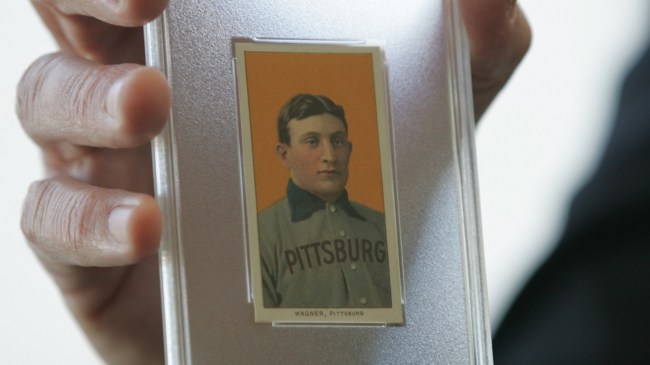
Bob Chamberlin/Los Angeles Times via Getty Images
The famous 1909 Honus Wagner tobacco card, considered the "Holy Grail" of baseball cards
A Honus Wagner card that looks like it survived surgery, reconstruction, and a century-long identity crisis just sold for $1,337,263.20. The hobby that normally treats a soft corner like a federal offense just paid seven figures for a card whose grading label literally says “Authentic – Restored.”
The Wagner is the famous “Die-Cut Wagner,” a 1909-11 T206 that originally had nearly its entire background and three borders cut away. Love of the Game Auctions sold it Sunday after 24 bids, proving there is apparently a point where scarcity becomes so powerful that collectors stop asking, “How original is this?” and start asking, “Where do I wire the money?”
This Honus Wagner Is Basically Three Cards Wearing A Trench Coat
Calling the card “restored” undersells what happened to it.
The original survived only as Wagner’s head and torso after the surrounding cardboard was trimmed away decades ago. During a later restoration, damaged areas and paper loss were repaired, another authentic T206 was used to provide a new background, and a second donor card supplied the Sweet Caporal Factory 25 back.
That is not touching up a scratch. That is baseball-card reconstructive surgery.
The finished product looks shockingly normal. Wagner sits centered inside four white borders, the reverse carries the familiar tobacco advertisement, and the card has the eye appeal of something that did not spend part of its life looking like somebody attacked it with craft scissors.
CGC examined the card with forensic equipment, authenticated the surviving Wagner portion and assigned it an “Authentic – Restored” designation. It was also the first T206 Wagner CGC had ever graded.
Then somebody paid $1.337 million for it.
The auction started at $400,000 and closed with 24 bids. The final price included the buyer’s premium.
Condition Lost The Fight To Provenance
Sports-card collecting is usually obsessed with condition.
Collectors inspect corners, centering, surfaces and edges with the intensity of detectives reviewing security footage. A tiny print line can turn a celebration into a three-day mourning period.
This Wagner basically told the entire grading culture to relax.
Its value comes from what remains authentic, how absurdly rare any genuine T206 Wagner is and the card’s bizarre history. The piece was first documented in a New Jersey card shop in the 1970s, where it was reportedly purchased for $1. It later sold for nearly $10,000 in the 1990s before disappearing from public view for decades.
The restored version eventually resurfaced in Keith Olbermann’s collection, where it had spent years sitting inside a Lucite holder on his desk like the world’s most irresponsible paperweight.
That provenance matters because T206 Wagners occupy their own universe. Fewer than 100 are known, with only a little more than 50 certified across major grading companies. Another low-grade Wagner sold for more than $5 million earlier this year, while the record for the card remains $7.25 million.
Nobody buying the Die-Cut Wagner confused it with an untouched example.
They knew pieces came from other cards. They knew it was heavily reconstructed. The label announced the restoration before anyone could pretend otherwise.
And it still brought $1.34 million.
Apparently when the surviving piece is an authentic Honus Wagner, “original condition” becomes more of a suggestion.
Some collectors buy the grade.
This buyer bought the story.