



Matt Bush-USA TODAY Sports/Cheng Xin/Getty Images
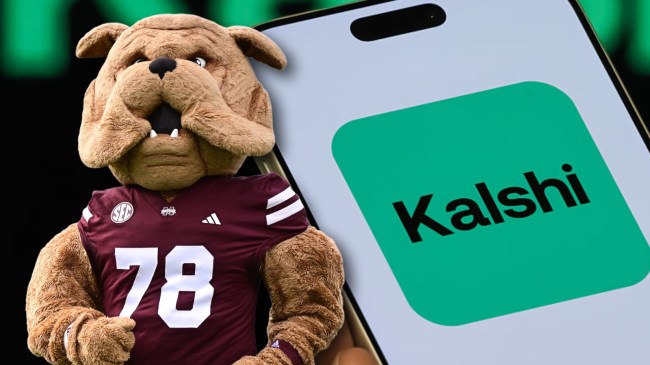
Mississippi State mascot next to Kalshi logo
Two Mississippi State football players managed to turn roughly $70 in prediction-market trades into NCAA compliance paperwork, which may be the least profitable gambling story in college sports history. The Mississippi State Bulldogs players, whose names were redacted in university documents, used Kalshi to trade on the Super Bowl and NBA All-Star events and ended up with Level III violations instead of anything resembling a Vegas origin story.
The Bulldogs did not lose either player to suspension, but the cases are a perfect snapshot of how weird the line between sports betting and federally regulated prediction markets has become. Kalshi calls these products event contracts, the CFTC regulates them as financial instruments, and the NCAA still looks at a football player clicking “Patriots” and sees sports wagering.
A $50 Super Bowl Trade Became A Compliance Meeting
University documents show one player put $50 on a Kalshi contract predicting New England would beat Seattle in Super Bowl LX.
Seattle won 29-13.
So the player lost $50 and then got something considerably worse than a bad beat: a meeting with compliance.
ProhiBet, a monitoring system used to detect prohibited sports-wagering activity, flagged the trade on Feb. 8. Mississippi State met with the player on Feb. 17, reviewed his Kalshi account, and confirmed his claim that it was his only sports-related trade.
His punishment was rules education.
The second case was somehow even more college-football-in-2026.
Another player made two $10 trades during NBA All-Star weekend. One correctly picked Damian Lillard to win the 3-Point Contest and paid out $64. The other involved whether an announcer would say certain words during the broadcast.
That one lost.
Mississippi State met with him two days later. He eventually donated $66.47 to a charity of his choice and completed NCAA gambling education.
Nobody lost eligibility. Nobody was accused of betting on Mississippi State. Nobody was moving five figures through a sportsbook account.
We are talking about $70 total.
The NCAA Still Counts ‘Trading’ As Betting
The dollar amount is what makes this more interesting than a routine compliance note.
Kalshi is not structured like DraftKings or FanDuel. The CFTC describes prediction markets as federally regulated exchanges where users buy and sell event contracts tied to future outcomes. Kalshi itself operates as a CFTC-designated contract market.
For a normal customer, that distinction matters.
For a college athlete, apparently not enough.
The NCAA still prohibits athletes from wagering on professional sports in sports where it sponsors championships. It briefly moved toward allowing pro sports betting in 2025 before Division I schools rescinded the change, keeping the broader ban intact.
That means a Mississippi State player can legally access a federally regulated market and still commit an NCAA violation by using it on the wrong subject.
The punishment guidelines at least recognize scale. NCAA reinstatement rules say professional-sports wagering totaling $200 or less generally calls for education rather than lost eligibility, which helps explain why neither player missed games.
Still, this is where college sports is headed.
Prediction markets are expanding, sports contracts are everywhere and the vocabulary is getting fuzzier. One company says “trade.” The NCAA says “bet.” The athlete sees a $10 button on his phone.
Then compliance sees an alert.
The two Mississippi State players risked roughly $70.
The most valuable return may have been a lesson in semantics.