



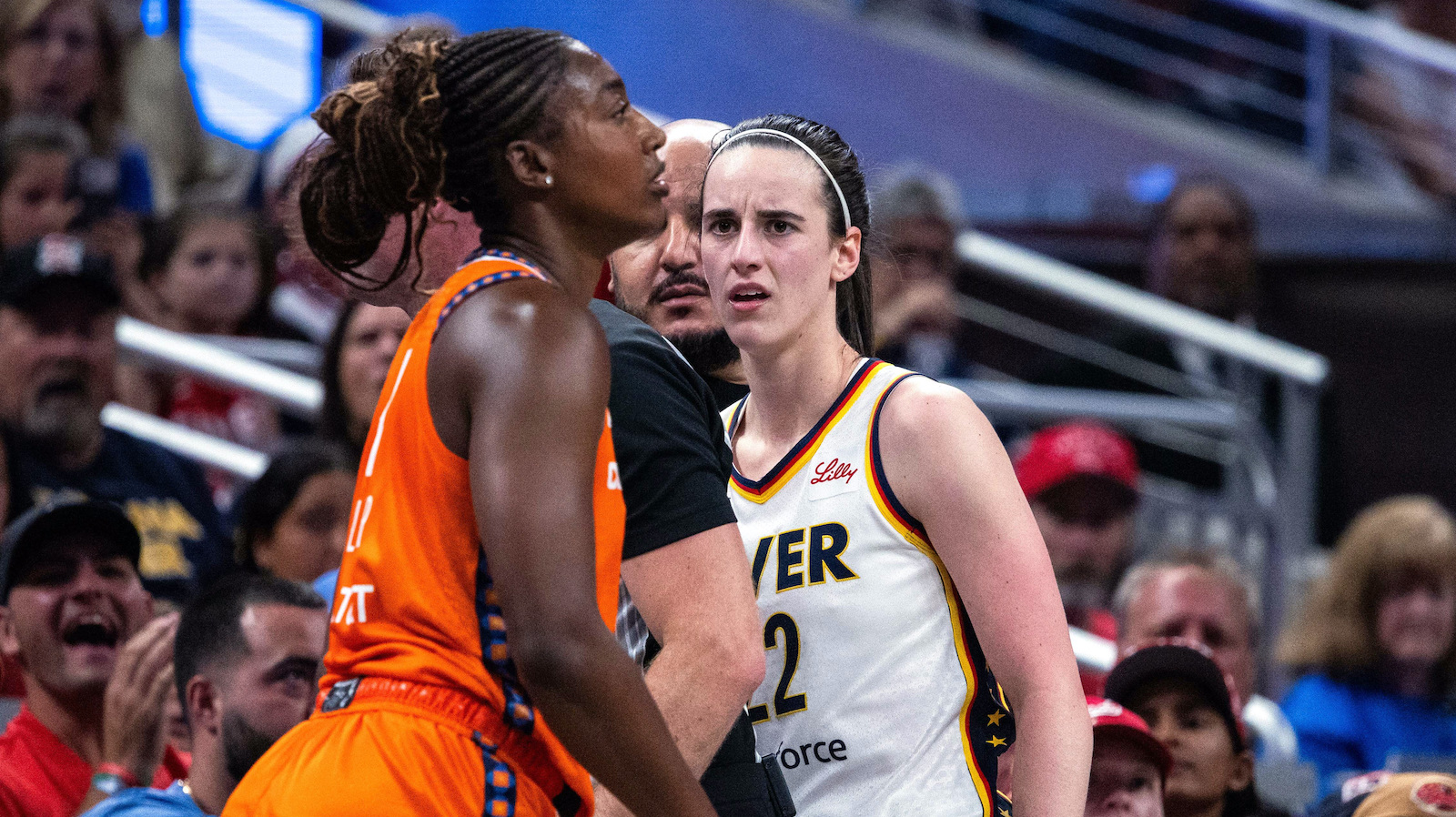
Trevor Ruszkowski-Imagn Images
A USA Today writer invoked Emmett Till's lynching while writing about Caitlin Clark
A USA Today sports columnist has released an apology statement after going viral for invoking Emmett Till in an article about Caitlin Clark. The article was written by Nancy Armour, a White female journalist that has been with USA Today since 2014.
The column’s thesis is that Caitlin Clark’s perceived flopping is driving the “white nationalist” and “racist” part of her “fandom” to see Clark as a “white woman in need of saving.” These people, according to Armour, are also the ones who are abusing WNBA players online (which is legitimately an issue that the WNBA is currently addressing).
According to Armour’s LinkedIn, which states she was a writer at the Associated Press for 19 years before joining USA Today in 2014, says that she “[doesn’t] shy away from the tough or uncomfortable topics and there’s no assignment [she] won’t tackle.”
USA Today sports writer Nancy Armour apologized for invoking Emmett Till while writing about Caitlin Clark
“It seems there is a white nationalist faction to Clark’s fandom that is deeply, deeply problematic, made even more so because the WNBA is made up predominantly of Black women, many of them queer. When Clark claims fouls that don’t exist, when she goes on profanity-laced tirades at referees, those racists see her as a white woman in need of saving and take matters into their own hands,” the USA Today column read.
“It shouldn’t need reminding this country has an awful history of Black people being harmed, even killed, in the name of ‘defending’ white women. The WNBA’s All-Star Game this weekend is in Chicago, Emmett Till’s hometown, and a local art gallery is currently hosting an exhibit imagining his life if he hadn’t been lynched. While it’s incumbent on the WNBA to do more to protect its players, there also should be an expectation on Clark to recognize the wider consequences of her actions.”
In August 1955, 14-year-old Emmett Till, a Black teenager from Chicago, was visiting family in Money, Mississippi, when he was falsely accused of flirting with — specifically, whistling at — the white co-owner of the store he was shopping in, Carolyn Bryant.
Days later, her husband Roy Bryant and his half-brother J.W. Milam abducted Till at gunpoint before they brutally beat him, shot him in the head, and tied a large metal fan to his neck with barbed wire before throwing him into the Tallahatchie River.
Whatever Armour’s point might’ve been, it was entirely swallowed by the extremity of invoking Emmett Till, one of the darkest moments in American history, while discussing fouls in women’s basketball.
There is a section/paragraph in this story that is among the most insane choices to include I’ve ever read in any sports story from a serious publication. Like, the kind of crazy where I genuinely have no idea how an editor let it get through. https://t.co/p3vZosbQT2
— Sam Vecenie (@Sam_Vecenie) July 23, 2026
One again, it is impossible to overstate the complete off-the-rails lunacy of people who hate Caitlin Clark https://t.co/DTOXfCkhsv
— David Burge (@iowahawkblog) July 23, 2026
Given how massively viral the article went, its author, USA Today’s Nancy Armour, published an apology statement in which she called her analogy “inartful.”
“In my recent column, I made an inartful comparison with the murder of Emmett Till. I intended to connect the issues the WNBA is currently facing with its All-Star Game being hosted in Till’s hometown of Chicago. I obviously did not provide enough context for that,” Armour statement reads.
“However, this point stands: There is a history in this country of perceived threats to white women being weaponized against African-Americans, and the danger that poses to Black players in the league. Players have been abused online and have reported receiving death threats. That has to be taken more seriously,” she continued.
“I sincerely regret that my lack of appropriate context is overshadowing that important conversation and the action that needs to be taken by the WNBA to address it directly – for the benefit of ALL players.”
Statement from USA Today sports columnist Nancy Armour pic.twitter.com/wif3P9Yg82
— Joe Schad (@schadjoe) July 23, 2026
Clark likely had dreams of one day becoming the greatest female basketball player that ever lived. We doubt becoming such a lightning rod for the culture wars was what she envisioned, though.