



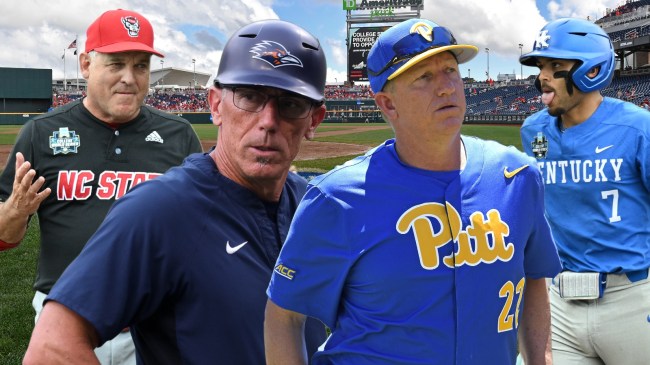
Getty Image / Steven Branscombe-USA TODAY Sports
The NCAA Baseball Tournament field has been unveiled for the 2026 postseason. Sixty-four teams will compete for an opportunity to play in Omaha and win a national title.
As is the case with each and every selection process, a few deserving teams were left out of the bracket while others questionably earned bids.
Here, we’ll take a look at three teams snubbed by the committee and three schools that received preferential treatment.
NCAA Baseball Tournament snubs and teams that stole their bids.
Diamond64 provides an easy-to-read template for each college baseball team’s regular season resume. Included are metrics like Quad wins, record against top competition, RPI, and strength of schedule.
The site allows visitors to evaluate resumes head-to-head while comparing how different teams stack up alongside one another. Here, outliers can be easily identified. That relates to both sides of the bubble.
Let’s start with three teams snubbed from the tournament field before diving into less deserving programs that swiped their spots.
3 NCAA Baseball Tournament snubs
Mercer Bears
The Bears are the most controversial snub on the list. The metrics led many to believe they’d be a shoo-in. They were left out of the bracket on selection Monday.
Mercer won 44 games, ranked 28th in RPI, and had a win over national seed Georgia Tech. It also beat Troy in a season opening series but watched the Trojans make the field ahead of them.
The Bears finished third in the nation in home runs. They won the SoCon regular season crown. Unfortunately, they were beaten by The Citadel in the conference tournament to prevent them from securing an automatic bid. That loss proved costly.
The omission was historic as Mercer became the first ever team with a Top 30 RPI and winning record in conference play to be left out of the field. A 118th-ranked strength of schedule was cited in the committee’s reasoning for the snub.
Pitt Panthers
Pitt won 33 games against one of the most difficult slates in America. The Panthers scheduled strong, making multiple trips to the West Coast while also competing in a loaded ACC.
They blasted rival West Virginia 23-1, a team that will host a regional, swept UVA, and beat other NCAA Tournament participants FSU, Wake Forest, and Virginia Tech.
The team went 14-15 against Q1 and Q2 opponents but probably lost a few games it shouldn’t have. It ended the year with an RPI of 40.
The Panthers went on a run in the conference tournament to win 14 games against ACC opponents, a mark that matched a team listed later in this feature. It wasn’t enough to make the field.
Pitt was viewed as the third-best team left out of the bracket.
UTSA Roadrunners
UTSA does not have the metrics as other snubs previously mentioned. It finished the year with an RPI of 53 and a strength of schedule that ranked 102nd.
That does not mean their resume was lacking. The Roadrunners tested themselves often in non-conference play, facing the likes of Texas, Texas Tech, and Baylor. They went 2-3 in those contests with one loss coming in extra innings and another coming on a grand slam in their opponent’s final at-bat.
UTSA also won three games over conference champ ECU, annihilated Texas State, beat Coastal Carolina, and had a game vs. Texas A&M cancelled.
The Roadrunners finished 5-5 vs. the Top 50 and 10-8 in Q1 and Q2 games. It wasn’t enough to be considered for the postseason.
3 teams that stole NCAA Baseball Tournament bids
NC State Wolfpack
NC State received by far the most grace following a largely mediocre season. The Wolfpack went 32-22 with 14 wins in the ACC. They were one and done in the conference tournament after giving up 21 runs in an upset to last-place Duke.
NC State was also shut out by Elon and Princeton, and it was not punished by the committee for cancelling a game vs. NC A&T to protect its resume.
The Wolfpack finished with an RPI of 51, well behind previously mentioned conference rival Pitt. It went 3-9 against the Top 25 and 12-16 vs. Q1 and Q2 opponents.
Injuries led to late season struggles, something that’s been cited in decision making by other NCAA selection committees. The Wolfpack lost four of their last five ACC series but made the field as a No. 3 seed in the Auburn regional. Some believe the retirement announcement of head coach Elliott Avent influenced the decision.
Kentucky Wildcats
On paper, Kentucky had a resume deserving to get in. They went 14-13 in Q1 and Q2 games. They went 7-8 against the Top 25 and won 20 games over teams inside the Top 50.
With that being said, there are glaring holes in their argument to be included over previously mentioned snubs.
The Wildcats started the year hot, winning 18 of their first 20 games. That included a sweep over Alabama in their SEC opener. Kentucky then dropped eight of their last nine SEC series.
Those series losses came against the likes of South Carolina, LSU, Missouri, and Vanderbilt – all teams that failed to make the NCAA Baseball Tournament field. They then went one and done in the conference tournament.
The Wildcats finished with an RPI of 37. It seemed the committee valued that metric over the fact that the team won just two of its 10 conference series against the easiest schedule in the league.
Virginia Tech Hokies
The Hokies finished the year 30-24 and .500 in ACC play. It did not prevent the team from making the NCAA Baseball Tournament field.
Virginia Tech was rewarded for its scheduling after playing a Top 15 slate nationally. Unfortunately, it did not win a ton of those contests.
The Hokies dropped five of their six games against Top 25 competition. They went 5-12 in Q1 matchups. That included being swept in an early season tournament by a trio of SEC foes. Virginia Tech was outscored 28-9 in those matchups.
There were also blowout non-conference losses to Marshall and Rutgers, as well as midweek setbacks vs. Liberty, UNC Greensboro, and ETSU. They went unpunished by the NCAA selection committee for cancelling a rematch with the Thunder Herd to protect RPI.
Despite the strong schedule strength, the Hokies ranked 44th in RPI, lower than both Mercer and ACC snub Pitt. Virginia Tech did test itself, and was rewarded for it, but they failed in most of those opportunities.