



Matthew Emmons-USA TODAY Sports Copyright © 2006 Matthew Emmons
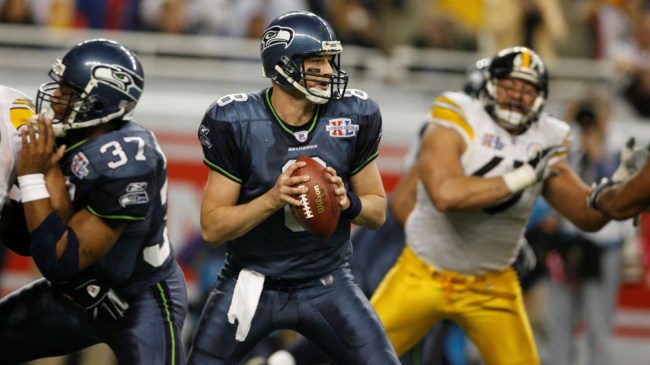
Feb 5, 2006; Detroit, MI, USA; Seattle Seahawks quarterback Matt Hasselbeck (8) passes against the Pittsburgh Steelers in the fourth quarter of Super Bowl XL at Ford Field.
In recent years, several former NFL players have either experienced difficulties that are presumably associated with CTE, or have lost their lives due in part to the condition.
Unfortunately, doctors are only able to officially diagnose athletes with CTE after they’ve passed and medical examiners and scientists have the opportunity to study their brains.
Former Pro Bowl quarterback Matt Hasselbeck is trying to change that, and he’s undergoing multiple studies in order to do so.
Matt Hasselbeck Leads Charge To Find Living CTE Diagnosis
Hasselbeck played nearly two decades in the NFL and made three Pro Bowl appearances, all for the Seattle Seahawks, whom he led to the Super Bowl in 2006.
Along the way, Hasselbeck took some hard hits, and he’s now concerned about the after-effects. But more so, Hasselbeck is concerned about the health of some of his former teammates.
“They need guys like me. They need people who are feeling good to step up to the plate and volunteer,” he told ESPN. “I played quarterback, so I didn’t take some of the hits that a lot of my teammates took.
“But the guys who were blocking for me, or playing special teams, or trying to get the ball back for me on defense, I wanted to do something. They had my back, so in a way I’d like to have their back.”
Most recently, researchers revealed that former Dallas Cowboys defensive end Marshawn Kneeland suffered from CTE when he died at just 24 years old.
Hasselbeck underwent an array of mental tests at Boston University. He also had a blood sample taken, an MRI on his brain, and a PET scan that injects a small amount of safe radioactive tracer that maps out the brain’s function.
“I’ve got a healthy respect for people who are dealing with serious brain trauma, whether it’s tumors or cancer,” Hasselbeck said. “I walked in there feeling completely healthy, and you still get a little anxious when you’re doing a brain scan, an MRI. You come out, and you’re looking at your brain.”
He also plans to donate his brain for research after his passing. But if we can find a way to diagnose CTE while a patient is still living, it could save numerous lives.