


iStockphoto / Brett Davis-USA TODAY Sports
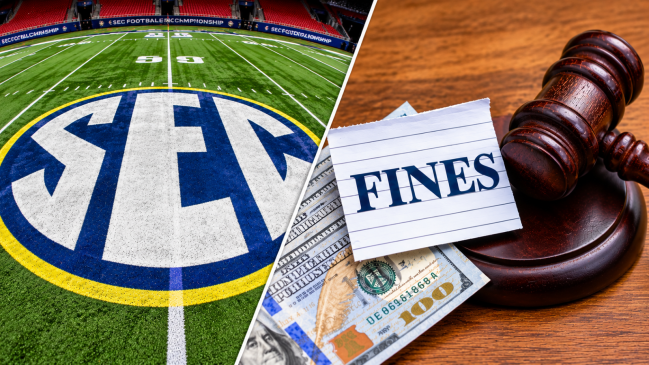
Dec 4, 2021; Atlanta, GA, USA; Detailed view of the SEC logo on the field before the SEC championship game between the Georgia Bulldogs and Alabama Crimson Tide at Mercedes-Benz Stadium. A stock image of court fines fills the other side of the collage.
The Big Ten Conference recently passed a rule that would limit schools’ involvement in the NIL marketplace outside of their federal revenue-sharing amount. Now the SEC appears to be following suit, with violators potentially facing eight-figure fines.
Under the Big Ten’s new rule, outside spending would be capped and monitored by the conference, which said it would impose financial penalties and other disciplinary measures for violations.
On Wednesday, Ross Dellenger of Yahoo Sports reported that the SEC is working to install a similar system in the near future.
Details of the SEC’s proposed cap policy are emerging: The league would penalize schools in a tiered fine system reaching $10M+ in fines for those spending $70.5M+ on rosters, sources tell @YahooSports.
Said one AD: “The new cap would basically be $70M.”
https://t.co/zeNuP1SZH9— Ross Dellenger (@RossDellenger) November 11, 2026
New SEC Rules Would Set Hard Cap For Spending On Athletes
According to the proposal, the conference would establish a cap policy that penalizes penalizing schools that spend above the $21.6 million House settlement revenue-share cap.
Additionally, they will face escalation fines, potentially exceeding $10 million, should they spend more than $70.5 million on their total athletic rosters.
Under the proposed tiered system, fines would start at less than 1 percent for those spending below $50.5 million on their rosters. They would then increase to 1 percent for those spending $50.5-60.5 million, and to 3 percent for those spending $60.5-70.5 million. Lastly, if a school spends more than $70.5 million, it would face a 10 percent penalty.
That 10 percent would be in addition to the fines already levied at the lower thresholds. On top of that, repeat offenders would be subject to even larger fines.
The SEC has not yet clarified where the fine money will go and how it will be distributed among member schools.