



REUTERS/Brian Snyder TPX IMAGES OF THE DAY
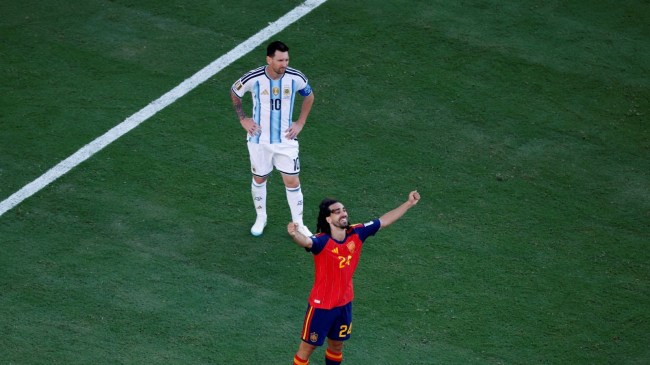
Soccer Football - FIFA World Cup 2026 - Final - Spain v Argentina - New York/New Jersey Stadium, East Rutherford, New Jersey, U.S. - July 19, 2026 Spain's Marc Cucurella celebrate winning the World Cup as Argentina's Lionel Messi looks dejected
It may have taken Spain 106 minutes and a red card for Enzo Fernandez to finally score in its 1-0 victory over Argentina in the 2026 FIFA World Cup Final, but the game was never that close.
A quick look at the underlying numbers shows that Spain was absolutely dominant throughout the match, racking up 2.29 expected goals compared to just 0.22 for Argentina, according to ESPN.
Meanwhile, Argentina had 0.00 expected goals prior to extra time and registered zero shots on goal in the 120-plus minutes of the match.
Spain, meanwhile, had 12 shots on goal in the contest and completed 763 passes compared to just 357 for Argentina. It was a thorough butt-whooping from the Spaniards.
However, Argentina may well have an excuse.
Extra Day Of Rest Gave Spain Major Advantage Over Argentina In World Cup Final
On Tuesday, July 14, Spain defeated France, 2-0, to return to the World Cup final for the first time since it won the tournament in 2010. Meanwhile, Argentina had to wait 24 hours to complete a thrilling comeback and defeated England, 2-1, to advance to its second consecutive final.
That meant that the Spaniards had an extra 24 hours of rest coming into Sunday’s final.
How much does that actually matter? History tells us that the answer is “a lot.”
It’s now four men’s World Cups in a row won by the team that won the first semi-final and had 24 hours extra rest before the final.
(And four men’s Euros in a row, three Women’s World Cups in a row, and three Women’s Euros in a row (aside from 2017 when the semis the same day)). https://t.co/PSryhyQZrU— Tom Garry (@TomJGarry) July 19, 2026
The team with an extra day of rest has now won four consecutive World Cup finals. Meanwhile, the same team has also won four UEFA Euro finals in a row, three FIFA Women’s World Cups in a row, and three UEFA Women’s Euro finals in a row.
Correlation is not necessarily causation, but it’s hard to ignore that evidence.
To make matters worse, there’s no rhyme or reason to which teams play first in the semifinals. It’s just a matter of how the schedule shakes out.
Would Argentina have fared any better with the rolls reversed? It’s impossible to say with any certainty. But it may be time for FIFA to re-evaluate its scheduling and put both semifinals on the same day moving forward.