



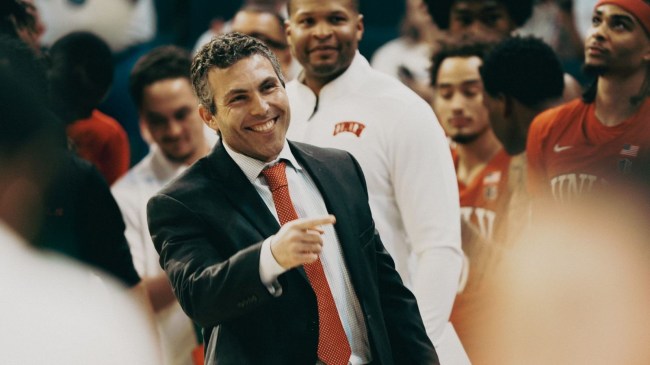
Stu Boyd II-The Commercial Appeal / USA TODAY NETWORK via Imagn Images
UNLV head coach Josh Pastner smiles during his introduction before a game against the Memphis Tigers, where he is a former head coach, on Nov. 16, 2025 at the FedExForum in Memphis, Tennessee.
The landscape of college sports changes seemingly every day in the NIL era, with new court cases and rulings that blow up any framework for rules that the NCAA tries to put in place.
But if UNLV Rebels men’s basketball coach Josh Pastner had his way, he’d blow up the entire system with a radical new idea.
Pastner, who burst onto the scene at 31 years old when he was promoted to succeed John Calipari at Memphis, is now in his third head coaching job after seven seasons with the Tigers and seven more at Georgia Tech.
His first year at UNLV didn’t exactly go according to plan, as the Rebels went just 18-17 and were eliminated in the second round of the NIT. But he has a radical new idea to get the program on track.
Josh Pastner Wants To Sell The UNLV Men’s Basketball Team
In a recent interview with Taylor Rocha of local news station KTNV 13, Pastner laid out his vision for the future of the program, which includes a wealthy investor deciding that they want in on the action.
“I have told people, why buy the NBA team? Buy the college basketball team,” Pastner said. “You can be the owner of the UNLV Runnin’ Rebels men’s basketball team, and it’s a lot less expensive … We can make it thinking outside the box and being unique,” Pastner said. “You still get your excitement and your adrenaline rush being around basketball, being around the program.”
“Sell” @TheRunninRebels?
With several groups pursuing an NBA team in Las Vegas, Josh Pastner has a different idea:
“Why buy the NBA team? Buy the college basketball team.”
The UNLV head coach tells me he’s looking for a $10-12 million backer to become the “owner” of the… pic.twitter.com/MohABmJtX7
— Taylor Rocha (@TaylorRochaTV) July 23, 2026
Pastner said that a $10-$12 million investment could make his team competitive against the biggest programs in the country.
“If you have a $12 million check… you can compete against Kentucky, Duke, Arizona, UCLA for any player you want,” he said. “Right now… if another school offers someone $1 million and our budget only allows us $100,000, it doesn’t matter how much the kid likes me.”
There are just a couple of major issues with Pastner’s idea. For one, any prospective “owner” would likely want a return on investment, which comes with owning a pro team but not with a college program, because you don’t actually “own” anything.
Secondly, while boosters have always played a role in college athletics, Pastner’s suggestion is exactly why fans are turning away from college sports.
Nobody wants to watch a watered-down version of the pros that is essentially just some rich billionaire’s plaything. What made college sports was the ties that the athletes had to the university, its students, and its alumni. Now it feels as if that connection is long gone, and it’s hard to see it ever coming back.
But who knows? Maybe Pastner is on to something.