



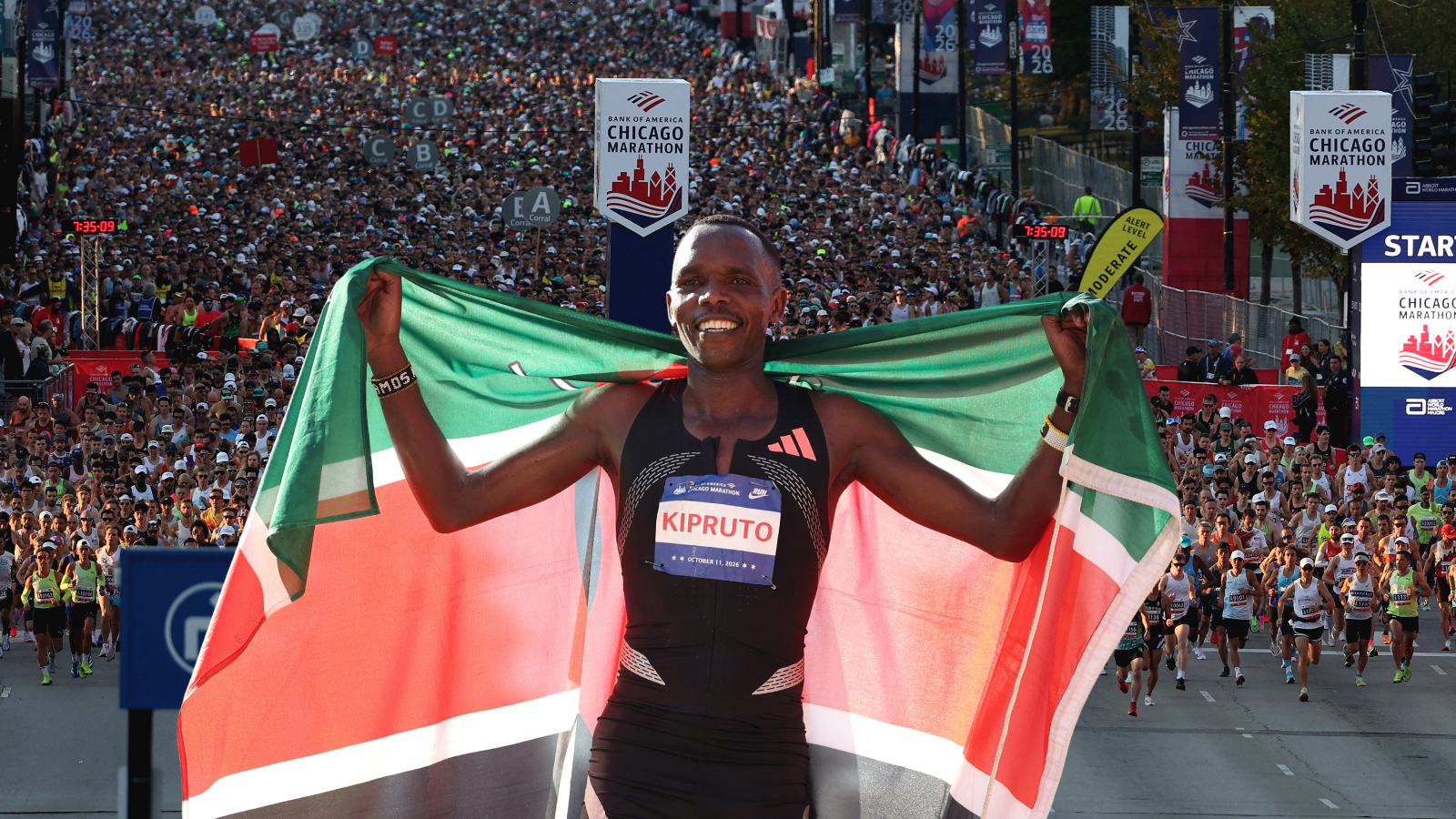
Talia Sprague-Imagn Images
Kenyan marathon runner Amos Kipruto wins the 2026 Chicago Marathon
The 2026 Bank of America Chicago Marathon took place over the weekend, one of the seven races that make up the Abbott World Marathon Majors. 34-year-old Amos Kipruto of Kenya won the Men’s Elite race and had the fastest overall time of 2:01:09 followed by Tadese Bikila and Milkesa Mengesha of Ethiopa who finished in 2nd and 3rd place respectively, and Ugandan runner Jacob Kiplimo rounding out the top four with a time of 2:04:18.
For a while, it seemed like Jacob Kiplimo was going to win the 2026 Chicago Marathon as Kiplimo has incredibly finishing speed and a powerful kick down the stretch. Kiplimo and Kipruto were battling it out through the 95-minute mark until eventual winner Amos Kipruto broke free and distanced himself.
Amidst all this, Kipruto and Kiplimo running side-by-side for much of the race caused many people in the Running world to ponder why so many men’s elite runners are named ‘Kip’.
Why Are So Many Distance Runners From Kenya Named ‘Kip’ Or ‘Chep’?
Going back in time, Kenya has produced some of the greatest distance runners in history. We could name them all, but just to throw out a few legendary names on both men’s and women’s side, we’ve got Eliud Kipchoge, Kipchoge Hezekiah Keino, Stanley Kipleting Biwott, Amot Kipruto, and Faith Chepngetich Kipyegon (W).
That is far from all of the legendary Kenyan runners but it still include quite a few legends whose named begin with ‘Kip’ or in Faith’s instance, she also has ‘Chep’ in addition to ‘Kip.’ And with the two pro runners battling it out in Chicago this year it got many people wondering why ‘Kip’ is such a common prefix in Kenyan names and among other elite African runners.
As it turns out, the circumstances of one’s birth have everything to do with the name.
Time and Place Dictates Everything
2026 Bank of America Chicago Marathon winner Amos Kipruto also previously won the 2022 London Marathon and a Bronze medal at the 2019 World Athletic Championships. He has won the Seoul Marathon, Rome Marathon, and the Hamburg Marathon which puts him side by side with the most accomplished runners in the world.
Amos Kipruto is part of the legendary Kalenjin tribe from Kenya’s Rift Valley. Jacob Kiplimo is part of the Sebei (or Sabiny) ethnic group which peaks Kalenjin. Faith Chepngetich Kipyegon? Yup, she’s ethnically Kalenjin too.
And within the Kalenjin culture, boys’ names typically begin with ‘Kip’ while girls’ names typically begin with ‘Chep.’ The rest of name is usually determined by the time of day they were born and other circumstances.
On Meta’s Threads, someone used the example of ‘Kiprotic’ as meaning ‘born when the cattle are coming home.’ Another person replied to say they were Kenyan themselves, and of Kalenjin descent, and their name is Chebet because they were born during the daytime.
An old article published by WorldAthletics.org explained it further, stating “Traditional Kalenjin names are commonly drawn from a stock of just a few dozen, both first names and surnames from the same limited inventory. A son takes his surname from his father, as in the West, but the name he takes is the fathers first name.”
It goes on to add “typically, a child is given a name at birth that relates to the circumstances of the birth. A boy’s name usually starts with the prefix Kip, a girls with Che or Chep. Thus, for example, a boy born at dawn may be Kipkoech; one born at sunset, Kiplagat; born outdoors, Kipsang; born during a drought, Kipkemei, and so on. A few months after birth, the child will be given an ancestral name, used only by close relatives, and these days most children are given a biblical name as well.”
Names change for boys at 15-years-old when they undergo a right-of-passage procedure and then take a surname which is typically their father’s name minus the ‘kip.’ But boys are also free to choose any of their father’s names… first name, nickname, ancestral name, etc. So there is some variation.
Common examples of how the birth circumstances dictate a name include ‘Kipkorir’ meaning they were born shortly before dawn, ‘Kibet’ meaning they were born at mid-day, ‘Kiplimo’ meaning the child was born among grazing cattle, and ‘Kipchoge’ means the boy was born near the grain storage bin.
So now you know! When the NYC Marathon is televised on the first of November and you see several men’s pro distance runners from Kenya whose names begin with ‘Kip’ it will all make sense now.