



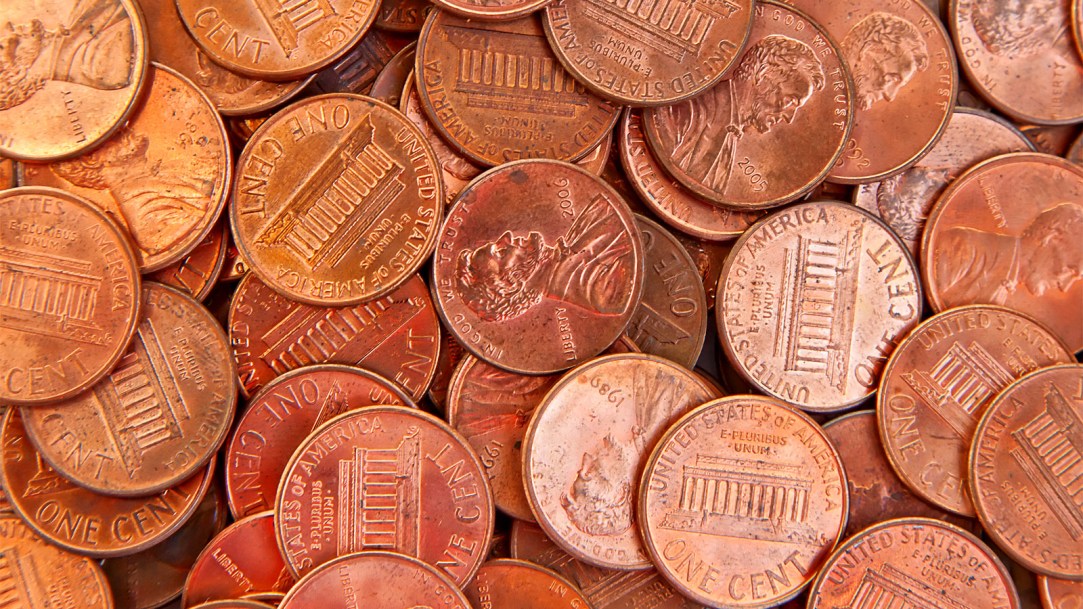
The bipartisan Common Cents Act was unanimously passed by the House of Representatives on Monday, permanently ending the production of the penny. Last month, the Senate unanimously approved an identical version of the bill.
The measure would also provide a framework for rounding monetary transactions to the nearest five cents to eliminate the need for pennies, and would prohibit the U.S. Treasury from minting any more pennies other than “as numismatic items,” or collector coins.
The Common Cents Act may affect how Americans pay with cash and possibly open the door for the United States to adopt a new nickel, according to The Hill.
The bill doesn’t make pennies worthless, however
It does not, however, mean that any pennies already in circulation no longer have value. The bill states that “any one-cent coin that is minted and issued on any date before the date of the enactment of this subsection shall remain legal tender for all debts, public charges, taxes, and dues.” This is good news, since an estimated 300 billion pennies are still in circulation.
Despite the massive number of pennies still out there, last October, McDonald’s and several other businesses told customers they might not be able to make “exact change” because of what was being called a penny shortage.
McDonald’s restaurants in some parts of the country, as well as convenience stores such as Love’s and Kwik Trip have begun rounding down to the nearest 5 cents when charging their customers. Another convenience store chain, Sheetz, offered its customers a free soda if they brought in 100 pennies. Supermarket chain Giant Eagle has offered customers a gift card worth double the amount of pennies they bring into their stores.
Now, pennies won’t be necessary if President Donald Trump signs the bill into law, since cash transactions will be adjusted to the nearest five cents. As far as cash wages go, if the amount can’t be divided by five cents, it will be rounded up.
Interestingly, the new smallest currency, once the penny goes away, the nickel, costs 13.31 cents to produce. This new bill permits the Treasury Secretary to test and assess coin compositions and propose a new nickel composition if it “reduces the cost” of production and “has a minimal detrimental impact on devices designed to receive coins.”
Americans react to the news that the government is discontinuing the penny
Americans on social media had a wide range of reactions to the House voting to permanently eliminate the penny.
Several people pointed out that if a penny costs more to make than it’s worth, it is best to stop making it. However, others disagreed, stating that, given the fact that a penny will be used over and over and over again once it is produced, it doesn’t really cost more than it is worth.
Then there are those who echoed this statement: “Pennies are basically just taking up space in every drawer in America at this point. Good riddance.”
Many others had this line of thinking, some seeing it as a good thing, while others fear it: “One step closer to a cashless society.”