



Mountain Dew
Hollywood is littered with the so-called “That Guys” who have been able to pursue a successful career built on a foundation of largely minor roles while quietly amassing a filmography that rivals the number of items on the menu at The Cheesecake Factory.
Most of the actors who’ve earned that label never come close to becoming a household name and don’t have to worry about being stopped on the street on a regular basis. However, that is not the case with one man who was firmly able to transcend it after stumbling into a career that ended up spanning more than four decades: Danny Trejo.
Danny Trejo would be the first person to tell you he never envisioned his life working out the way it has. The Los Angeles native found himself caught up in a life of drugs and crime at a young age, and he spent his formative years bouncing in and out of prison before getting sober and becoming a counselor committed to helping others do the same.
That job led to him being called to the set of 1985’s Runaway Train, where the boxing skills he’d honed behind bars helped him land his first-ever acting role. The movie (where he trained the equally prolific Eric Roberts) was the first of the nearly 500 projects he’s added to his résumé, and while most of them came in a supporting role, his longtime relationship with director Robert Rodriguez led to him earning Leading Man Status in 2010’s Machete.
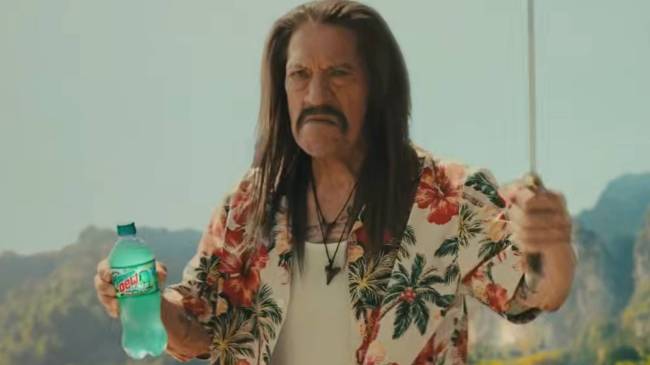
That movie spawned a sequel, Machete Kills, in 2013. He recently got the chance to reprise the role in a spot for Mountain Dew Baja Blast, and BroBible got an exclusive look at the commercial where he reunited with the signature weapon the character gets his name from.
The lifelong Dodgers fan joined forces with the official soft drink of Major League Baseball for an ad that will debut on TV and streaming platforms on May 15th, and I got the chance to chat with him while he was filming it to pick his mind about a truly fascinating career.
Connor: Danny, very excited to get the chance to talk with you. I know it’s been a while since you played Machete. Was it nice to step back into that role?
Danny Trejo: I’m opening a bottle with a machete! I love the character. It made me a household name all over the world. I was the lead in both of those movies and everybody is waiting for Robert Rodriguez to do Machete Kills in Space, but he was lucky with two and now I think he’s scared [laughs].
Do you have a special connection with that character compared to other ones that you’ve played?
You know what’s so funny? Before my mom passed away, she started calling me “Machete.” After we did Machete, the biggest heartwarming thing to me was seeing all these little Mexican kids showing up as him with their painted-on mustaches and all the stuff.
It didn’t have to be Batman or Superman. It was like their Latin hero, Machete, you know, so that was kind of cool.
I was going to ask you about your mustache because it’s such an iconic part of your look. How long have you had it?
You know what’s funny? Even my eyes, the bags under my eyes, have been part of it. I went to a party that was thrown by one of Hollywood’s top eye doctors, and my best friend Eddie Bunker and my agent were there. This doctor comes up and says, “Hey, I can take care of those bags,” and both my agent and my friend say, ‘No! Don’t try to be pretty now.’
It’s the same thing with my mustache. If the check’s right, I’ll shave it, but I’ve had it forever.
You’re a bit unique because you could be described as a character actor, but you also sort of play what a lot of people would just describe as “Danny Trejo.” I’m curious how you approached roles when you first started out, how you evolved, and if you ever feel limited by certain expectations.
You know, when I first started out, I think there were ten movies where I never even had a shirt on because I have a big tattoo on my chest and every director was like, “Wait, wait, take your shirt off.” I used to think I was doing a different kind of movie because I was always without a shirt.
The first movie I ever got to wear one in was with Charles Bronson in Death Wish 4: The Crackdown. I got to wear a suit. I was like, “I made it. This is it,” you know what I mean? But my characters have been from a gangster to a killer to a gecko in Zootopia 2. I’ll do whatever you’ve got.
I was also going to ask you if you had an “I Made It” Moment. I know that you never really planned on making acting your main gig.
You know, I got into this thing by accident. I was a drug counselor and I showed up on set to help one of my clients. He called me up and I showed up, and when I was standing there, this first AD says, “Hey, do you wanna be in this movie?”
I said, “What do I gotta do?” He says, “You wanna be an extra?” I said, “Extra what?” He says, “Can you act like a convict?’ and I said, “I’ll give it a shot.” I’d been a convict, so that was my life. It was a movie called Runaway Train. I took off my shirt, and he saw my tattoo and he said, “Leave your shirt off.”
That’s where I ran into Eddie Bunker, who actually adapted the screenplay. The original writer, Akira Kurosawa, had made Jon Voight’s character the hero who killed his wife and went to prison. You can’t be a heroic convict if you killed your wife. Maybe if you killed her boyfriend, you’d be all right, but not your wife. So they had Eddie change all that.
When I was on that set, Eddie asked me, “Hey, are you still boxing?” I had won a couple of championships but I said, “No, I’m 40 years old. I don’t get hit in the face anymore.” He told me, “We need somebody to train one of the actors.” I said, “What’s it pay?”
They were going to give me $50 for acting like a convict, and we both laughed cause we’d been doing that for free forever. He said, “$320 a day.” When he said that, I said, “How bad do you want this guy beat up?” You know, give me $200 more and I’ll kill him.”
So that’s how I started training Eric Roberts for Runaway Train. The director, Andrei Konchalovsky, had a little problem with him. It was his first American movie, and he didn’t know how to deal with American actors, especially the stars. In Russia, the director was the star. The director was god. Here, if the actor is a major star, he’ll tell the director what he wants.
Eric had that persona, so he and the director didn’t get along, but when he saw Eric would do whatever I told him, he was scared of me. I’ll never forget, Andrei came up and said, “You be in movie, and you be my friend.” In prison, being my friend is a red flag. Then he leans over and kisses me on both cheeks.
I’m like, “Wait a minute, homes, we’re not taking a shower together.” I told Eddie, “I’m gonna train the kid for the $320, but if I’m gonna be kissing that old man, I want more money.” He said, “No, no. He’s European,” and I’m like, “Oh, OK.” It’s funny, when I found out what Andrei did by getting me that SAG card, I would have come over and washed his back. I didn’t know.
The stunt coordinator on that saw that I was easy to work with, so he hired me for a movie that they were gonna start right after, and 40 years later I’m still going.
You’re doing a great job of leading me into my next question because I knew you had a boxing background and your physical stature has been a big part of a lot of the characters you’ve played. What’s your training regimen like nowadays?
I’m hitting the heavy bag and weights at the house. I walk a lot. I jog a lot. I train. I don’t box anymore, but I train. I also have three dogs that want to be walked all the time.
Oh yeah? What kind?
I’ve got a golden retriever named Max, a pit bull named Coco, and a Staffordshire terrier named Duke. My pit bull probably weighs 100 pounds, just all solid muscle, and it’s scared of bugs. I got a vicious pit bull that’s got paranoia.
So coming back to Mountain Dew. It’s hard to talk about Baja Blast without mentioning a certain restaurant that is known for tacos. You have your own chain of taco places, and I’m curious about how food played in your upbringing and your life in general. What would your go-to meal be?
Mountain Dew actually started getting popular in my neighborhood in the 1950s. That’s when I started drinking it and everybody loved it.
But my mom, she was an unbelievable cook. I used to piss off my dad because in the 1950s, Mexican women didn’t work. They were homebound. I would always tell my dad at the dinner table, “Man, mom’s gotta open a restaurant.”
I love tacos. I’ve got five taco restaurants. My mom used to cook them. Any kind.
You’ve been in hundreds of movies. I assume someone as prolific as you gets recognized in public a lot. Do people know you by name or by your character? Have you had any weird interactions?
I started to get recognized right away after Runaway Train. From that point, it was on. Like I said, every movie I did, I didn’t have a shirt on. I lived in Venice at the time, and they’d recognize me by my tattoo before they’d recognize me.
I also read you can’t go to Mexico because it gets too crazy when you go out in public.
I can’t. I have to have people with me when I go to Mexico, or else we won’t move. If I come out of the trailer, people just rush it trying to get an autograph, but Mexico’s a lot of fun.
You’re 81 years old and still going strong? Have you ever felt tempted to slow down or retire or do you just have a natural urge to keep going?
I was recently on set with another older actor on a cowboy movie and we were sitting in an air-conditioned tent and somebody came in and said, “Hey, when are you guys going to retire?” From what? We’re playing cowboys, you know? I’m 81 and I don’t feel like retiring.
What would I do? I can only fish for so long. I love doing this. I like promoting stuff that I love, like Mountain Dew. I wouldn’t promote it if I did.
Are there any boxes you haven’t checked that you still want to?
I just want to keep working. I love it.
Portions of this interview were lightly edited for clarity.