


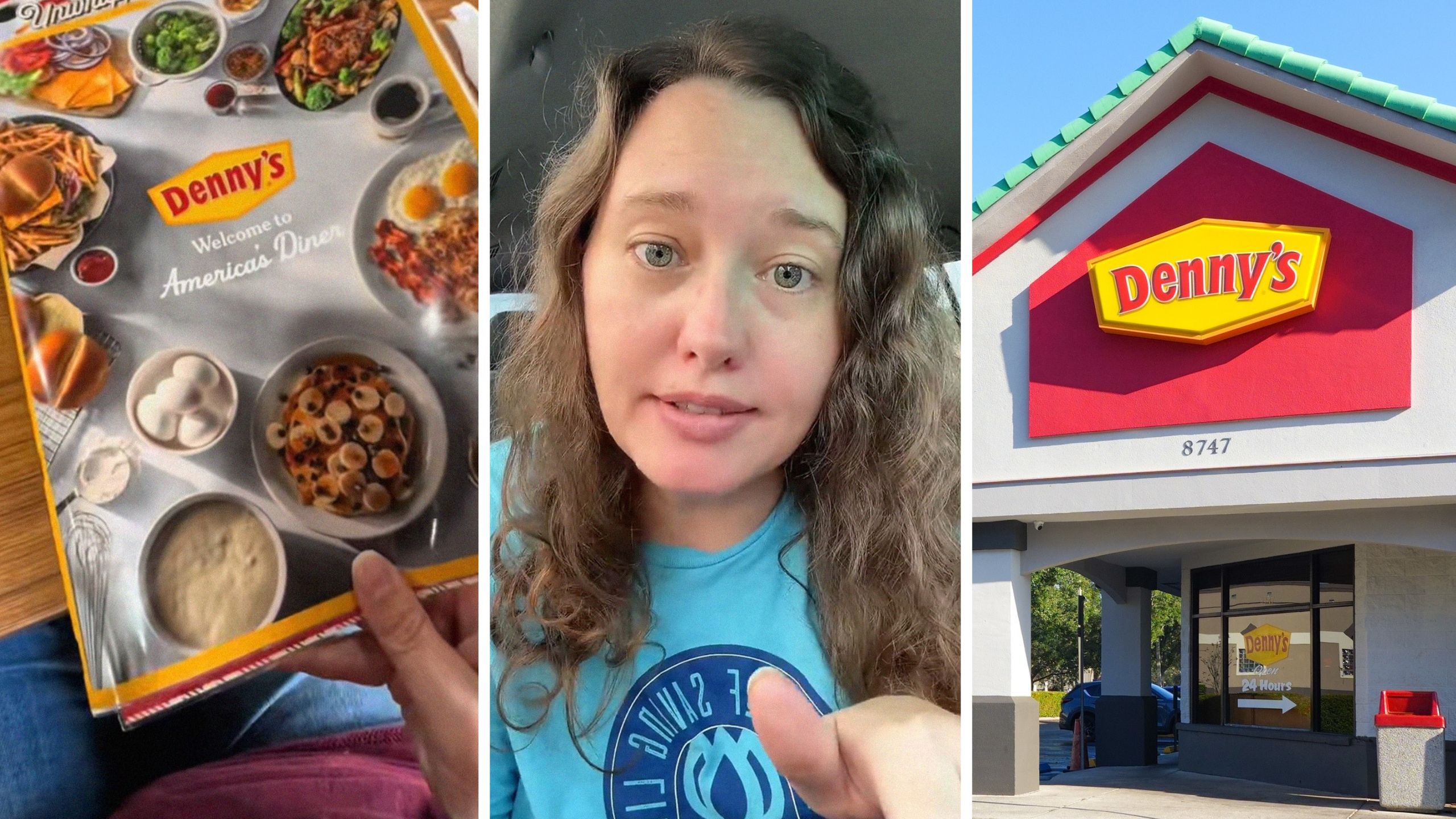
Via iStockphoto / @kristaleeann TikTok
A woman is accusing Denny's of ripping customers off after noticing an alleged price discrepancy on the menu.
Krista Leeann has spent years in educational accounting and business management. So when dining at a Denny’s restaurant, she was quick to spot what seemed to be a couple of price discrepancies on the menu.
In a TikTok video, Leeann (@kristaleeann) explained the issue to her followers: On the à la carte menu, tater tots are just twenty cents more than hash browns. But with a meal, it’s advertised that a hash brown can be upgraded to tater tots for $1.39.
So if tater tots are only worth twenty cents more than hash browns (per the à la carte menu), then why is it more than a twenty-cent difference to upgrade with a meal?
On the menu, she points out that the same happens with the hash brown and seasonal fruit. On the à la carte menu, there is a 10-cent difference. But with a meal, the hash brown can be upgraded to seasonal fruit for 99 cents, implying that seasonal fruit is worth 99 cents more than hash browns.
In Leeann’s words, “the math ain’t mathing.”
“As a restaurant owner… this all makes sense. An add on is almost always cheaper. A side generally requires ‘more work’ like washing extra dishes, carrying more items, etc,” explained one commenter.
“It’s not an add-on. It’s a swap. Her math is correct. They are ripping people off,” argued another.
“A substantial difference between adding on and the side order. The portions are gonna be much different so the math is indeed mathIng,” quipped one more.
À La Carte Versus A Meal
First off, comparing à la carte items to meal upgrades is an apples-to-oranges scenario. The two work entirely differently, especially from a business standpoint. When a restaurant is packaging a meal, the price is set so that the customer is getting a deal (or perceives themselves as getting a deal). Think, instead of paying $13 for all of the items separately, the restaurant might bundle the items as a meal for $11.99. The upcharge is the fee for personalizing the standard package.
How Does The Pricing Work?
So, how can tater tots be worth just twenty cents more on their own but $1.39 more as an upgrade? The answer is simple. Restaurants do not price menu items based solely on cost. They price them based on consumer behavior. It’s psychology: added value versus the additional cost.
Most customers assume menu prices are based on ingredient costs alone. In reality, ingredients often represent just a fraction of what diners are paying for. When a customer upgrades from (for this example) hash browns to tater tots, the restaurant is not calculating the additional cost of the potato. The actual food cost difference between the two items may be less than the referenced twenty cents. Instead, the restaurant is charging for the customer’s willingness to pay for their preference.
The upgrade fee exists because the restaurant knows customers who specifically want tater tots value them more highly than standard hash browns. If a guest is already committed to buying a meal, paying an extra $1.39 feels relatively small compared to the total check.
Essentially, the restaurant is capturing additional value rather than recovering actual or additional cost.
Now, knowing the psychology behind pricing, let’s go back to the à la carte example of paying $13 individually versus $11.99 as a bundle. If the meal is $11.99 and the customer chooses to upgrade for the additional $1.39, the customer actually ends up paying 38 cents more than buying the items à la carte. (What’s the saying? The house always wins.)
The Math Is Mathing
While it is not known exactly how Denny’s set their prices, or all the inputs, this psychology of pricing is utilized across the industry. A restaurant’s menu is more than a list of food. It is a carefully engineered sales tool. It is designed to influence customer choices, maximize profits, and balance operational costs. Every item’s placement, description, and price serves a purpose. What appears to be a simple price is actually a sophisticated blend of psychology, mathematics, and marketing designed to guide a customer’s dining experience.
The $1.39 tater tot upgrade is not a mistake. It is a deliberate pricing strategy. The twenty-cent difference on the à la carte menu reflects the relative value of two side dishes sold individually.
So what’s the lesson here? The math is mathing as intended. It’s just that the majority of customers are not concerned with why the numbers are the way they are. As long as their order is correct, the food is good, and the cost doesn’t outweigh the value, then all is well.
BroBible reached out to the creator and Denny’s for comment.