




The FBI and Google recently took down an AI-powered cybercrime ring that used more than one million phishing URLs to steal data and passwords.
In an announcement, the FBI revealed it had dismantled a major Chinese phishing-as-a-service (PhaaS) operation called Outsider Enterprise. Over 3.8 million credit card records were stolen by hackers using this PhaaS.
A Shopify e-commerce storefront, several administration servers, and an account the attackers used to test the PhaaS were all confiscated, according to the FBI. The FBI also seized a Telegram bot used to store stolen data, redirected thousands of phishing pages to an FBI announcement website, and confiscated about $100,000 in cryptocurrency.
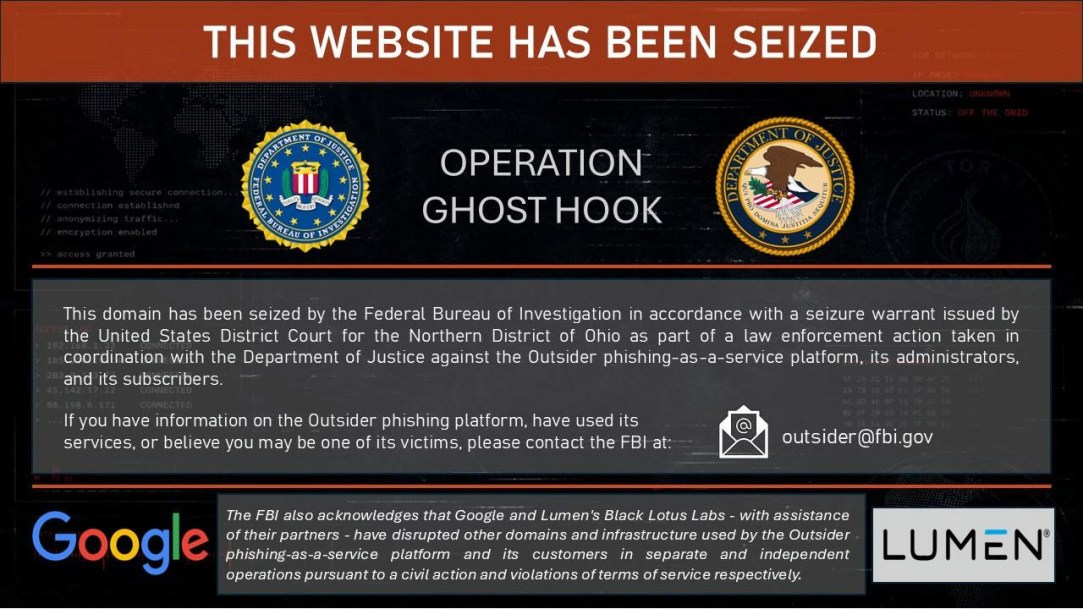
Additionally, Google filed a lawsuit alleging that Outsider Enterprise used Google’s Gemini artificial intelligence to steal an estimated $1.9 billion from hundreds of thousands of victims in 95 countries since July 2023.
Google claims to have found over a million URLs connected to Outsider Enterprise and 9,000 phony websites. Additionally, over two weeks in May, Android users flagged more than 55,000 spam texts – more than two text spam complaints per minute – and received more than 2.5 million messages containing links to scam websites.
Google is working with the FBI, AT&T, T-Mobile and Verizon
On Friday, Google wrote in a blog post that Outsider Enterprise is based in China and coordinates its scam through Telegram by distributing “phishing kits” that allow criminals to blast out fake text campaigns that appear to be from Google and other trusted brands.
“Fighting fraud requires collective defense, and each technology provider in our industry plays an important role,” Rich Baich, AT&T Chief Information Security Officer, said in a statement.
“We’re proud to work with Google, law enforcement and others across the industry to fight the bad guys, block scam traffic, disrupt malicious activity and help keep people safe,” said Jeff Simon, T-Mobile EVP and Chief Information Officer.
“As cybercriminals increasingly leverage advanced technologies like AI to execute sophisticated text-messaging scams, defeating these threats requires a unified, cross-industry response,” said Nasrin Rezai, Verizon Chief Information Security Officer.
The scam economy is now bigger than several countries’ gross domestic product
A new report by The Next Web revealed that the scam economy is now bigger than several countries and “is accelerating.” According to Interpol, fraud cost victims $442 billion in 2025, roughly equivalent to Denmark’s economic output.
The tools are disturbingly accessible. Deepfake fraud has surged as generative AI makes voice-cloning, face-swapping, and instant translation available for as little as $50 per month through dark web “fraud-as-a-service” marketplaces. These platforms resemble legitimate SaaS businesses, offering tiered pricing, customer support, and plug-and-play fraud kits that let a convincing forged driver’s licence scan be produced and delivered within hours.
Interpol’s analysis says AI-enhanced fraud is already 4.5 times more profitable than conventional techniques. Agentic AI systems can now autonomously plan and carry out entire fraud campaigns at costs that would have been significantly higher just five years ago.