



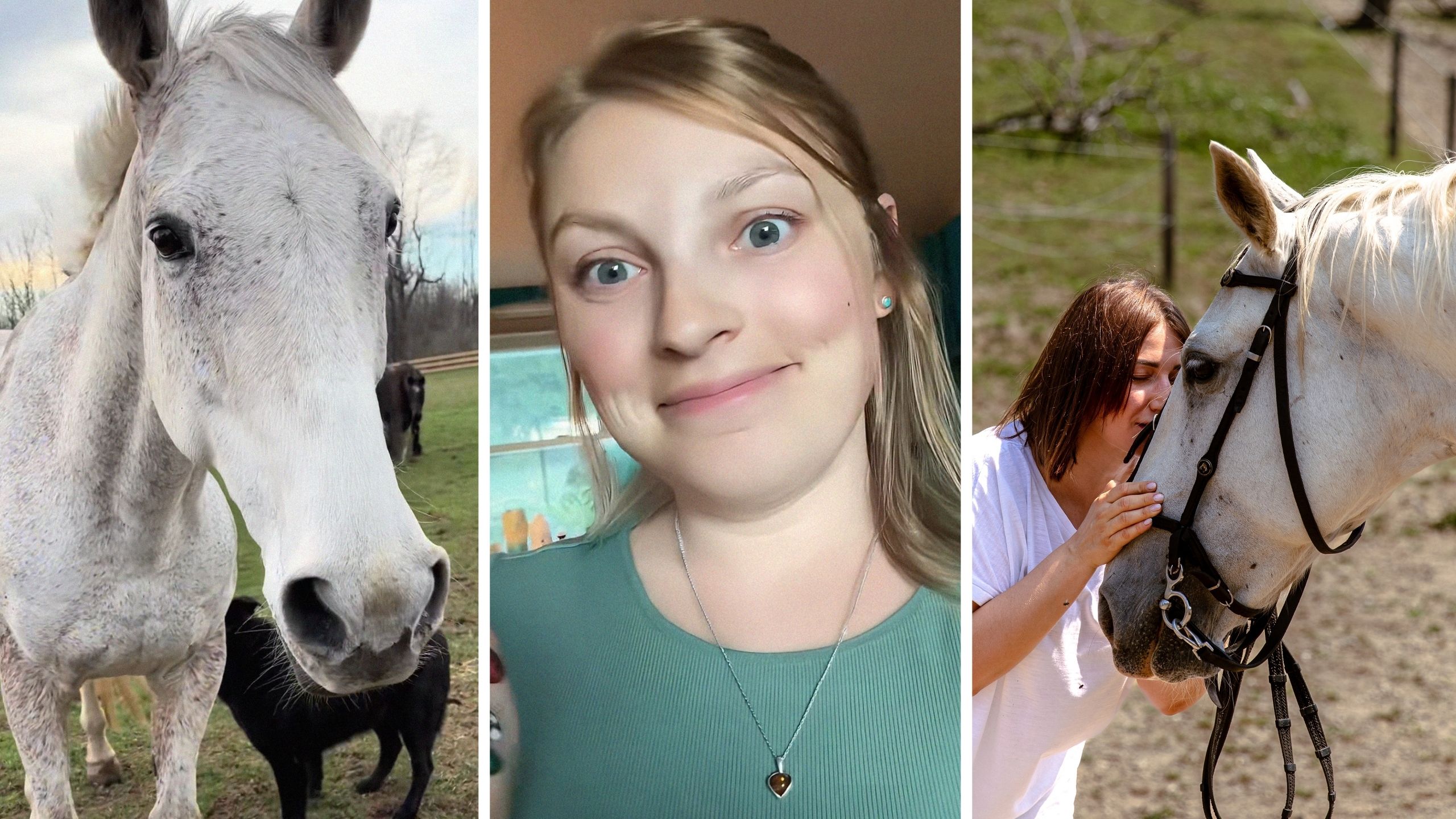
Via iStockphoto / @foxhallfarm TikTok
A woman took her horse to an animal communicator. The horse allegedly said, 'Mom brain no good.' Turns out, she needed brain surgery.
If you’ve spent any time on social media lately, you’ll know that the horse girls are ascendant. From mustang rescue to dressage, the stories of the deep connection that horse people have to their animals are everywhere. So it’s pretty natural that horse owners seeking a more meaningful connection with their steeds would turn to “animal communicators.”
In a TikTok slideshow celebrating her return to riding post-brain surgery, Taylor credits her horse, Nemo, with first identifying something wrong with her brain. It was a “Chiari malformation.”
The Mayo Clinic explains it as “a condition in which tissue from the lower part of the brain, called the cerebellum, goes into the spinal canal. It happens when the skull is shaped in a way that is not typical or when the skull is smaller than usual.”
In earlier posts, Taylor complained of anxiety, which is consistent with the malformation in the brain. But now that her sutures are out, and she’s had three weeks of recovery, she’s ready to get back in the saddle. She’s added in-video text to her post, “In less than three weeks I am back to riding him and I no longer feel at war with my body.”
The post has been viewed more than 844,000 times.
What Is An Animal Communicator?
She is able to ride in comfort and without managing anxiety is because of events that began when she bought a new farm and moved her horses there. She says that with the move, her horse Nemo was upset and acting out.
“He was fine outside, but the second I brought him in the barn, he became very violent, and it was really out of character. So I called the animal communicator,” she says. For context, she’s worked with the animal communicator before. Animal communicators are people who purport to communicate with animals via body language, emotions, and even a psychic connection. The wild part? Many animal lovers such as Taylor (@foxhallfarm) say it works.
During the session with the communicator, Taylor says that Nemo kept saying, “brain, brain do this to me. Brain underwater, brain squish, brain pressure.” As a former veterinary technician, she was worried he had a brain tumor. But according to her, he meant her brain. She put it together because she’d been having symptoms, and so the communicator asked him if he meant Taylor.
He purportedly replied, “Mom brain, mom brain no good.”
Then, she says she ran to her doctor because she’s been dismissed by doctors all her life. She’s been told to go to therapy. But this time she was “able to score an MRI.” Doctors detected the anomaly, and she had brain surgery to correct it.
‘Does Your Horse Do Telehealth?’
The idea that some animals can detect illness is not new. Dogs that alert when a person is about to experience an oncoming medical change, often from a chronic or complex condition, are a part of medical care. Is it such a stretch to believe that other animals might be able to detect an illness?
According to the internet, the answer is no. But the results aren’t always life changing: “My cat told the animal communicator she’d ‘try her best’ to be nicer to our friends and not bite them,” said Kourt (@kourtnet).
Laura Brashley just wanted to know if Nemo takes appointments. “Hey, so does your horse do telehealth?” she quipped.
Can Animals Sense When Something Is Wrong With You?
Animals, especially dogs, can be trained to detect illness or other problems in a person, and that typically takes a year. “Seizure-sensing dogs look for subtle smells and changes in features of their owners (such as dilated pupils),” explains How Things Work. And these aren’t rare stories. There’s even proof that dogs have successfully detected bladder cancer in urine.
The abilities of dogs and other animals to sense these changes are because of their highly and provably refined senses.
BroBible reached out to Taylor via TikTok direct message and with a comment on her post. We will update this if she replies.