


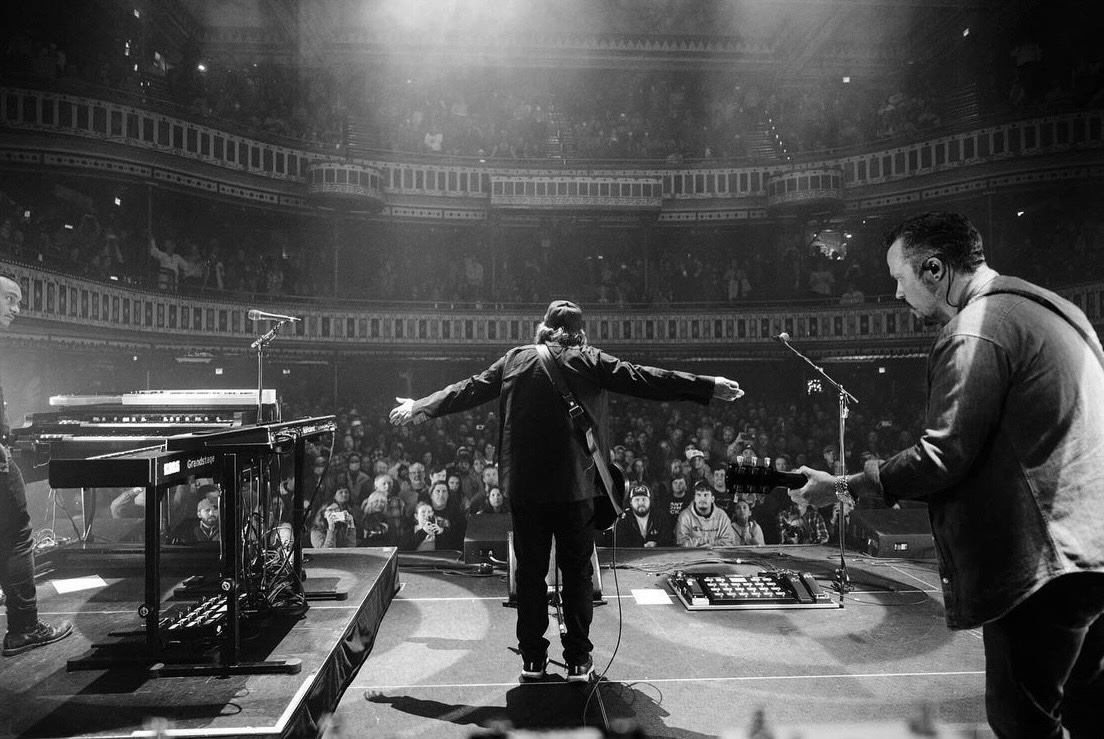
via Drivin 'N Cryin'
There’s a line buried in a Drivin N Cryin song that says everything about where Kevn Kinney stands after four decades in rock and roll: “In the corner there’s a poet. No one thinks she’s very good, but I like her the way that nothing rhymes.”
Kinney recited it unprompted during a recent conversation on The Load Out Music Podcast, as if to explain not just the song but his entire philosophy.
“I wish the whole world could hear it, just like me,” he said. “I see so many people who are so great — young bands — and they asked me what to do, and I’m like, I don’t even know.”
The humility feels real. At 65, with 40 years of Drivin N Cryin behind him, Kinney hasn’t softened into a rock elder dispensing wisdom. He’s still figuring it out — still, as he puts it, just here to sing to himself.
Before getting into the music, there’s the matter of the name — specifically, the missing letter. Kevn Kinney has been spelling it without the ‘i’ for decades, and the origin story is equal parts accident, tribute, and punk rock attitude.
“The gas company sent me a bill, and it was spelled K-V-N,” he recalled with a laugh. “So I just was like, alright, it worked for you — you’re gonna stick with it.”
But the story goes deeper than a billing error. Before he had a band, Kinney was doing paintings, drawn to a website called The Museum of Bad Art.
“It’s like they would go around and get bad art from Goodwills and stuff,” he said. “That’s kind of my style of art.” He began signing his work “Kevn” as his artistic name. When it came time to start a band, the spelling followed him.
Then came the layer that made it permanent.
“My grandmother was Gaelic,” he explained. “So I thought, well, I’ll do this tribute to her.”
His bass player wasn’t entirely sold. When the credits for the band’s first record were being prepared and Kinney confirmed the spelling, he came home to a note on his door — his bandmate’s dry response spelling out every possible variation of the name.
“All right, smart ass,” Kinney said, still amused.
Kinney formed Drivin N Cryin after moving from Milwaukee to Atlanta in 1985 — the same fertile underground scene that produced R.E.M., the Indigo Girls, and the Black Crowes.
When asked whether he ever imagined, back then, that 40 years later he’d be looking back on a career this long and productive, his answer was characteristically honest.
“I think that if I thought I’d be around 40 years, back then I thought it would be more,” he said, then paused. “I have no forethought to see if I’d go make it 50 years. I don’t really know.”
He noted that in 1985, the concept of a rock band lasting 40 years was nearly inconceivable.
“A band that had been around 40 years was, I don’t know, Benny Goodman. Glenn Miller Band, 1945. You didn’t really run into a rock band that had been around 40 years.” He paused again. “And then everyone’s setting the bar so high now — Springsteen and the Who and the Stones and Elton John. I guess it’s just what we’re supposed to do.”
The template for that longevity, he says, came from an unlikely source: Johnny Ramone, whom he met — as only a Kinney story could begin — through baseball card trading.
“I got to see the inner workings of a band like the Ramones from a friendship point of view,” he said.
What stuck with him was the Ramones’ relentless, un-apologetic consistency.
“They were very diligent about being the Ramones family. We are the Ramones. We follow the Ramones. We don’t care if you don’t get us.”
They drove a 15-passenger van for their entire run. They did a record a year, or every other year. They didn’t chase the mainstream.
“That kind of set the template,” Kinney said. “Let’s just do this as long as we can — until it isn’t real anymore.”
After a seven-year break from studio albums, Drivin N Cryin — the core trio of Kinney, bassist Tim Nielsen, and drummer Dave Johnson — have delivered Crushing Flowers, released April 10, 2026 on their own label. Critics have responded warmly; Rock & Blues Muse called it “as sharp and concise a collection as they have recorded,” while Americana Highways praised the stripped-back production that “favors clarity and chemistry over excess.”
Kinney made the record with intention.
“I really made this one deliberately for Drivin N Cryin fans,” he said.
The reference points he held in his head were deep and eclectic — the White Album’s range from “Helter Skelter” to “Rocky Raccoon,” the Replacements’ ability to hold “chaos and beauty and chaos” in the same record.
“I wanted to be a tribute to the Who,” he said. “Because we’re all Who nuts.”
He cites traces of “Won’t Get Fooled Again,” “Boris the Spider,” and more woven into the album’s DNA.
The album’s sonic atmosphere — sweeping harmonies, chorus-effect guitars, minor-to-major chord movements — was deliberate.
“I deliberately wanted to sound like it could be a ’90s, late ’80s, middle ’80s college radio,” he said.
The title track was among the first songs conceived, and Kinney wanted it to carry that specific feel: “The phase shifter guitar, or whatever it is — the chorus guitar — and then the minor to major, which I got from Mike Mills.”
That minor-to-major idea led directly to one of the album’s most celebrated contributions. Kinney and Peter Buck of R.E.M. have maintained a friendship across decades — Buck produced Kinney’s 1990 solo debut — and the two regularly hold a small musical residency together in Athens, Georgia, playing in the basement of a hotel.
“We had a day we did two in a row,” Kinney said. “So that next day I was like, hey, if I have him fly down the stuff — you want to come play your 12-string on a couple songs?”
Buck came with his Rickenbacker 12-string, and they recorded with David Barbe from Sugar also in the room. Kinney still can’t quite get used to the fact that they’re friends.
“As long as I’ve known him, I still don’t know how to treat him like a friend,” he admitted. “He’s still like — this guy that has written endless amounts of amazing guitar licks, from ‘South Central Rain’ to ‘Feeling Gravity’s Pull’ to ‘Fall on Me.’ His guitar intros are like Jimmy Page. Jimmy Page level guitar licks, I think, in history.” He paused. “So I’m always honored to have him.”
Sadler Vaden in the Producer’s Chair
Producer Sadler Vaden — who played guitar in Drivin N Cryin before joining Jason Isbell’s 400 Unit and was a past guest on The Load Out — helmed the sessions and also played on the record. Kinney’s philosophy toward producers, he says, is simple: get out of their way.
“I allow you to produce me,” he said. “I’m not going to co-produce. Same thing I did with Anton Fier when I made a record with Anton, I just said, ‘Anton, I’ll be your actor. You direct.’ Producers are directors to me. I’ll write the script, but I’ll act in it. You tell me what to do.”
He first encountered Vaden when Vaden had a power-trio band called Leslie, and later invited him to play with Drivin N Cryin. The two made four EPs together — a series called Songs from the Laundromat, Songs from the Psychedelic Time Clock, Songs from the Turntable, and Songs About Cars, Space, and the Ramones — and Kinney loved what Vaden brought to those sessions. Trusting him as producer on Crushing Flowers felt like a natural continuation.
“I’m 65 years old,” Kinney said. “I have nothing to teach anybody left. So I’m here to learn.”
“Mirror Mirror”: The Hardest Song to Write
The emotional core of Crushing Flowers may be “Mirror Mirror,” a song Kinney wrote about his mother’s battle with Alzheimer’s. She’s in an assisted living home and, as Kinney describes it, operates in 30-minute memory cycles — lucid in the distant past, lost in the recent present.
“She really remembers the past really well,” he said. “She could talk about 1939. She remembers her first baseball game. She can tell you the bus she took, how much it cost to get in, where she sat. But she can’t tell me if she took her lunch.”
The song moves through three verses and three perspectives. The first establishes the scene. The second reaches toward her — “I know you’re in there somewhere, sanity and grace.” The third turns inward, toward Kinney himself.
“That one was about me looking in the mirror saying, ‘Oh boy — is this happening to me?'” he said. “It happened to my grandfather. It’s happened to my mom. I don’t know if it might have happened to my dad if he’d lived longer.” He’s found that the song has resonated far beyond his own family. “A lot of people have come to me and been like, ‘Man, thank you for that perspective on it.'”
The song, he said, is about “making the punk rock kid reexamine his mortality and come to grips with the reality we all do.”
On the Music Industry, Fame, and the Road Ahead
Kinney has been independent since Drivin N Cryin left Geffen Records in 1994. He’s paid for his own records, promoted his own tours, and built his following without a major label’s infrastructure. He’s pragmatic about what that means, and unsentimental about what the music industry has become.
“It isn’t what it was, but nothing is,” he said. “I’m inspired by people like Billie Eilish — when I hear, ‘Oh, she made this in her bedroom.’ That’s pretty awesome.” He’s clear-eyed about his own position: “If I was 20, that’s what I would be doing. I’d be posting TikTok videos. I’d be doing all sorts of stuff.”
For young artists asking him how to make it, he admits he doesn’t have much of a roadmap to offer. “The old school movie system I was brought up in doesn’t exist anymore,” he said. What he does recommend is the slow, unglamorous path: find a bar, play every Tuesday night, build an audience the hard way.
As for whether Crushing Flowers is Drivin N Cryin’s last album, Kinney is equivocal but forward-thinking. “It’ll be the last one that I do as an album,” he said. Going forward, he wants to record songs as they come — put them out immediately, the way bands used to release singles — and if enough accumulate, maybe make a record.
“I don’t ever want to say I don’t want to do another Drivin N Cryin album,” he added. “But the story-arc thing is exhausting.”
None of this sounds like a man winding down. It sounds like a man who’s still figuring out how to do what he loves — on his own terms, without apology, without a map.
“I just came here to sing to myself,” he said. “And if you want, you can listen. I don’t really care.”
He means that as a compliment.