


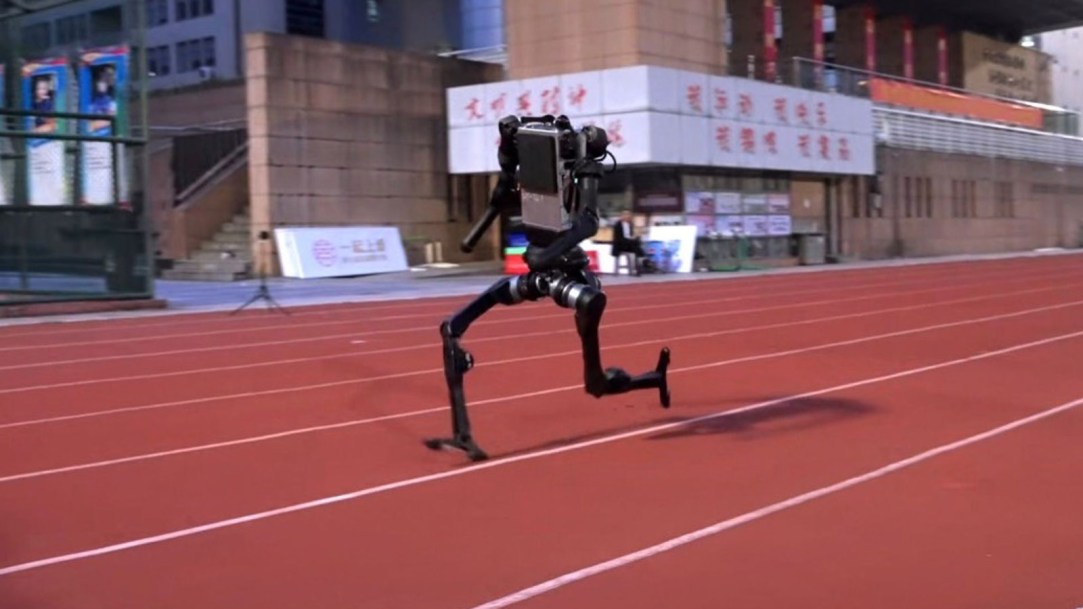
Unitree Robotics recently revealed in a video that one of their humanoid robots reached a running speed of 10.1 meters per second. By comparison, Usain Bolt’s 100-meter record of 9.58 seconds required an average of 10.44 meters per second.
While the Unitree humanoid robot didn’t officially break Bolt’s 100-meter dash world record, that day is certainly coming, and it may be soon.
A humanoid robot already beat humans in a half-marathon
In April, a humanoid robot developed by Chinese phone brand Honor finished a half-marathon race in Beijing in just 50 minutes and 26 seconds. As Reuters pointed out at the time, that was several minutes faster than the half-marathon world record set by Ugandan runner Jacob Kiplimo in March. It was also almost two hours faster than the winning humanoid robot ran in the 2025 race.
Unitree’s bipedal H1 model uses high-torque motors, LiDAR, and depth cameras, so as those technologies develop, so will the humanoid robot’s running speed. According to NDTV, Wang Xingxing, CEO of Unitree Robotics, said at the 2026 Yabuli Entrepreneurs Forum that he thinks humanoid robots could possibly break the 10-second barrier in the 100-meter dash as early as mid-2026.
In February, MirrorMe, another Chinese company, unveiled “Bolt,” a full-sized humanoid robot that weighs 75 kg and is 175 cm tall, and can travel up to 10 m/s.
What purpose is there for a speed-running robot?
As for what practical application a speed-running humanoid robot possesses, there currently really isn’t one. It’s really more just for show.
“It’s like a stress test for the hardware, because you need to exert high torques on the actuators for a prolonged period of time, which can cause overheating,” Petar Kormushev at Imperial College London told New Scientist. “The impact with the ground causes shocks to the gear boxes, and if they’re not good quality, it’s very easy to break teeth on the gears.”
And as for how fast these humanoid robots will eventually be able to run, Behnam Dadashzadeh at Bournemouth University, UK, believes they will break all human records, but not by much, and that’s about where the limit will be drawn.