



Shutterstock
If the media is to be believed, millennials are on a mass killing spree with no end in sight. They’ve slaughtered Applebee’s and straight up murdered sex, and it seems like there’s a new story basically every day about yet another industry falling victim to the generation.
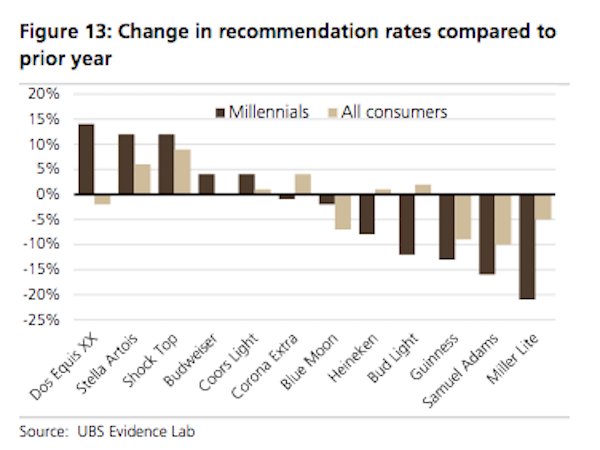
According to Business Insider, the most recent casualty of millennials’ war on big business would appear to be the beer industry. Last month, we noted that Big Beer was facing a bit of a crisis, and a new set of charts released by UBS illustrates the issues facing larger brewers.

UBS
As the picture above illustrates, millennials are less likely to recommend bigger and more traditional brands to other people compared to older generations. Macro lagers seemed to take the biggest hit, with imports and beers masquerading as “craft” absorbing slightly less damage (with the notable exception of Sam Adams, a former leader of the craft beer movement who now finds itself in a weird limbo in an increasingly crowded marketplace).
UBS
What’s the reason for this shift? Goldman Sachs claims millennials are gravitating toward wine and spirits, and while the generation might be shying away from bigger beer brands, they’re drinking plenty of craft beer. It appears brand loyalty isn’t what it once was, as millennials who drink craft beer try an average of 5.1 different brands per month (with 15 percent of those people trying more than 10 different brands of beer in the same amount of time). When there are more than 5,000 breweries to choose from in the United States alone (compared to less than 100 in the 1980s), it’s no wonder the generation is branching out.
[protected-iframe id=”7bbc6bcc239aaf8c7db77ea8f44bf1c3-97886205-55047561″ info=”//static.apester.com/js/sdk/v2.0/apester-javascript-sdk.min.js” height=”458″ class=”apester-media”]
Marco brewers are also undoubtedly impacted by millennials’ seeming indifference to traditional advertising. It’s no secret that larger companies have leaned on massive marketing budgets in order to generate sales, but it would appear those ads are falling on increasingly deaf ears.