


Adam Gray/Getty Images for The New York Times/2K
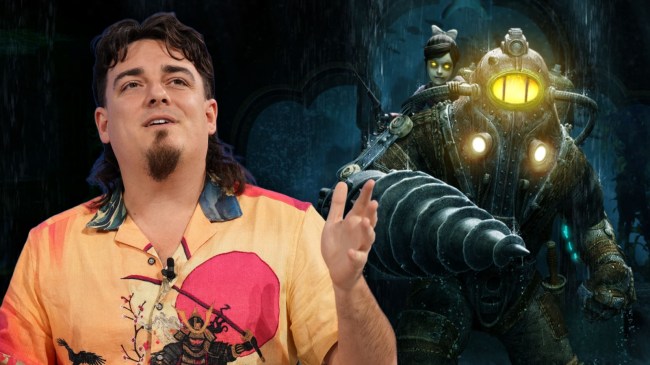
Palmer Luckey next to Big Daddy from 'BioShock'
The BioShock video game franchise is a cautionary tale highlighting the potential downsides of constructing a libertarian paradise in the middle of the ocean. However, tech billionaire Palmer Luckey is hoping to avoid some of those pitfalls after unveiling his ambitious plan to do exactly that.
Virtual reality headsets existed before Palmer Luckey started working on the one he dubbed the Oculus as a teenager, but he was largely responsible for ushering in a new era with the device that managed to raise more than $2.4 million in a Kickstarter campaign in 2012.
That ended up being just a tiny slice of what the company would ultimately sell for, as Luckey ended up doing pretty well for himself when Facebook acquired Oculus a couple of years later for a cool $2 billion.
Luckey has only seen his fortune grow since then. The 34-year-old has an estimated net worth of $5 billion with the help of the government contracts that have been funneled into Anduril Industries, the military defense company he founded in 2017.
He stayed in a similar lane with Warhound, the venture he announced last month that will focus on the creation of genetically modified dogs spawned with the military in mind.
I don’t think it’s unreasonable to suggest his more recent pursuits give off some slight Aspiring Supervillain Vibes, and that’s also the case with his vision for a concrete fortress in the middle of the ocean governed by no laws but its own.
Palmer Luckey is planning to construct a libertarian city located in international waters to skirt government regulations
Luckey has not been shy about hiding his political leanings. He was a vocal critic of Hilary Clinton who donated to support Donald Trump’s campaign, which sparked some drama behind the scenes at Facebook that ultimately led to him being dismissed from his Oculus role.
He’s continued to throw his financial support behind Republican candidates across the country over the past decade or so, and he says he personally identifies as a libertarian.
That tracks with the plan he unveiled earlier this week, as Luckey shared he is currently working to develop a “seastead” dubbed SLAB, which is essentially a city that will sit on a concrete foundation in international waters to skirt “laws that cripple critical American industries.”
Selling Oculus to Facebook in 2014 gave me money for helicopter flight lessons and developing a seastead called SLAB with a 1,000 year design life.
The goal was to be cheaper than land and absent state/local laws that cripple critical American industries like metal processing, medical research/treatment, desalination, oil refining, chemical engineering, and more. Me and a few close friends cashed it up at a $1B valuation back in 2017, and while it still has a long way to go, there has been significant progress towards my goal of reviving manifest destiny and westward expansion. At a time when most of the seasteading community wanted to escape the US and smoke pot, this was the one project explicitly designed to make America stronger, a relief valve for ill considered or outdated rules and regulations.
I am only talking about it now because a few media outlets got wind of me and some friends topping up the coffers and plan on calling SLAB my new floating AI datacenter project. It is way cooler than that, way older than that, and I hate looking like a hype-chasing consensus loser, so now you have to read this tweet.
— Palmer Luckey (@PalmerLuckey) November 18, 2026
Luckey noted he was quietly working on developing the project but decided to go public to counter rumors about his plans to build a “floating AI datacenter,” saying SLAB is “way cooler.” He didn’t reveal a timeline or a potential location, but he asserts it will be able to operate for 1,000 years once it’s constructed.
It’s pretty hard to talk about a city in the middle of the ocean positioned as a libertarian paradise without discussing BioShock, the video game that featured an underground city known as Rapture that was founded on a nearly identical political philosophy.
I probably don’t need to worry about spoiling a game that came out close to two decades ago, but without getting too deep into the details, that fictional experiment did not end well, so it’ll be interesting to see how this one pans out.