



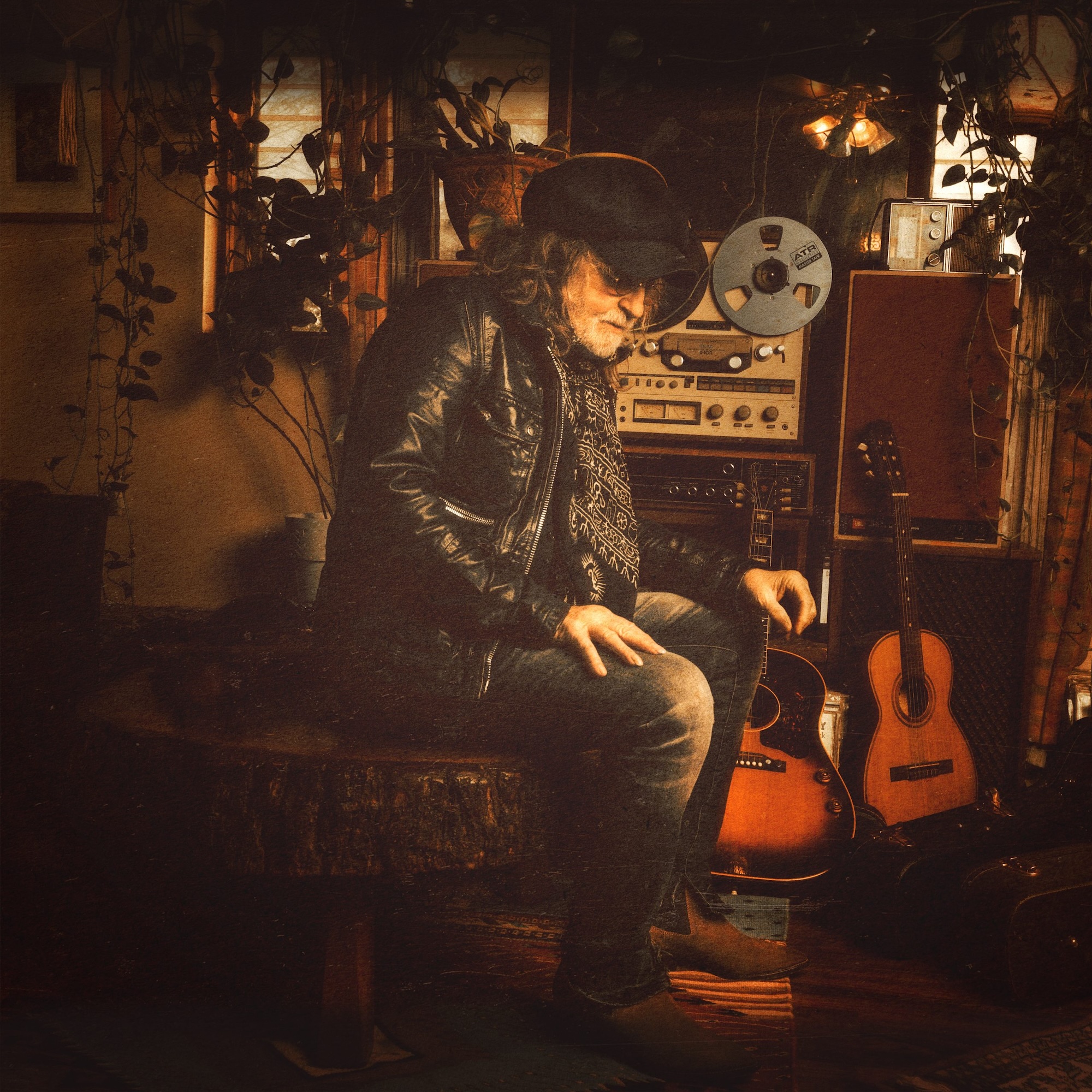
via Ray Wylie Hubbard, with permission
At an age when most musicians have long since traded the road for the recliner, Ray Wylie Hubbard is still logging highway miles, still chasing the next song, and — by his own admission — still doing it as long as he’s got a mortgage. The Texas songwriting legend – arguably one of the greatest songwriters in American history – joined host me recently on the Load Out Music Podcast for a conversation that ranged from near-death airline turbulence to the accidental birth of one of outlaw country’s most famous songs, all in advance of his new album, Reel to Reel, For Real, due out this summer.
Hubbard, who splits his time now between south Texas and northern New Mexico, opened by describing a full calendar: Dinners with fellow songwriters Paul Williams and Eliza Gilkyson, an upcoming song swap with Gilkyson and Jimmie Dale Gilmore in New Mexico, and a run of Texas shows tied to a Robert Earl Keen fan-appreciation event. He also recounted a hair-raising flight out of Santa Fe in which passengers were pulled off the plane to lighten the load for takeoff — a reminder, he joked, of why touring life is “rough,” even if the payoff of performing makes it worthwhile.
That payoff is amplified these days by sharing the stage with his son, Lucas, who plays guitar in what Hubbard calls “Hubbard and Son” (Lucas prefers “Hubbard and Father,” he notes, so he can avoid top billing). Hubbard spoke with evident pride about Lucas’s development — not just as a guitarist but as a producer and co-writer, crediting Austin mentors like Derek O’Brien and Seth James for instilling restraint in his playing rather than flashiness. Father and son co-wrote at least two songs on the new record, including “God’s Playing Poker,” built around the image of assorted deities — Odin, Shiva, Buddha — sitting down for a card game.
The conversation also touched on Hubbard’s long habit of mentoring younger songwriters, a practice he traces back to his own formative years in a New Mexico club where Jerry Jeff Walker, Michael Murphey, B.W. Stevenson, and Steve Fromholz used to pass through. He recalled discovering Hayes Carll playing video poker before a gig, later inviting him on tour with Slade Cleaves partly, Hubbard joked, because Carll would carry the gear up two flights of stairs. He also described teaching Carll a fingerpicking pattern that turned into the song “Beaumont” — a small, generous moment Hubbard treats as simply how the songwriting community is supposed to work: “in order to keep it, you’ve got to give it away.”
Previously: A Conversation With Ray Wylie Hubbard, One Of America’s All-Time Great Songwriters
I’ve admittedly been the recipient of Hubbard’s generous personal mentoring and kindness, as have friends like singer-songwriters Christopher Wright, Charlie Shafter and Isaac Hoskins, and countless others – often because of our shared challenges with substance abuse, or just because Hubbard may like you. Hubbard even recently lent his time and voice in-studio to another member of our tribe, Marshall Hunt, along with his singer-songwriting protégé, Max Aman, for Aman’s forthcoming debut album Restless Souls that Hunt is producing.
Much of our interview centered on Hubbard’s creative philosophy — what he refers to as “the rattle,” that raw, unmistakable quality a song has when it’s working. Hubbard was characteristically unsentimental about judging his own material, saying it isn’t his job to predict what will resonate, only to write the best song he can. He traced the strange, mostly accidental origin story of “Up Against the Wall, Redneck Mother” — a joke made up on the spot after a bar altercation in Red River, New Mexico — which was passed along by bassist Bob Livingston to Jerry Jeff Walker and became one of the defining songs of the outlaw country era, despite Hubbard writing it almost as a throwaway line.
Turning to the new album, Hubbard walked through several tracks, including “Cassette Mixtape,” inspired by literally unearthing a box of old mixtapes and the memories that came flooding back. He also discussed “She Plays Crazy Mama” and “The Night Opens Up Like a Penny Arcade,” both recorded with Heartbreakers guitarist Mike Campbell, calling those sessions a highlight of the record. Other guests on the album include Ringo Starr, Don Was, Joe Walsh, Chris Robinson, Ashley McBryde, Larkin Poe, and Tyler Bryant, several of whom got involved simply because Hubbard called and asked — not, he emphasized, because he was chasing a particular sound or commercial angle. The Ringo Starr collaboration, in particular, began almost casually: a text inviting Hubbard to Los Angeles to record drums on a song called “Bad Trick,” co-written with his wife Judy after a rough gig.
Asked how he wants to be remembered, Hubbard demurred at first before settling on something plainly stated: a stand-up guy with a checkered past who wrote some pretty good songs, tried to stay sober, be kind, be useful, and be a good husband and father along the way. It’s a modest self-assessment for a songwriter widely regarded as one of the sharpest lyrical minds in American roots music — but it tracks with everything else in the conversation: a working artist still driven purely by the joy of the next line, the next session, and the next show with his son beside him.