



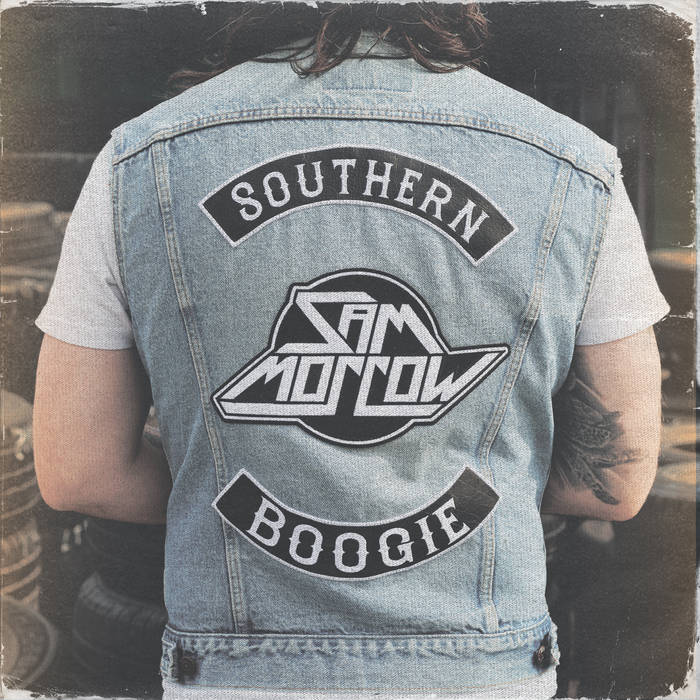
via Sam Morrow
Sam Morrow Southern Boogie album
Sam Morrow has been on The Load Out Music Podcast enough times now that I can needle him about it on air: Three appearances (here, here, and here), a distinction no other guest has reached. We go back beyond the podcast as my band Atomic Junction has shared stages with him, and it shows in the ease of our conversation, which most recently centered on Morrow’s new album, Southern Boogie, a record he describes as a leap beyond Americana into something rawer, grittier, and funkier than anything he’s released before.
Morrow moved from California to Nashville a few years back, and he’s still glad he did. Where a tour once meant committing to at least three weeks away just to make the trip worthwhile, Nashville lets him duck home for a couple of days between runs — something he says was “impossible” living in California. He’s currently mid-tour up in the Northeast, but that ability to touch base at home remains the biggest quality-of-life change the move bought him.
Musically, Morrow has never fit neatly into one lane, and he’s made peace with what that costs him. Raised on ZZ Top, punk, and hip-hop, he’s never been strictly southern rock, country, or funk — some combination of all three, with deep funk rhythms underneath. He says the Southeast and Florida give him his best audiences, and suspects it’s because he doesn’t chase genre purity, even if it means he’ll never be any single fan base’s diehard pick. “I don’t really care,” he said. “I make the music I make sort of selfishly, because it’s what I want to hear.”
That instinct came up when Morrow and I discussed artists whose sound is instantly recognizable — Elvis Costello, and, in Morrow’s case, Sturgill Simpson, an artist he relates to for doing “whatever the hell he wants” without over-indexing on listener expectations. Morrow noted he’s not anti-AI and sees potential for it in songwriting, but Southern Boogie was a deliberate swing the other way: something human, live, and unpolished.
That instinct shaped how the record was made. Morrow and producer Jonathan Tyler cut the album in Austin at a studio called Finishing School, tracking live as a five-piece — two guitars, bass, keys, and drums — through all-tube amps, chasing the feel of a band actually in a room together. Tyler mixed it “out of the box,” on a physical board rather than inside a computer: once a mix is done, it’s done, with no revisiting it for a minor tweak. Morrow, who admits he can obsess over details nobody will notice, found that finality freeing — even if it’s still driving Tyler a little crazy over one guitar part he wishes had been louder.
For all its grit, Morrow describes the album as one of his most optimistic — a byproduct, he says, of being at maybe the happiest point of his life. It includes songs about his wife and about digging yourself out of a hole, alongside character sketches like “Saturday Night,” his favorite track on the record, about a guy returning to his hometown determined to convince everyone he’s a badass. Then there’s “Lucretia,” named after the Los Angeles street where he was staying with guitarist Eli Wolfmeyer when the title line came to him. Finished with co-writer Ben Chapman, it became a story about being stuck in the mud and needing a little help to take the final step out. It joins “Juanita” and “Rosarita” on the record, an unplanned trio of songs named for women.
Morrow has said before that he wanted to make a straight rock record a decade ago, only to be told rock wasn’t commercially viable then — advice that steered him toward outlaw country instead. Southern Boogie is him finally arriving where he’d been aiming, though the next record, he said, could just as easily swing back toward funk. Live staples like “Quick Fix” and “Rosarita” skew rockier on stage than on tape, and that live energy informed the new record directly.
The conversation closed on a note fewer artists are willing to strike: touring right now is genuinely hard. Gas is expensive, tickets are a tougher sell post-COVID, and Morrow pointed to what his agent calls “blue dot fever” — a wave of high-profile cancellations, Post Malone included, tied to soft ticket sales industry-wide. Morrow was candid about economics most artists avoid discussing: he has people who depend on him, and the job has to be sustainable, even when it doesn’t feel that way. He’s not throwing in the towel — just adapting, and hoping Southern Boogie helps.
Southern Boogie is out now, and Morrow tours through the rest of the year. Hear the full conversation at loadoutmusic.com.