


Via iStockphoto / @consistent.with.cleo TikTok
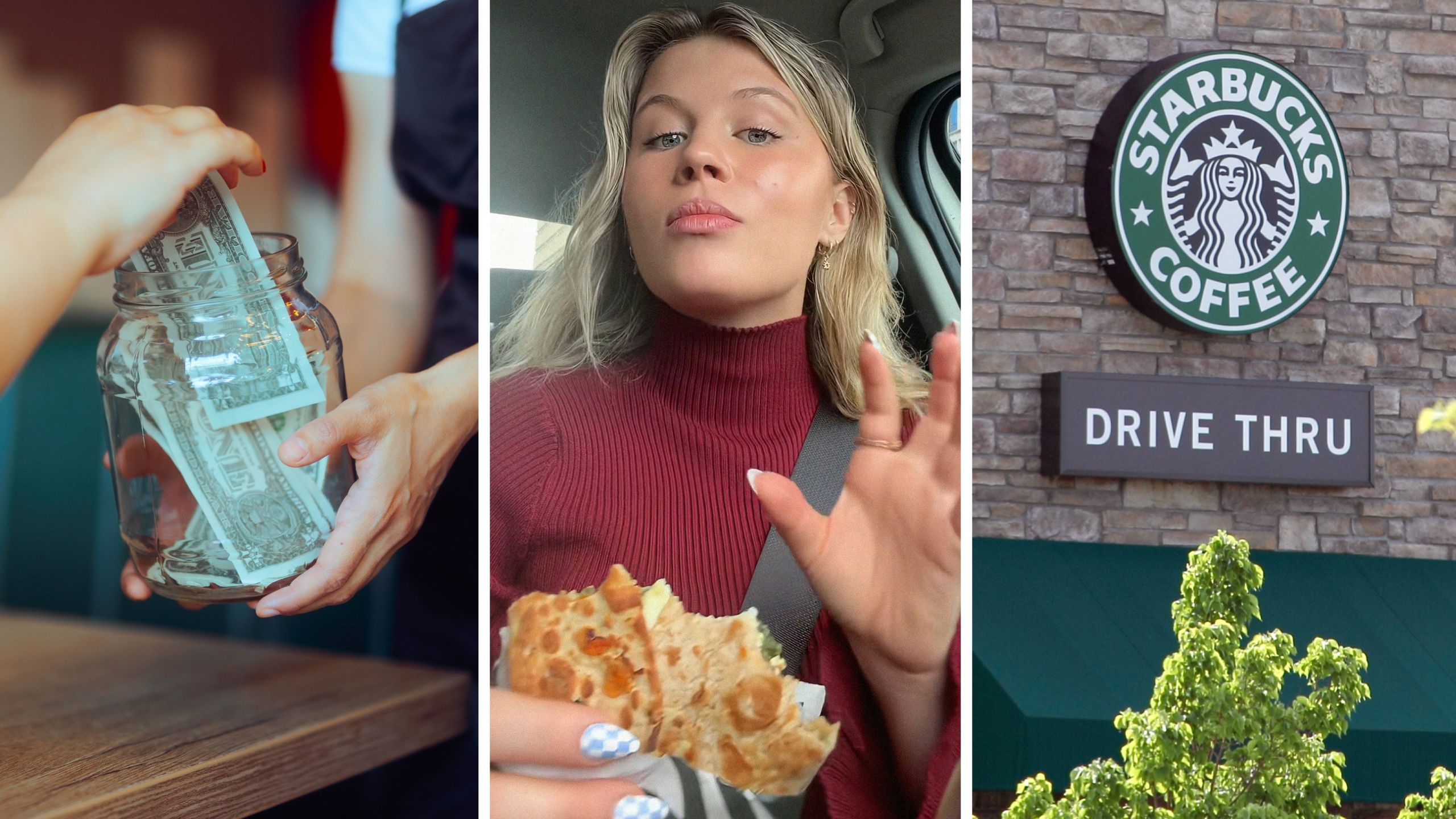
A woman hit 'no tip' in the Starbucks drive-thru. The worker 'genuinely stopped talking to' her after that and would barely make eye contact.
A woman pulled into a Starbucks drive-thru. After ordering her food, she drove to the window to pay. Like millions of everyday Americans, she was presented with the option that is increasingly common across the economy: Tip or no tip?
“I pressed the ‘no tip’ button, and she [the cashier] just stopped talking to me. Genuinely stopped talking to me altogether. She would barely look at me,” says content creator Cléo Gauthier (@consistent.with.cleo) in a video with 174,000 views.
According to Gauthier’s account, the employee’s demeanor immediately changed. The interaction became noticeably colder. What was supposed to be a routine transaction suddenly felt uncomfortable. Gauthier even tried to lighten the mood by being overly chipper.
“I don’t normally tip counter service workers. Maybe I just don’t know about drive-thru service workers. Maybe you are supposed to,” she says.
Her situation soft-launched a question to her 71,000 followers about tip decorum. Whether one agrees with the employee’s reaction or not, the incident highlights a growing tension in American culture: tipping fatigue.
“Personally, as a Starbucks employee, I’m grateful for whatever tips we receive, but [they’re] not necessary. And I hate that I have to stick the pad out with a big tip question. It’s awkward and weird and feels pressuring,” chimed one commenter.
How Did Tipping Start?
The tradition of tipping dates back to 5th-century Rome. But as people traveled and discovered the practice, naturally the idea spread, was adapted, and evolved over time. In the United States, specifically, tipping became ingrained in American society following the Civil War.
Since the early 19th century, tipping in the United States was largely confined to jobs where gratuities were understood to be part of compensation. Formerly enslaved people and immigrants were hired in service positions (servers, bartenders, hotel staff, porters, and delivery drivers) for meager wages, forcing them to depend on generosity (gratuity) to fill the gap. The Pullman Company, known for its luxury train cars, institutionalized the practice of tipping in America.
In the 2010s, with e-commerce picking up and companies like Square taking off, to accommodate the needs of many different industries, tipping prompts were being added as a part of the optional interface. During the pandemic, when coming to work and interfacing with the public was truly a sacrifice, the tipping option on business point of sales increased. People were tipping in non-conventional industries to support frontline workers. Fast forward to today, and tipping prompts appear almost everywhere—coffee shops, drive-thrus, self-checkout kiosks, and retail stores.
“If I have to drive to the place and go to drive thru or a pickup counter… I don’t tip. Tipping is for a service not for purchasing something,” regarded one commenter.
Do You Feel Pressured To Tip?
Consumers who are simply purchasing a product are increasingly being asked to supplement wages through voluntary contributions. Despite now doing much of the work themselves (think self-checkout), consumers are still being prompted to tip.
The result is a growing sense that tipping has expanded beyond its original purpose. Many Americans no longer feel like they are being given a choice. They feel like they are being tested.
“As a UK girlie the tipping situation in the US baffles me. I think it’s mainly because everyone gets paid a least minimum wage here but tipping isn’t really common unless you’re at a restaurant and get good service but even then it’s not like a percentage you just leave a few £,” said another commenter.
The most controversial aspect of modern tipping is not the request itself. Few people object to being given the option.
The problem arises when that option appears to come with consequences. When customers believe they may receive poorer service, judgment, or visible frustration after declining a tip, the system stops feeling voluntary. A gratuity offered freely is one thing. A gratuity offered to avoid guilt, embarrassment, or retaliation is another.
In Gauthier’s case, her annoyance did not stem from the prompt. It stemmed from the perception that selecting “No Tip” changed how she was treated.
“I feel like if the service is conditional on a person tipping you, that is no longer good service,” said Gauthier.
The Tipping Point
Traditionally, tips represented appreciation for service that exceeded expectations. It was a voluntary expression of gratitude. When every transaction requests a tip, the meaning becomes diluted.
Gauthier had every right to select “No Tip.” The employee had every right to wish she tipped. What neither should experience is a system that pits them against each other. The debate over tipping evolved from generosity to expectation.
As tipping prompts continue to spread across American commerce, businesses and workers must remember a simple principle: A tip requested is optional, and an optional choice should never result in a customer feeling judged for making it.
If declining a tip changes the experience, then what is being presented as a choice may not be one at all.
BroBible reached out to Gauthier for comment.