


iStockphoto / Merlinus74 / 3dsam79
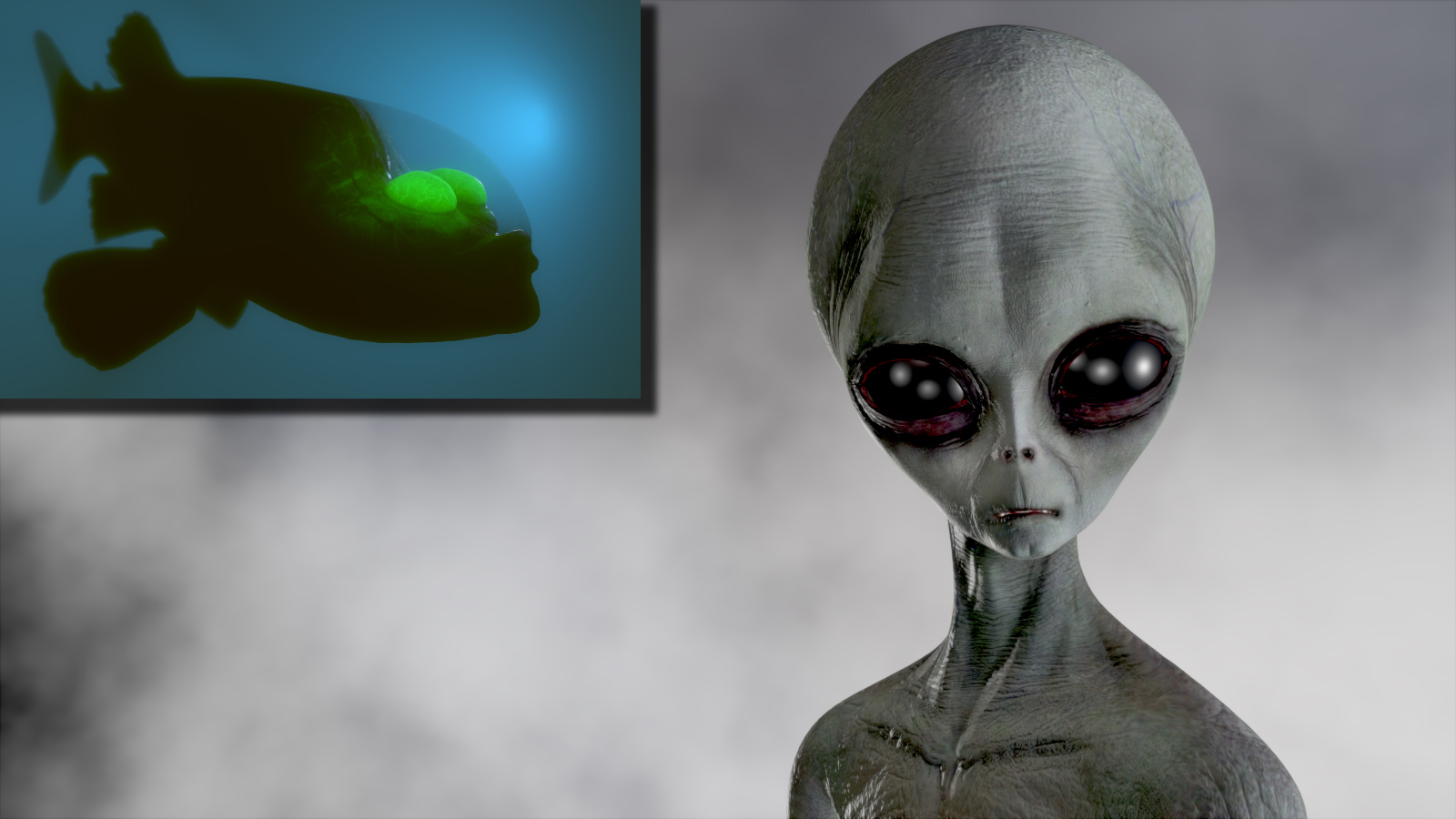
a real-life and rarely seen barreleye fish next to a rendering of an alien
One of the strangest fish in the ocean, the barreleye fish (Macropinna microstoma), was just spotted for the first time in years by the Monterey Bay Aquarium Research Institute (MBARI). This species of fish has a transparent forehead and tubular eyes that gives it the appearance of a literal alien and it was last spotted by MBARI back in 2021 during a dive into the ‘Twilight Zone’ (600 to 800 meters).
These fish feed on zooplankton including crustaceans and siphonophores and are believed to live primarily between 1,500 to 2,600 feet deep. This one was spotted by MBARI researchers from the Biodiversity and Biooptics Team who were around 55 miles off the Northern California coast using a remotely operated vehicle (ROV), Doc Ricketts, when they spotted the the barreleye fish (Macropinna microstoma) and filmed it in 4K.
Aliens Among Us: Barreleye Fish With Transparent Head Filmed In 4K Off California
As is the case with most deep-sea fish, it spends most of its life at such extreme depths that it is virtually never seen by people. This particular species has been known to researchers since 1939 but it wasn’t photographed for the first time until 2004.
MBARI researchers have only ever encountered the barreleye fish 10 times in history counting this one. It’s as rare as it gets. Its peculiar eyes “rotate like binoculars” to spot prey.
How Big Are They?
One common reaction to seeing deep-sea fish such as this one or the popular anglerfish is horror that such a creature inhabits the same ocean we swim in. Well, let me include some information to assuage your fears.
For starters, the barreleye fish looks like a complete alien. If we were to create a Mt. Rushmore of Alien-Like Creatures on Earth then this fish would 100% be up there. But it is quite tiny. They only grow to a size of around 15 centimeters or 6 inches.
So while this fish can be found in the Northern Pacific Ocean from Japan to California, they are quite difficult to find because they are so tiny. This is often true for many deep water species as life at such extremes requires unique adaptations. Mainly, there is not a lot of life down there. A shark requiring thousands of calories to survive would not be able to find suitable meals let alone survive the pressure at such depths.
This video published by MBARI back in December 2021 makes the fish look massive! That is of course due to the camera on the remotely operated vehicle (ROV) being zoomed in for a close-up image of the fish and not because the fish itself is enormous.
After spotting the recent barreley fish 50ish miles off California in 1,970 feet of water, MBARI Senior Scientist Steven Haddock said “seeing a barreleye fish is a rare treat. Crew from across the ship joined the science team in the control room, mesmerized by this remarkable animal. Deep-sea animals capture the imagination, creating wonder and awe that we hope will inspire stewardship of the largest living space on Earth.”
For this 8-day expedition, the team was using the same “flying” ROV Doc Ricketts that spotted the barreleye fish back in 2021 (video just above). Which leads me to believe this particular flying ROV, the Doc Ricketts, might have the best luck in the industry of any research vessel.