



Via @bethannevn TikTok/DmyTo Adobe Stock/Roman Tiraspolsky Adobe Stock
A woman says she had to perform a virtual, self examination while at Urgent Care. They're becoming more common.
A woman says she had to perform her own examination at urgent care. She’s one of many who claim this is becoming a common occurrence—and one that comes with a significant price tag.
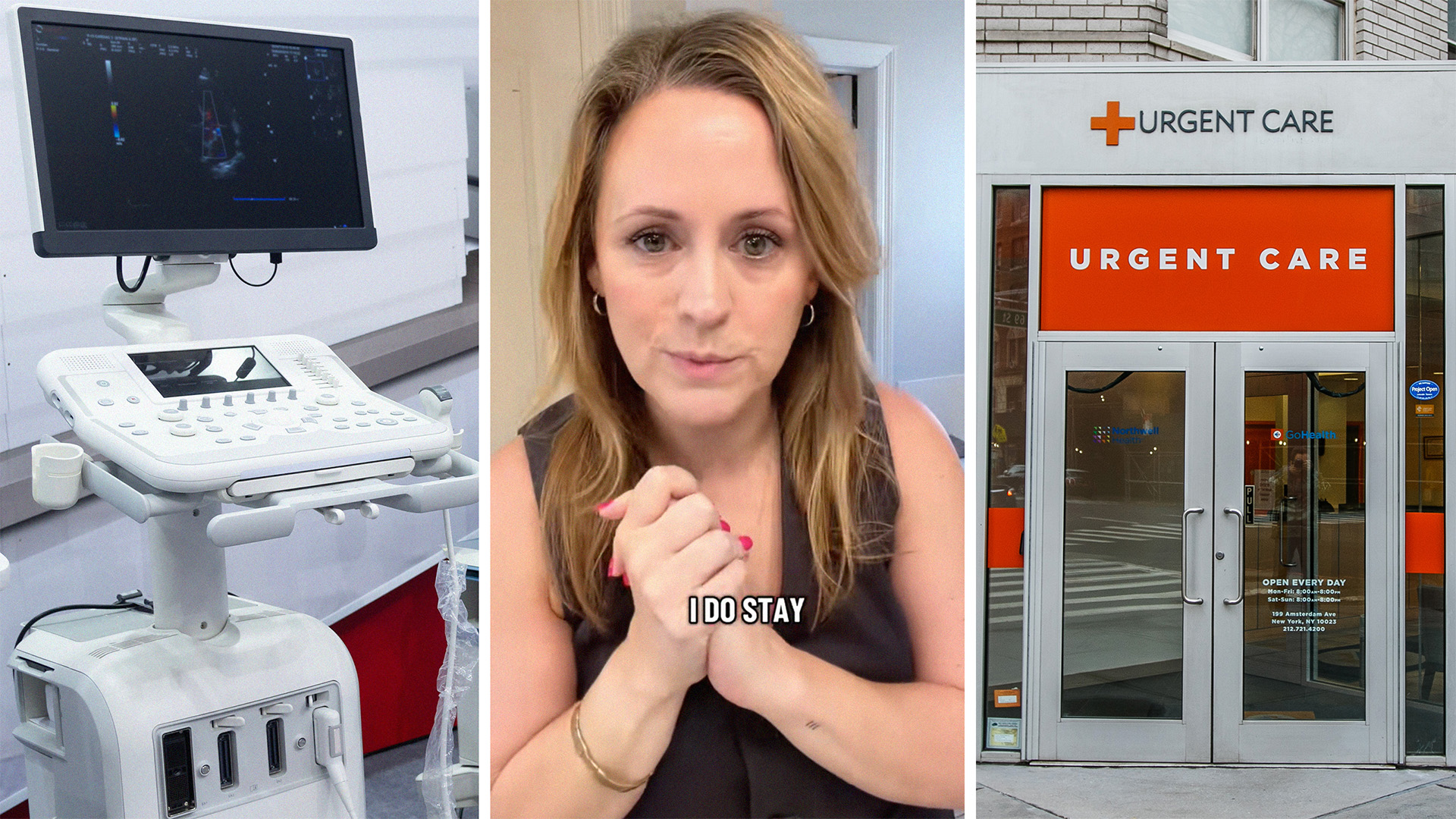
In a video with over 672,000 views, TikTok user Beth Anne (@bethannev) recounts her recent visit to urgent care.
According to Beth, she was welcomed with a computer screen. From there, she learned that she would be performing her own examination.
“[I] was tasked with doing my own physical exam with the guidance of a virtual physician,” she writes in her video.
“I checked my own ears, throat and lungs,” she continues. She adds, “I don’t know how to feel about it.”
Beth is far from the only person claiming that they’ve had to perform their own examination in urgent care. But what is this machine? And is all of this even safe?
Why Are Urgent Care Patients Examining Themselves?
Urgent care centers around the country increasingly feature telehealth tools like the one shown in Beth’s video.
For example, tools produced by the company TytoCare allow patients to use a digital stethoscope to transmit the sound of their breathing to a doctor or use an illuminated camera to allow a professional to view the inside of their ears.
While telehealth services expanded dramatically during COVID, the focus of these additional services tended to be on people in their own homes.
But as healthcare facilities attempt to reduce wait times, services like the one shown by Beth are being introduced as an accompaniment—or alternative—to on-site medical providers. TytoCare itself claims its devices can be found in over 130 hospitals and urgent care facilities across all 50 states.
Is This Safe? Is It Even Effective?
There’s some evidence that doctors can effectively assess patient conditions using these tools. That said, there are some massive caveats.
For example, a 2023 study had medical professionals operate telehealth devices, like the one shown in the video, on child patients. They transferred this information to another medical professional in real-time, who made an assessment. The results from these tests were then compared with traditional physical examinations.
While the results showed promise—for example, researchers often found consensus between telehealth and in-person assessments—there were some obvious limitations.
First, telehealth devices proved considerably less effective than in-person assessments in certain areas. For example, remote throat and mouth examinations missed almost half of the abnormalities identified during in-person examinations.
Second, these devices were operated by medical professionals. Assessments like Beth’s are performed under the guidance of a medical professional. However, that’s not the same as having an expert with the device in-hand who knows what to look for.
On that point, a December 2025 study had patients film the inside of their ears using a digital otoscope. To do this, the patients followed the advice of a short instructional video.
When doctors reviewed this patient-recorded footage, they arrived at the correct diagnosis about 48% of the time. In comparison, doctors reviewing videos filmed by an ear, nose, and throat medical resident arrived at the correct diagnosis approximately 64% of the time.
This discrepancy reveals a potential issue of having patients record videos of their own assessments, even if they’re doing so under physician guidance.
Are These Visits Any Cheaper?
Seeing all of this, one might think, “OK, I’d prefer to have an in-person doctor. But if it’s cheaper to use the camera, I’ll give it a shot.”
Unfortunately, that’s often not the case.
Telehealth visits can cost the same as a traditional office visit, even if you’re the one operating all of the equipment. Allina Health, which offers telehealth services, states on its site that “most virtual visits cost the same as a traditional in-person office visit,” though how much you pay out-of-pocket often depends on your insurance.
Providers also tend to be paid the same amount for telehealth services as in-person visits, according to the PETERSON-KFF Health System Tracker. In some states, the law requires insurers to provide equal payment for both services.
Even if the addition of telehealth services results in higher throughput—and thus, less overall cost for the healthcare provider—those savings aren’t always passed on to you, the patient.
A 2023 study found that, while telemedicine services were associated with lower overall medical costs for certain office-based appointments, those savings did not necessarily translate into lower out-of-pocket expenses for patients.
On your next trip to your local urgent care center, look out for one of these machines. If trends continue, you may have to familiarize yourself with them sooner rather than later.
Viewers Have Stories
In the comments section, users shared their own experiences dealing with telehealth services.
“No lie my insurance company offered me a VIRTUAL COLONOSCOPY because the Dr’s in my area are limited,” wrote a commenter.
“I went in for a yeast infection, I knew I had one but the otc stuff wasn’t working,” recalled another. “I had to swab myself and pay $300.”
“‘Don’t Google your symptoms, leave it to the medical professionals.’ ‘Okay you’ll be examining yourself today that’ll be $100,’” joked a third.
BroBible reached out to Beth via email, TikTok direct message, and comment.