



Rhona Wise-Imagn Images
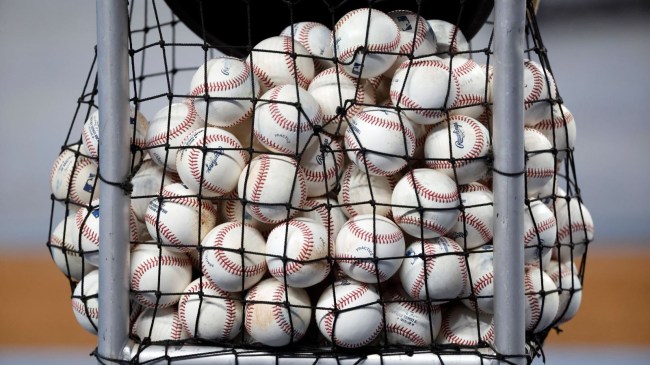
Jun 20, 2026; Miami, Florida, USA; A bucket of baseballs sit on the field before a game between the San Francisco Giants and the Miami Marlins before the game at loanDepot Park.
As the old saying goes, “chicks dig the long ball.” As it turns out, dudes also dig the long ball; in fact, the home run is widely considered the most exciting play in baseball.
With that in mind, you could understand why Major League Baseball would want more home runs in the game. But what lengths would MLB go to in order to get more homers into games?
If evidence is any indication, pretty significant ones. New data seems to show that MLB altered the makeup of its baseballs, which it is entirely in control of the production of, in the middle of the 2026 season in order to lead to more home runs.
Did MLB Doctor Baseballs For More Home Runs In Games?
Now, allegations of “juiced baseballs” that fly farther than the standard ball would are nothing new. In fact, they left an asterisk on Aaron Judge’s remarkable 2022 season, in which he hit 62 home runs.
However, this time around, it’s pretty impossible to ignore the evidence at hand.
According to Eno Sarris of The Athletic, the current baseball creates less drag than those used in recent seasons.
“If it seems like there’s been more offense recently, there has, and then well, there’s this. Drag on the ball currently lower than any year other than 2019, when baseball broke all kinds of homer records. Super weird considering MLB owns the ball maker, has humidors in every park,” Sarris posted on X alongside a chart showing his work.
But wait, there’s more!
There is strong evidence that MLB either changed the baseballs or introduced a new batch of baseballs (while still cycling out the old) in late May / early June
Almost every contact-quality-controlled Statcast metric has seen an outlier uptick in recent weeks
Barrel distance… https://t.co/FSZe54fCHe pic.twitter.com/YJrHiR1Klr
— Sean Zerillo (@SeanZerillo) June 22, 2026
Sean Zerillo of Action Network reports that starting in late-May/early-June, almost every contact-quality-controlled Statcast metric has seen an outlier uptick. Since April, barrel distance has increased by 10.2 feet, which Zerillo says represents the biggest in-season jump from April to June of the Statcast era, which began in 2015. The average in that time frame 4.6 feet, which is typical as the weather warms up.
Meanwhile, the additional six feet appears to line up with the same time frame as the drop in drag on the baseballs.
Perhaps Vladdy Guerrero Jr. was onto something.
What do you think? Did MLB sneakily alter its baseballs for more dingers? And if so, are we a fan of the move? Let us know in the comments below!