



Peter Brouillet-USA TODAY NETWORK/The Providence Journal-Kris Craig/Peter Brouillet-USA TODAY NETWORK
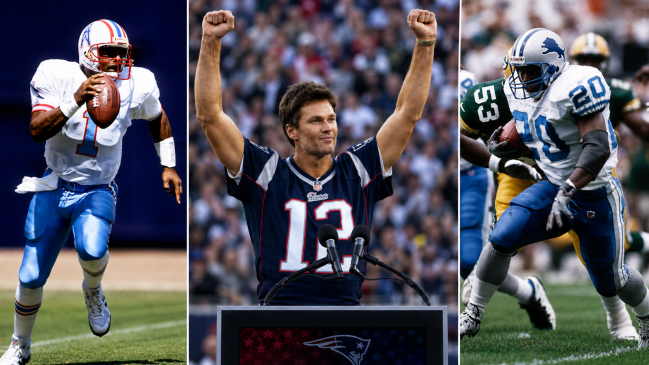
A college of Pro Football Hall of Famers that includes Warren Moon on the left, Tom Brady in the center, and Barry Sanders on the right.
There are currently 382 members of the Pro Football Hall of Fame, with five more legendary players set to join in the Class of 2026. But every so often, a player comes around in the NFL who is head and shoulders better than the rest.
That player isn’t just a Hall of Famer, but a player who leaves such an indelible mark on the league and the game that they become synonymous with a specific jersey number.
In this project, we took a look back through NFL history and determined which players are the greatest to ever wear every number, starting from No. 1 and going all the way to No. 99.
Greatest NFL Players To Wear Jersey Nos. 1-25
Up until 2021, the NFL had very specific rules regarding jersey numbers. Certain numbers, like those in the single digits and teens, were traditionally reserved for players such as quarterbacks and specialists.
Meanwhile, wide receivers and tight ends could only wear 80-89 up until 2004, when the league allowed receivers to also wear No. 10-19. And defensive linemen were only allowed to wear 90-99.
That means that much of our list is position-based. Which, in turn, means we start part one with a number of familiar faces at the quarterback and running back positions, with a few others thrown in.
With further ado, these are the greatest players in NFL history to have worn Nos. 1-25.
1) Warren Moon
After an absolutely dominant run in the CFL that saw him win the Grey Cup five years in a row with the Edmonton Eskimos, Warren Moon came to the NFL with the Houston Oilers in 1984 and didn’t skip a beat.
Moon was a nine-time Pro Bowler, including every season from 1988-1995, and won the NFL Offensive Player of the Year Award in 1990.
In total, he amassed nearly 50,000 yards and 291 touchdowns in his nearly 20-year career in the NFL, and ultimately went into the Pro Football Hall of Fame in 2006. Moon remains the only player to be in both the Canadian Football and Pro Football Halls of Fame.
Runner up: Cam Newton
2) Matt Ryan
Surprisingly, the No. 2 didn’t have a ton of clear-cut options. In fact, there are zero modern-era Hall of Famers to have even worn the number.
However, had the Atlanta Falcons not absolutely collapsed and blown a 28-3 lead in Super Bowl 51, we’re probably talking about Matt Ryan as a Hall of Famer.
Ryan, the 2016 NFL MVP, came into the league as the third overall pick in the 2008 NFL Draft and immediately lived up to the hype, winning the Offensive Rookie of the Year award for Atlanta.
He’d go on to make four Pro Bowls and lead the Falcons to a sustained era of success in the 2010s. Ryan may not live up to the rest of this list, but he had a damn good NFL career.
Runner-up: David Akers
3) Bronko Nagurski
At 6-foot-2 and 226 pounds, Bronko Nagurski originated what would become the prototypical NFL power back. Without him, there would be no Jim Brown, Earl Campbell, or Derrick Henry.
Nagurski, born in Canada, was a four-time All-Pro for the Chicago Bears and led the organization to championships in 1932, 1933, and 1943, the last of which came after a five-year retirement when the Bears lost several players who were drafted to fight in World War II.
Oh, and did we mention he did it all while playing both ways as a defensive tackle as well? Nagurski is the stuff of legends, and the clear pick for No. 3.
Runner-up: Russell Wilson
4) Brett Favre
Say what you want about Brett Favre’s misgivings off the field, and there’s plenty to be said, but on the field, Favre was one of the best quarterbacks the league has ever seen.
After being selected in the second round of the 1991 NFL Draft by the Atlanta Falcons, he was promptly traded to the Green Bay Packers in 1992, with whom he’d become an absolute superstar.
Favre won three consecutive NFL MVP Awards from 1995-1997 and led the Packers to a victory in Super Bowl 31 over the New England Patriots.
Even today, Favre ranks third all-time in completions, fourth in passing yards, and fifth in passing touchdowns.
Runner-up: Adam Vinatieri
5) Paul Hornung
Like Nagurski, Paul Hornung laid the groundwork for many superstars to come in the NFL.
The legendary halfback and kicker (doubt you’ll see that combo again anytime soon) led the Green Bay Packers to victory in Super Bowl I. The No. 1 pick in the 1957 NFL Draft played for just 10 years, but he left everything out on the field.
Hornung was a four-time NFL Champion, three-time All-Pro, and led the league in scoring every season from 1959-61.
Did we mention that Hornung won the 1961 championship and NFL MVP all while serving active duty in the U.S. Military?
Runner-up: Morten Anderson
6) Johnny Hekker
Listen, if you thought we were going to get through this list without showing punters any love, you’re out of your mind.
As it turns out, there were extremely slim pickings for No. 6, so we went with Johnny Hekker, who was the best punter in the league in the 2010s, making four All-Pro teams and four Pro Bowls while also helping the Rams to victory in Super Bowl 51.
He holds NFL records for highest net average punting yards in a season at 46.0 in 2016, and for longest punt in a Super Bowl at 65 yards.
Hekker was also renowned for his remarkable ability to pull off fake punts at a ridiculous high rate, perhaps because teams were so focused on executing a proper return whenever he was on the field.
Runner-Up: Jay Cutler
7) John Elway
Long before John Elway was the general manager of the Denver Broncos, the team made him the first overall pick of the 1983 NFL Draft. And Elway didn’t just live up to the hype; he exceeded it.
The Stanford product won the NFL MVP in 1987 and then led the Broncos to a pair of back-to-back Super Bowl victories in Super Bowls 32 and 33.
Elway made nine Pro Bowl appearances and was selected to both the 1990s All-Decade team and the NFL’s 100th Anniversary All-Time team.
Runner-Up: Michael Vick
8) Steve Young
While there are several numbers on this list where the decision was difficult, none was as difficult as No. 8, where Steve Young comes out just ahead of a pair of other superstar quarterbacks
One year after Elway went No. 1 to the Broncos, Young chose a different path, heading to the CFL and the Los Angeles Express, who offered him a record contract.
However, he played just two seasons for the team before it collapsed, leading him to enter the NFL Supplemental Draft.
Young then played two seasons for the putrid Tampa Bay Buccaneers, where he struggled mightily before being traded to the San Francisco 49ers.
Once there, he spent four seasons behind fellow legend Joe Montana before taking over and becoming a superstar in his own right. Young won a pair of NFL MVP Awards, led the 49ers to three Super Bowl victories, and made seven consecutive Pro Bowls from 1992-1998.
Runner-up: Lamar Jackson/Troy Aikman
9) Drew Brees
Because he played in the same era as Tom Brady and Peyton Manning, it’s easy to underemphasize just how great Drew Brees was. But make no mistake, Brees was one of the best quarterbacks to ever play in the NFL; an inner-circle Hall of Famer?
Just how good was Brees, who started his career with the then-San Diego Chargers before signing with the New Orleans Saints in free agency?
He ranks second all-time in passing yards, completions, and touchdowns, and he helped lead the New Orleans Saints, one of the league’s most historically poor franchises, to victory in Super Bowl 44.
Brees, a two-time NFL Offensive Player of the Year, teamed up with Sean Payton to form one of the most fearsome offenses in the league for over a decade, and his status as an all-time great should never be in question.
Runner-up: Sonny Jurgensen
10) Fran Tarkenton
Much like Nagurski with the power back, Fran Tarkenton was the architect of the modern running quarterback.
Aptly nicknamed “The Scrambler,” Tarkenton was the superstar QB behind the 1970s Minnesota Vikings, who may have never won a Super Bowl, but were perennial contenders.
Perhaps even more impressive is Tarkenton’s elite longevity. He played for nearly 20 seasons between the Vikings and New York Giants and made nine Pro Bowls. In 1975, he was named the NFL MVP for the first time in his 15th season in the league.
Runner-Up: Eli Manning
11) Larry Fitzgerald
There’s a reason that Larry Fitzgerald is a first-ballot Pro Football Hall of Famer in the class of 2026.
The Arizona Cardinals legend tends to get buried in the conversation about the greatest receivers of all time, especially when compared to someone like Calvin Johnson, who had a far shorter career but higher peaks.
But make no mistake, Fitzgerald was a superstar.
After being selected with the third pick of the 2004 NFL Draft, he’d play his entire career in Arizona, making 11 Pro Bowls and leading the league in receptions twice and receiving touchdowns twice.
He ranks second all-time behind Jerry Rice in both all-time receptions and yards, and sixth all time in receiving touchdowns.
Fitzgerald’s run through the 2008 NFL Playoffs, in which the Cardinals reached the Super Bowl before falling to the Pittsburgh Steelers, is one of the best in league history.
He still holds the records for both receiving yards (546) and touchdowns (7) in a single postseason.
Runner-Up: Norm Van Brocklin
12) Tom Brady
Love him or hate him, there’s little denying that Tom Brady is the GOAT.
Brady beats out a loaded list of candidates to take the top spot on our list for No. 12, and there’s really no argument against it. Seven Super Bowl victories, five Super Bowl MVP awards, three NFL MVPs, the league records for all-time completions, yards, and touchdowns.
Tom Brady accomplished everything you could possibly ask of an NFL quarterback, which is why he was the easiest choice on this list regardless of number.
Runner-Up: Aaron Rodgers
13) Dan Marino
Anytime you hear the name “Dan Marino,” the first thing that comes to mind is that he was the greatest NFL quarterback to never win a Super Bowl, and it’s hard to argue otherwise.
Marino was the 27th overall pick in the 1983 NFL Draft and immediately starred in the NFL, winning the Sporting News Rookie of the Year Award that season before winning the NFL MVP Award just a year later.
Marino made nine Pro Bowls and led the league in passing five times. The lack of a Super Bowl ring is truly the only thing missing from his incredible resume.
Runner-Up: Kurt Warner
14) Y.A. Tittle
After starring in college at LSU, the Baltimore Colts selected Y.A. Tittle with the sixth pick in the 1948 NFL Draft, and he went on to have a stellar pro career across three franchises.
Tittle made the Pro Bowl seven times; he was a three-time All-Pro, and he won the NFL MVP Award in 1963 for the New York Giants.
Additionally, he’s still tied for the NFL record for passing touchdowns in a game with seven.
Runner-Up: Dan Fouts
15) Patrick Mahomes
Patrick Mahomes has not yet turned 31 years old, and yet his resume is already good enough to not only make him a Hall of Famer, but a first-ballot lock.
The Kansas City Chiefs superstar is a three-time Super Bowl champion, winning the MVP award in all three of those games. He’s also a two-time NFL MVP and a six-time Pro Bowler.
For years, Mahomes was the undisputed top quarterback in the NFL.
While some fans will tell you that Mahomes is now cooked, others will look at it and say he’s accomplished all that with potentially another 10 years left in him.
Runner-Up: Bart Starr
16) Joe Montana
Before the era of Brady and Manning, and later Mahomes, there was a strong argument to be made that Joe Montana was the greatest quarterback in NFL history.
Montana, a third-round pick in the 1979 NFL Draft out of Notre Dame, was the catalyst behind one of the most dominant dynasties in NFL history with the San Francisco 49ers.
He led the Niners to four Super Bowl victories in the 1980s, winning the MVP award in three of them. Montana also won two NFL MVPs and was an eight-time Pro Bowler and five-time All-Pro.
Safe to say, Montana made this a fairly easy pick.
Runner-Up: Frank Gifford
17) Phillip Rivers
It’s easy to see how Phillip Rivers’ career could get lost in an era where he was often second-fiddle, or even third-fiddle, to Brady and Manning, and never won a Super Bowl.
But make no mistake about Rivers’ greatness. The future Hall of Famer made eight Pro Bowl appearances and was the engine of a high-powered Chargers offense for over a decade.
Rivers ranks in the top 10 all-time in passing yards, completions, and touchdowns, and was still out there slinging the rock as recently as 2025 at the age of 43.
Runner-Up: Harold Carmichael
18) Peyton Manning
For much of their respective careers, there was a genuine debate about whether Peyton Manning or Tom Brady was the better quarterback.
Ultimately, Brady’s longevity and success in the postseason won out, but the fact that Manning even made it a genuine discussion tells you how incredible he was.
The No. 1 pick in the 1998 NFL Draft more than lived up to the hype for the Indianapolis Colts, winning five NFL MVPs (the last of which came with the Denver Broncos), a pair of Super Bowls, one of which came in Denver, and making 14 Pro Bowl appearances.
In 2013, after a serious neck surgery, Manning set the NFL records for both passing yards (5,477) and touchdowns (55) in a season, both of which still stand today.
Runner-Up: Emmitt Thomas
19) Johnny Unitas
They don’t give the nickname “The Golden Arm” to just anyone, and Johnny Unitas’s resume is more than deserving of the honor.
Unitas fell all the way to the ninth round of the 1955 NFL Draft and was only on the Pittsburgh Steelers’ practice squad one year before joining the Baltimore Colts, with whom he flourished.
Unitas led the Colts to three NFL Championships and was a three-time NFL MVP in addition to making 10 Pro Bowl appearances.
He led the league in both passing yards and touchdowns four times, and made five first-team All-Pro appearances.
Runner-Up: Lance Allworth
20) Barry Sanders
Because he retired at just 30 years old, the all-time numbers don’t necessarily do Barry Sanders justice. But there are many who will argue that Sanders was the greatest running back of all time, and the tape certainly works in their favor.
After starring at Oklahoma State University, the Detroit Lions selected Sanders third overall in the 1989 NFL Draft, and he made an immediate impact, being named first-team All-Pro as a rookie.
Sanders made the Pro Bowl and either first or second-team All-Pro in every single season he played in the NFL from 1989 before his retirement in 1998, and led the league in rushing four times despite playing behind some terrible offensive lines.
Runner-Up: Ed Reed
21) Deion Sanders
While Barry Sanders may well have been the most exciting offensive player in the history of the NFL, that honor could well go to Deion Sanders on the defensive side of the ball.
The man they called “Prime Time” was a superstar in college at Florida State before being selected fifth overall in the 1989 NFL Draft by the Atlanta Falcons.
Sanders played three seasons in Atlanta before signing with the San Francisco 49ers in 1994, with whom he won the Super Bowl and the NFL Defensive Player of the Year Award.
One year later, Sanders signed a lengthy contract with the Dallas Cowboys and yet again won the Super Bowl.
Ultimately, he played 11 seasons in the NFL, making eight Pro Bowls and six first-team All-Pro appearances, solidifying his spot as one of the league’s all-time great cornerbacks.
Runner-Up: LaDanian Tomlinson
22) Emmitt Smith
Barry or Emmitt? That was the question for NFL fans in the 1990s when trying to figure out who the best running back in the league was.
Sure, Sanders had all the highlight-reel runs. But Smith, a first-round pick in the 1990 NFL Draft, was the picture of consistency and helped carry the Dallas Cowboys to three Super Bowl victories in four years.
Smith was named first-team All-Pro every season from 1992-1995, including winning the NFL MVP in 1993. He still holds the record for career rushing yards (18,355) and touchdowns (164) and is considered by many to be the greatest Cowboys player of all time.
Runner-Up: Mike Haynes
23) Devin Hester
Do you know how good you have to be at returning kicks to make the Pro Football Hall of Fame strictly as a return man?
Well, when you consider that Devin Hester is the only player to have ever done it, there’s your answer.
Hester played both receiver and corner for the Miami Hurricanes in college and continued to do so for the Chicago Bears after going in the second round of the 2006 NFL Draft.
However, while he didn’t flourish at either, he did become a superstar return man, taking back a record six kicks for touchdowns in 2007. Hester made four Pro Bowls and three All-Pro teams as a returner and still holds the career records for both kick (20) and punt (14) return touchdowns.
Runner-Up: Guy Chamberlain
24) Champ Bailey
It’s hard to quantify just how incredible Champ Bailey was for the duration of his NFL career.
But consider this: the 1999 first-round pick of the Washington Commanders leads the league in all-time pass deflections with 203, and it got to a point where teams simply stopped throwing in his direction.
Bailey made 12 Pro Bowls across 15 NFL seasons, led the league in interceptions in 2006, and is a member of the 2000s NFL All-Decade Team.
Runner-Up: Gale Sayers
25) Fred Biletnikoff
Fred Biletnikoff is best known for his remarkable college career with the Florida State Seminoles, where he was a consensus All-American in 1964 and eventually had the award for the nation’s best wide receiver named after him.
But Biletnikoff starred in the pros as well, winning an AFL Championship and a Super Bowl with the Oakland Raiders.
Biletnikoff was the MVP of Super Bowl XI and made four Pro Bowl appearances in addition to making two AFL All-Star Team appearances.
Runner-Up: Richard Sherman