



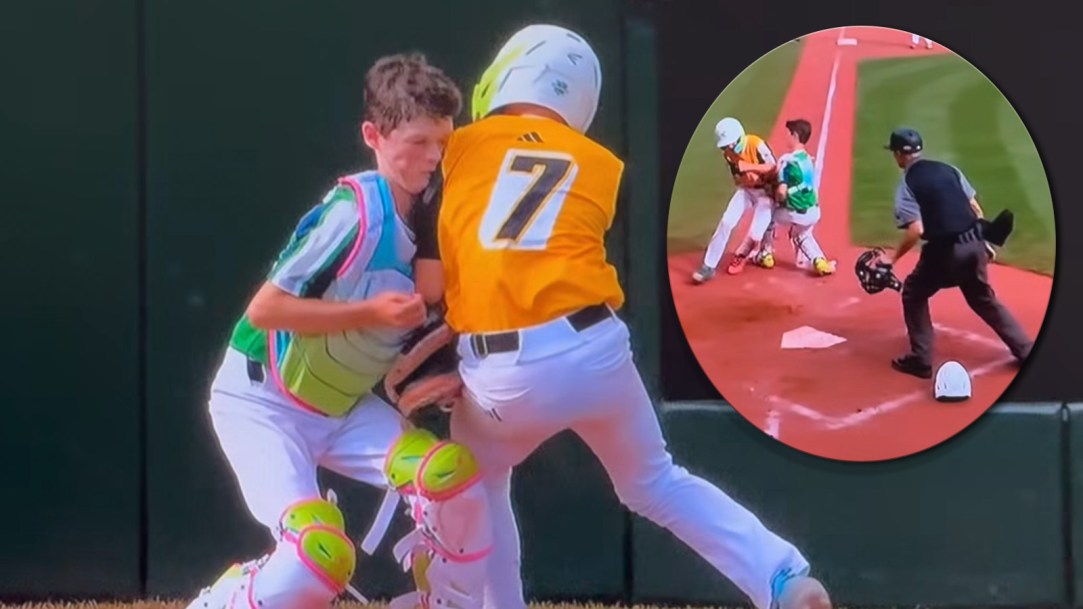
Alabama held on to defeat Washington in an elimination game at the Little League World Series but the result might’ve been even more lopsided if another run was allowed to score during the bottom of the fifth inning. The umpire ruled a high-speed collision as an out even though the catcher blocked the plate.
Did he make the right call?
There are specific rules for defensive obstruction in Little League that cover this kind of bang-bang play. The volunteer umpires in Williamsport are asked to make a judgement call that could go either way.
What is the rule for obstruction?
The current edition of the Little League Baseball Rules, Regulations and Policies refers to Rule 7.06(b) for obstruction. A defensive player may not block the runner’s path path to a specific base without being in possession of the ball. That same rule applies to catchers at home plate. They can’t block the dish without the ball.
Per Little League rules, obstruction occurs “when a defensive player hinders a runner’s progress while not in possession of the ball and not in the act of fielding a batted ball.” It can be called even when there is no physical contact. The umpire determines wether the defensive player’s positioning (or actions) hindered the runner in any way.
“When the obstruction occurs, the umpire shall call or signal obstruction. Obstruction is to be identified whether there is contact with the offensive player, or not. The umpire is tasked with assessing a value to the hit, and awarding bases accordingly.”
For a play at the plate, the catcher may legally be in the runner’s path if the catcher is in possession of the ball or is actively fielding the ball. For example, if a throw is coming home and the catcher is moving into position to receive the throw, his or her positioning is not obstruction by itself. If the catcher gets in the runner’s way before he or she has the ball, or blocks the runner from reaching home while not actively fielding the throw, the umpire may then call obstruction.
The key distinction is when and how. If a catcher blocks home plate without possession of the ball and causes the runner to either slow down or alter his or her patch, obstruction can be called. Even if the catcher receives the throw and makes the tag. If a catcher is actively fielding the throw or already has possession, it is not automatically called as obstruction. That is up to the umpire.
Little League also puts emphasis on a play at the plate being treated like any other play at any other base. The runner must attempt to avoid the defensive player when possible. Obstruction does not automatically excuse the runner. There is nuance to the call!
Did the catcher block home plate at the Little League World Series?
This uniquely specific rule came into play in Williamsport. Alabama ultimately defeated Washington by a final score of 4-2. It could’ve been 5-2. A run came off of the board in the fifth inning because obstruction was not called at the plate.
It was a huge collision.
Washington catcher Evan Yarbrough caught the throw to home just milliseconds before Alabama’s base runner made contact. He somehow managed to hold onto the ball. The runner was called out. The run was not allowed to score.
However, it appeared as though Yarbrough stepped right into the runner’s path to the plate. The umpire did not call obstruction because the runner did not try to avoid the defensive player or slide. Here is how it looked in real time and on the replay:
The call could’ve gone either way. Although it did look like Yarbrough blocked the base path before he gained possession of the ball, it also looked like he moved down the third base line to field the throw. Obstruction is not called if the defensive player is actively fielding the throw. The base runner also lowered his shoulder into the catcher.
Right decision or wrong decision, the run that came off of the board did not impact the final score. It simply creates a debate. Should Washington have been called for obstruction? Did the umpire correctly interpret the rules as they are written?
Let us know your thoughts in the comment section below!