



Lon Horwedel-Imagn Images / Jeff Hanisch-USA TODAY Sports
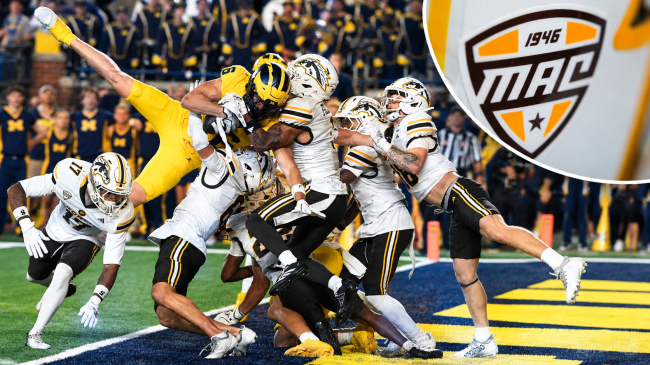
Michigan wide receiver JJ Buchanan (6) catches a Hail Mary pass for a touchdown with no time on the clock to beat Western Michigan at Michigan Stadium. A separate photo of Western Michigan's helmet is placed in the top right corner of the image.
If you thought the controversy surrounding Michigan‘s miraculous Hail Mary victory over Western Michigan was over, it’s time to think again.
After the Mid-American Conference and the Broncos initially accepted the result of the game and the Big Ten’s explanation of its replay procedure, the conference has now backtracked.
The MAC released a press conference on Tuesday afternoon announcing that it is officially appealing the result of the game on the grounds that the Big Ten did not follow proper college football replay protocols.
Statement from the MAC on the WMU-Michigan game: “it is now evident that replay protocol was not properly followed …” pic.twitter.com/XdIQBjrV01
— Ralph D. Russo (@ralphDrussoATH) September 8, 2026
The MAC Wants Western Michigan To Be Awarded Victory Over Michigan
“After further study and investigation, it is now evident that replay protocol was not properly followed in determining whether time remained on the game clock at the conclusion of the Western Michigan vs. Michigan football game,” the conference said in a statement.
“The established replay protocol requires that the game clock displayed on the program feed be used in determining whether time remained. Instead, the Big Ten Conference replay crew relied upon the clock feed embedded within its replay system. As a result, one second was placed back on the game clock, and an additional play was awarded.”
This is an important caveat. The MAC is not arguing whether or not the play was timed correctly. Because that fact is largely ambiguous, and depending on which angle of the play you watch, and which clock, you will see a different result.
Instead, the conference is arguing that the game officials did not follow the proper replay rules, which, if true, would be a simple thing to prove in an objective manner.
“This was not a judgment regarding the proper amount of time to place on the clock. It was an error in the application of the established replay protocol governing this specific end-of-game timing situation. Had the protocol been properly followed and the program-feed clock been used, no additional play would have been awarded and Western Michigan would have won the game, 12-7.
“As a result, the Mid-American Conference has submitted formal appeals to the NCAA FBS Oversight Committee and the College Football Playoff. The MAC is requesting that those bodies recognize Western Michigan as the actual winner of the game for purposes of their respective rankings, evaluations and selection deliberations and take such other corrective action as may be within their authority.”
Does The Appeal Have A Chance To Succeed?
If, as the MAC is arguing, Big Ten officials did not follow the proper protocol and incorrectly awarded Michigan an additional play, then surely Western Michigan will be awarded the victory, correct?
Well, it’s not that simple.
The result of an FBS game has never actually been overturned on appeal after the game was declared final. And NCAA rulebooks state that once an on-field referee signals the end of a game, the outcome is final.
On top of that, governing bodies do not have a mechanism to reverse a completed game’s score or official win-loss record, even when officiating or replay errors are later acknowledged.
So it’s very likely that we end up with a ruling that establishes the fact that the Wolverines shouldn’t have been given an extra play and that they keep the win regardless.
The only likely recourse, in that situation, is that the College Football Playoff Committee ranks the two teams as if the results were different than what is officially in the record book. There’s nothing preventing them from doing so. But if that ends up being the case, it would be one of the more controversial incidents in college football history, which is saying a lot.