



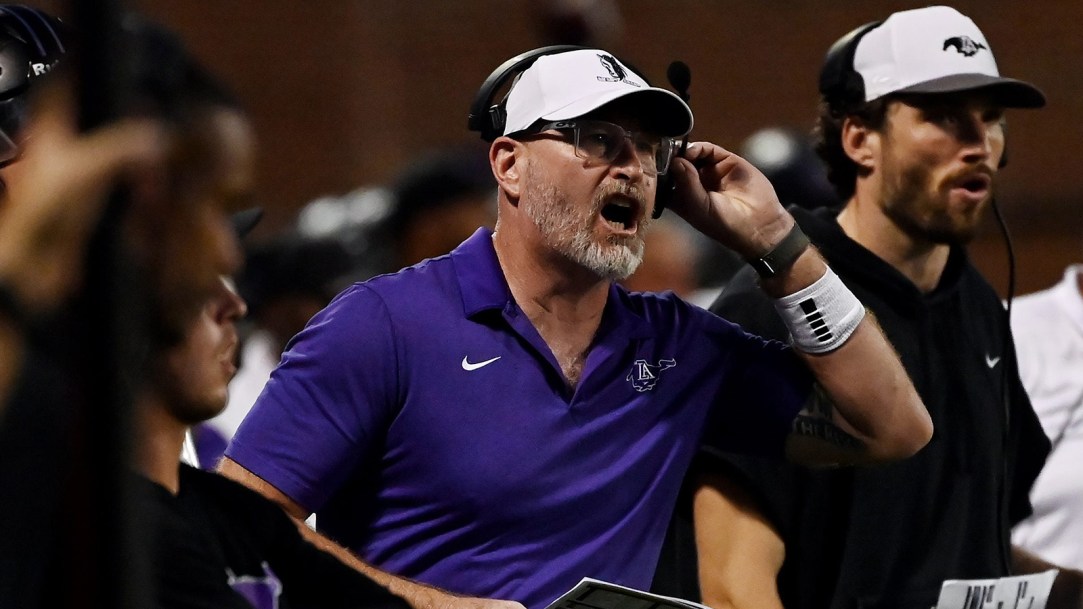
Trent Dilfer had every right to be angry with the officials during Friday’s high school football game between Lipscomb Academy and Ensworth. They were not aware of the fair catch free kick and robbed the Mustangs of three points.
Fortunately, the incorrect ruling did not impact the result.
Dilfer tried to explain the rule to the high school football officiating crew but his plea fell on deaf ears. The kick did not count.
What is a fair catch free kick?
Most simply put, a fair catch free kick is the easiest way to score points from distance if the head coach knows what he is doing. It is a unique rule that has existed in high school football and the NFL since the late 19th century. College football only (re)adopted the rule this season after a 70-year+ hiatus. There isn’t much to it.
Per NFHS rules, a receiving team that made a fair catch (on a kickoff or a punt) is allowed to attempt a free kick from the spot of the fair catch on the very next play— and only the next play. The free kick must be either a drop or place kick. It must be attempted from the exact spot where the fair catch was called. The ball cannot be moved to a hashmark or the middle of the field.
Unlike a traditional field goal, the ball can be placed on a tee. And the defense cannot rush the free kick.
If the free kick passes between the opposing team’s uprights, three points are awarded to the team that made the kick. Just like a field goal.
A free kick is not allowed if the precursory punt or kickoff goes out of bands. Nor is it allowed if the punt or kick returner does not call for a fair catch. He must call for a fair catch to trigger the ‘Fair Catch Kick.’ It must be attempted on the next play.
We saw a high school football team in Ohio use the fair catch free kick to crush its opponent in blowout fashion last season. We also saw a team in Alabama use the fair catch free kick to win the state championship in December. A team from Georgia also used the fair catch free kick to score three points from 60 yards out for one of the longest field goals in state history. It is a thing.
Trent Dilfer was not happy with the high school football referees.
After being fired by UAB, Trent Dilfer returned to Lipscomb Academy in 2026. He apparently knows more about the rules of high school football than the officials in Tennessee.
The Mustangs forced a punt with just seconds remaining in the first half. Their return man called for a fair catch.
Instead of taking a knee and going into the locker room up 28-7, Dilfer decided to extend his lead. He called for a fair catch free kick. Lipscomb Academy lined up at the 34-yard-line. Its kicker put the ball through the uprights for three points.
Weird HS football moment: Lipscomb Academy’s @TysonRobbins28 seemingly nailed this 44-yard field goal on a free kick, but it didn’t count.
— Russell Vannozzi (@RussellV_MSP) September 19, 2026
Lipscomb had just fair caught a punt at the Ensworth 34-yard line seconds before halftime.
Trent Dilfer was livid. He told me the officials… pic.twitter.com/Gm6odbliFq
However, the officials waved it off and the kick did not count.
We end the 1st Half on a missed free kick from Lipscomb
— Johnny Maffei (@MaffeiInTheMorn) September 19, 2026
Mustangs NOT happy with the call
Halftime:
Lipscomb 28
Ensworth 7 pic.twitter.com/vHMagS3oTx
Why? Great question. Dilfer said that the referees were not aware of the fair catch free kick rule. He was furious!
Lipscomb ended up winning by a final score of 49-14. The Mustangs moved to 3-2 after coaching malpractice caused a controversial overtime loss in Week 1. They keep getting better. Dilfer really knows the rules!