



iStockphoto / Rob Kinnan-Imagn Images
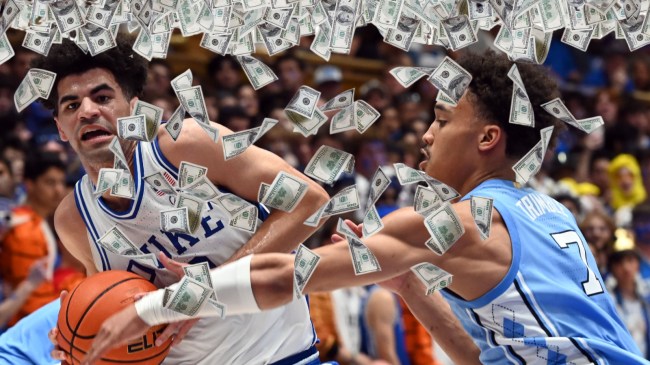
Shower of money falling over Duke and UNC basketball players
The Duke-North Carolina rivalry has spent more than a century producing hatred, heartbreak and grown adults screaming at college students. North Carolina has now found a beautiful new wrinkle: betting activity involving Duke can help create tax revenue that eventually winds up funding North Carolina Tar Heels athletics.
No, there is not literally a “Duke lost, send UNC $14” button in Raleigh. But North Carolina’s newly revamped sports-wagering formula pools taxes collected from sportsbook revenue and distributes millions of dollars to public university athletic departments, including UNC and NC State for the first time.
North Carolina Found A New Way To Make The Duke Rivalry Weird
Gov. Josh Stein signed the state’s new budget on July 7, and the changes are significant.
The new state budget raises North Carolina’s tax on sportsbook gross wagering revenue from 18% to 23% and dramatically changes where that money goes. UNC and NC State, previously excluded from the university athletics distribution, are now eligible alongside the other public schools in the UNC System.
According to the legislative analysis, UNC and NC State can each receive money through two different buckets immediately: one shared by Division I and Division II public universities and another specifically for Division I schools.
Then another pile arrives next summer.
Beginning July 1, 2027, public universities with FBS football programs get access to an additional 5.7% of the remaining wagering-tax proceeds, split among Appalachian State, East Carolina, Charlotte, NC State and UNC. That FBS portion is capped at $2.5 million per school.
Add everything together and the numbers become pretty substantial.
The official NC State breakdown says its athletic department expects about $3 million from sports-wagering receipts during the 2026-27 fiscal year and $5.8 million in 2027-28 once the FBS allocation kicks in. UNC is projected to receive the same amount under the formula.
That is real athletic-department money generated, in part, by North Carolinians repeatedly convincing themselves Duke -3.5 is free cash.
Duke Can Generate The Money But Cannot Get The Money
Here is the especially funny part.
Duke is a private university, so it is not one of the public institutions receiving these distributions.
If a North Carolina bettor wagers on Duke basketball, Duke football or basically anything else available through a legal sportsbook, that betting activity contributes to the operator’s overall business. When sportsbooks finish with positive gross wagering revenue, the state takes its 23% cut.
That tax revenue goes into one big statewide pool rather than being tracked by individual game or school, so it would be inaccurate to claim a specific $100 Duke bet directly deposits money into UNC’s checking account.
It is also completely fair to say the overall ecosystem can produce exactly that rivalry dynamic.
The more money sportsbooks make from North Carolina bettors, the larger the taxable revenue base can become. The larger that pool becomes, the more money available for the university allocations up to their statutory caps.
The fiscal estimate projects roughly $206 million in sports-wagering tax revenue for the 2026-27 fiscal year under the new 23% rate.
College sports spent decades insisting gambling needed to stay as far away from campus as possible.
We have now reached the point where a Duke fan losing a parlay can indirectly help pay for athletics in Chapel Hill.
Rivalries evolve.