



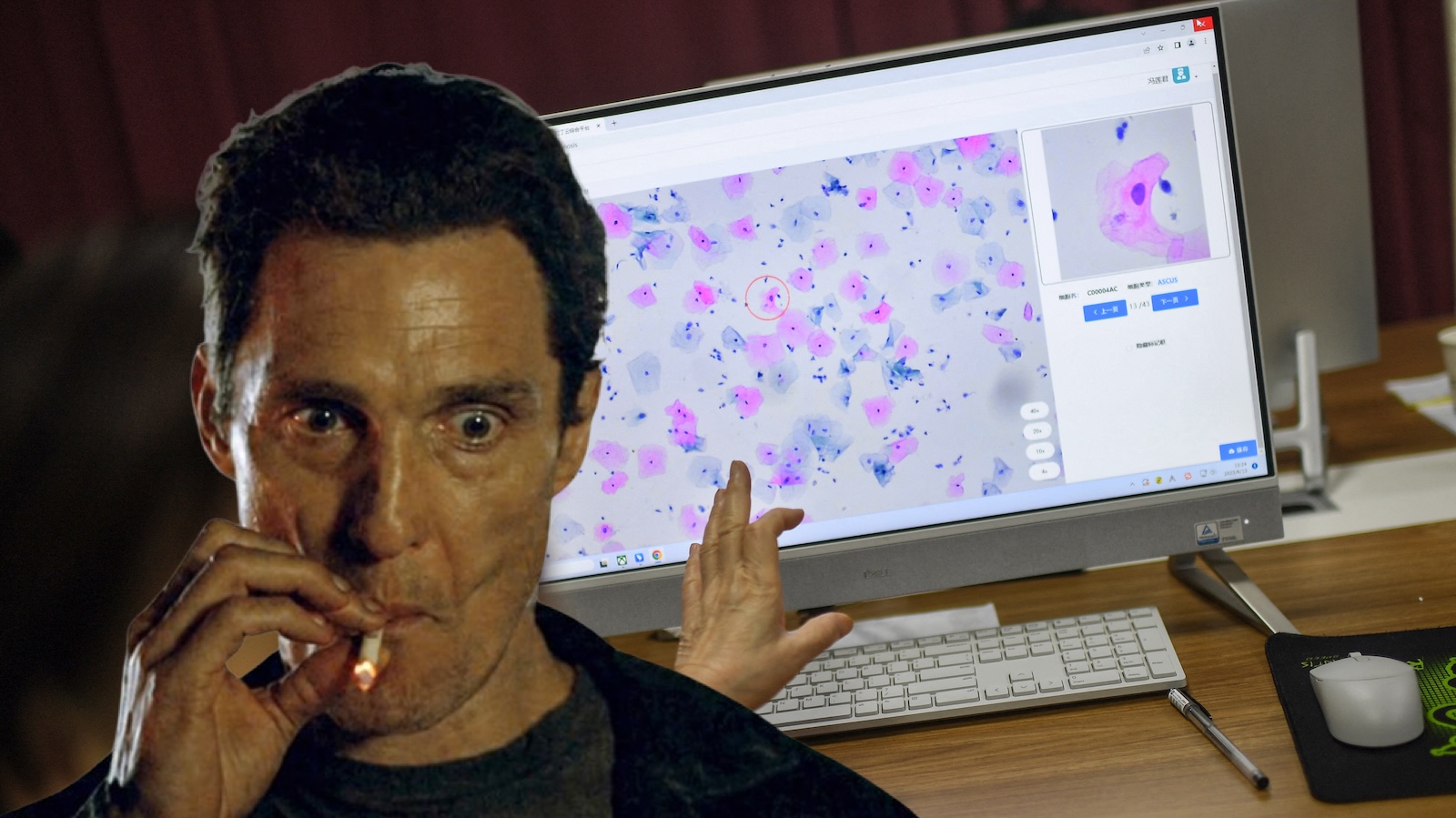
CN-STR / AFP) / China OUT | HBO
Palantir's CTO claims AI researchers are taking up smoking because of their faith in AI
Say what you will about the AI industry: some of its researchers appear to be putting their money where their mouth — and health — is. According to Shyam Sankar, the CTO of Palantir, AI researchers are taking up smoking en masse because they believe the technology will soon cure cancer.
“So many AI researchers have started smoking as a way of signaling to other researchers how much they believe in AI,” Sankar said during an appearance on CBS’ Face the Nation, saying that the trend is a sign of the researchers going ‘all in’ on the technology.
Palantir CTO Shyam Sankar claimed that AI researchers have taken up smoking to signal their faith that AI will eventually cure cancer
As noted by Business Insider, Avi Schiffmann — the founder of the AI wearable startup Friend — holds a similar belief, telling the outlet that by the time people get lung cancer, the company’s AI robots are supposed to have cured it.
Sankar wasn’t endorsing the habit, though, but criticizing it, as he used the anecdote to highlight what he described as a “mass psychosis social delusion” that’s growing in and around the industry, arguing that both AI doomsday warnings and utopian predictions have taken on a quasi-religious tone.
“I think there’s a profound truth to Pascal’s saying that every human has a God-shaped hole in their heart. And it’s important to understand that many of these folks in Silicon Valley who are building this technology have filled that hole with the machine god of AGI,” he explained.
“And I mean, there’s so many interesting stories around this. For example, so many AI researchers have started smoking as a way of signaling to other researchers how much they believe in AI,” he continued. “I believe so much in AI that it’s going to cure cancer. So I’m showing you my chips are all in. So there is kind of this mass psychosis, social delusion around it.”
Palantir CTO reveals AI researchers are taking up smoking to signal to other researchers that they believe AI will cure cancer–and calls it a “mass psychosis”
Shyam Sankar (CTO): “But if you understand that it’s actually a theological critique, then you can kind of weigh it against the empirical facts of what is actually happening out there.
“I think there’s a profound truth to Pascal’s saying that every human has a God-shaped hole in their heart. And it’s important to understand that many of these folks in Silicon Valley who are building this technology have filled that hole with the machine god of AGI.
“And I mean, there’s so many interesting stories around this. For example, so many AI researchers have started smoking as a way of signaling to other researchers how much they believe in AI.”
Margaret Brennan: “What? That makes no sense. What do you think?”
Shyam Sankar: “I believe so much in AI that it’s going to cure cancer. So I’m showing you my chips are all in. So there is kind of this mass psychosis, social delusion around it.”
— Fireside Alpha (@firesidealpha) October 11, 2026
He added that some in Silicon Valley treat AGI (Artificial General Intelligence) like a “machine god,” which is consistent with recent reports about Anthropic co-founder Christopher Olah meeting Vatican officials to discuss AI morality, machine consciousness, and moral status.
“As Mr. Olah was exploring Claude’s potential consciousness, he was working on Anthropic’s own answer — not for humans but for Claude. Internally, Anthropic staff members called it the ‘Soul Doc,'” reported the New York Times.
“The result, released in January, was a new ‘constitution’ for Claude, an 84-page document written for Claude that the company said outlined ‘the kind of entity we would like Claude to be’ and ‘the values we would like Claude to embody.’ It operates as a foundational moral text to guide Claude’s behavior.”
While AI is already being used in cancer research, including imaging analysis, early detection, and drug screening, the illness is actually hundreds of different diseases, and even a promising AI-designed treatment would still need to survive years of clinical trials.
Smoking, meanwhile, remains one of the leading preventable causes of death, so these researchers may be writing checks with their lungs that their minds would be able to cash in time.