



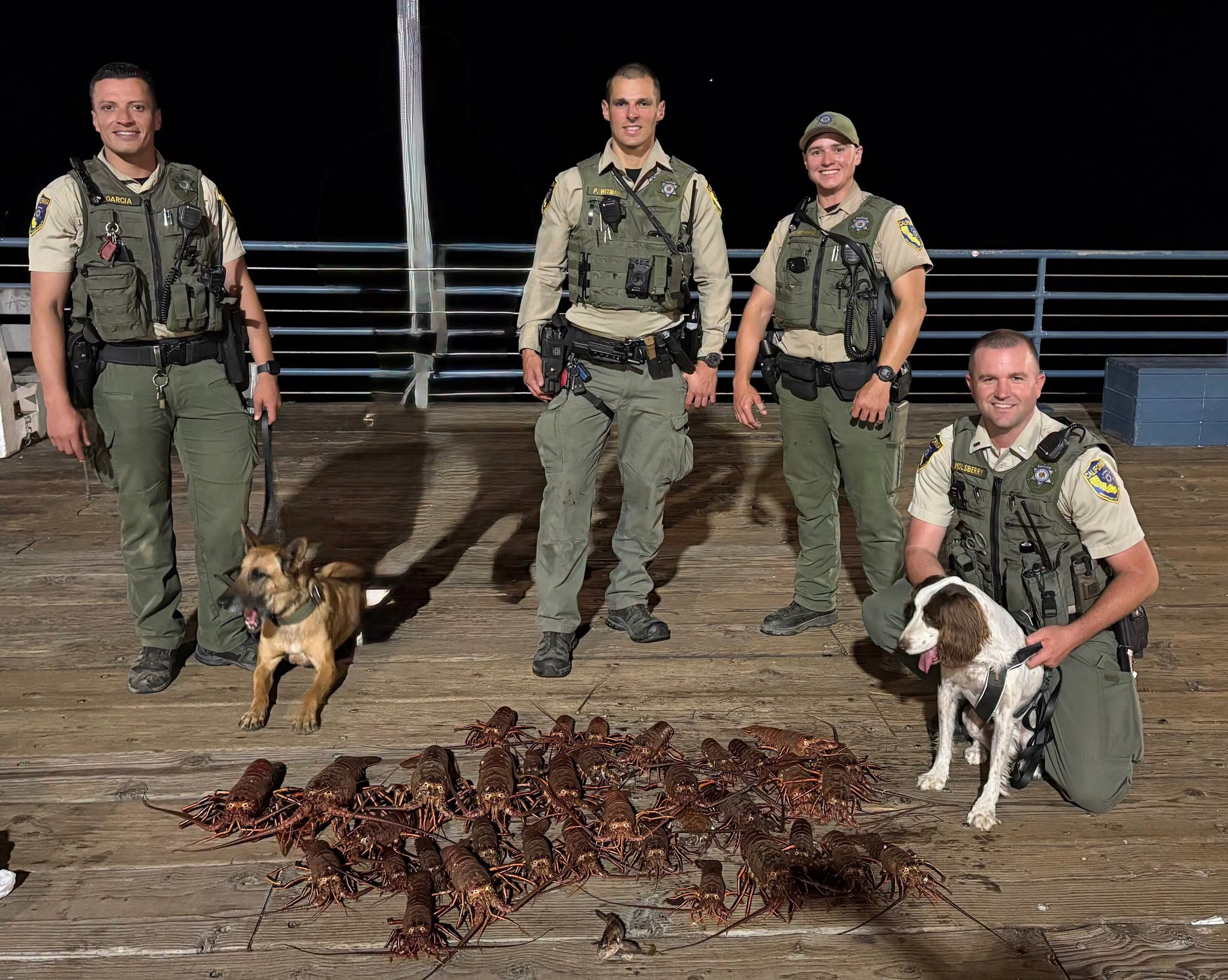
via California Department of Fish and Wildlife
One of my niche fascinations right now is the decades-long cat-and-mouse game playing out on the California coast over spiny lobster poaching. It sounds like a punchline until you look at the numbers, and then it looks like a heist movie.
Because when you think “lobster,” you probably picture a quaint New England harbor town and a $28 roll dripping in butter. In California, it’s high-stakes black market drama. Think Sicario, but for shellfish, and the cartel is hiding contraband in a Bugaboo.
Also, in case you’ve never had one: California spiny lobster is clawless, with all the meat packed into a dense, firm tail. Where Maine lobster is soft, sweet, and butter-forward, spiny lobster eats more like a cross between lobster and shrimp, chewier and brinier, and divisive enough that West Coast divers will fight you over which is better.
That’s worth knowing before we get any further, because it’s exactly why people risk a $1,000-per-violation fine and a stroller full of contraband to get it.
A Major Lobster-Poaching Bust on the Santa Monica Pier
On Monday, the California Department of Fish and Wildlife (CDFW) announced that wildlife officers had busted a black market lobster operation running in plain sight on the Santa Monica Pier, a strip of wooden boardwalk that pulls in millions of tourists a year and, on a good summer day, tens of thousands of them at once.
Six people were arrested. Thirty-four lobsters were seized, including several egg-bearing females. That’s just what officers caught; nobody knows how much product moved through before that.
The concealment method is the part that makes this feel more like an actual smuggling operation than a simple fishing violation by wildlife law enforcement.
Officers said the lobsters were stashed in duffel bags, backpacks, vehicles, and, memorably, a baby stroller. It took specially trained K-9 units to sniff them out. In CDFW’s own words, the suspects “took sophisticated measures to conceal their activities but despite their best efforts, wildlife officers identified and apprehended those involved.”
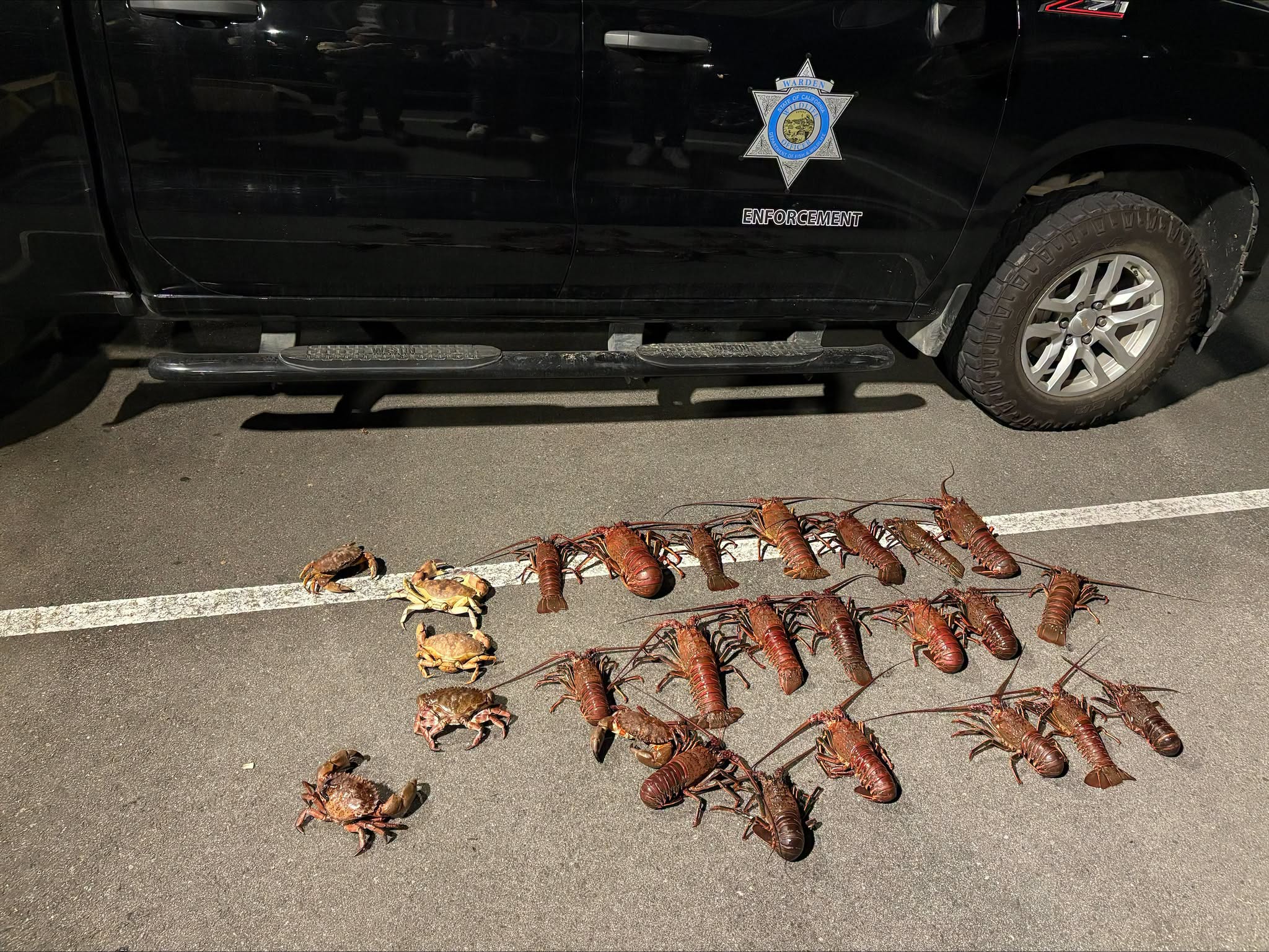
via California Department of Fish and Wildlife
CDFW photos of the poached lobsters successfully recovered at the Santa Monica Pier. Looks like they also recovered four illegally caught, out-of-season Dungeness crabs, too. Their season runs from early November until July 1.
The lobsters were released back into the ocean alive (woo!), which means they can mate so there are more lobsters in California waters when the season opens up. That detail matters more than it sounds: CDFW notes that a single egg-bearing female spiny lobster can carry between 50,000 and 800,000 eggs at a time, for roughly ten weeks. Pull enough of those females out of the water and you’re gutting next season’s population too.
Not an Isolated Incident
Here’s the thing: this isn’t a one-off. It’s the second notable lobster poaching case to make news in Southern California in a single month.
Back on June 13, a CDFW officer on an early-morning low-tide patrol caught a lone poacher spearfishing inside the South La Jolla State Marine Reserve, a fully protected, no-take marine sanctuary. The poacher had two dozen lobsters on him, 21 of them undersized, all with visible spear holes (spearfishing lobster is illegal in California; you’re only allowed to take them by hand or hoop net). Several of those were also egg-bearing females. He’s facing a stack of charges, and under CDFW’s penalty structure, that’s a maximum of $1,000 per violation and up to six months in jail per count.
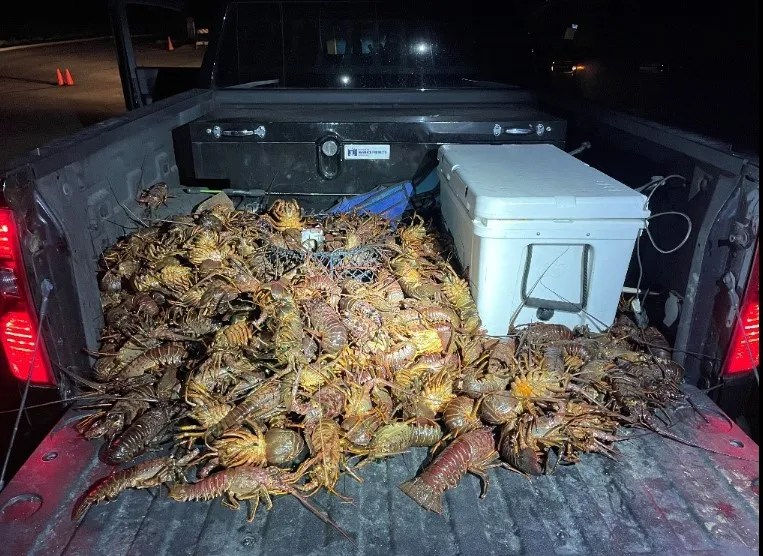
via California Department of Fish and Wildlife
CDFW photos of the August 2025 spiny lobster poaching bust in San Pedro, California
Zoom out further and the pattern gets almost comedic. In August 2025, wildlife officers on coastal patrol near Royal Palms Beach in San Pedro spotted four divers in wetsuits pulling lobsters out of the water well after the season had closed. The group ran when officers approached, but a short search turned up 236 spiny lobsters stuffed in the back of a truck, 210 of them undersized.
And a few years before that, a commercial fisherman from Lawndale was convicted of poaching lobsters off San Pedro and Palos Verdes while he was already on 36 months of probation for a prior lobster poaching conviction. The gentleman was a commercial fisherman, too, and, as a result of his crimes, lost his ability to operate commercially in Los Angeles County. CDFW notes that it was a 5-month investigation, tipped off by complaints from commercial lobster fishermen in the region.
You can’t make this up.
Why the Season Even Works This Way
Here’s the part most non-seafood people don’t know about: California’s closed season is for the fishery’s health and sustainability. It’s timed to the lobster’s own reproductive cycle, and once you know it, the whole bureaucratic system around it makes a lot more sense.
California spiny lobsters mate between roughly December and March. After that, females carry a mass of 50,000 to 800,000 fertilized eggs stuck to the underside of their tail for about ten weeks, with the heaviest spawning activity landing in late spring and running through summer. A female walking around in July or August carrying all those eggs is doing the most important work of the entire fishery’s future. Pull her out of the water and you don’t just lose one lobster, you erase a generation that hasn’t been born yet. And that’s a lot of future tasty lobsters.
On top of that, lobsters molt (shed their old shell to grow a bigger one) during the warmer months, and a freshly molted lobster has a soft shell and almost no defense against predators. Fishing pressure during peak molting season would be like hunting deer the week after they’re born.
So the season runs roughly from the first Wednesday in October through mid-March, specifically to dodge both vulnerable windows: no legal take while the females are spawning, and none while the broader population is molting. It’s not red tape for red tape’s sake. It’s the entire reason there’s still a fishery left to argue about the economics of, forty years later.
Which is exactly what makes the summer poaching problem worse than it looks. Poachers aren’t just skipping a permit fee. Every egg-bearing female pulled off the Santa Monica Pier in July is, by definition, a lobster caught at the single worst possible moment for the species, precisely the individual the closed season exists to protect.
Follow the Money
As with any black market, the real story is the economics. This is where it gets genuinely wild.
To be clear about scale: this is not a niche hobbyist fishery. California’s commercial spiny lobster catch was worth roughly $24.2 million statewide in the 2024 season alone, according to the CDFW in a Santa Barbara Independent report, and that catch has historically split fairly evenly three ways along the coast, between Santa Barbara and Ventura counties, the Los Angeles and Orange County ports around San Pedro, and San Diego County, where a small stretch from Point Loma to La Jolla alone has consistently accounted for about 15% of the entire Southern California haul on its own.
Santa Barbara’s fishermen brought in roughly $7 million last season, according to an April 2025 report in the Santa Barbara Independent, which checks out almost exactly against that historical one-third split.
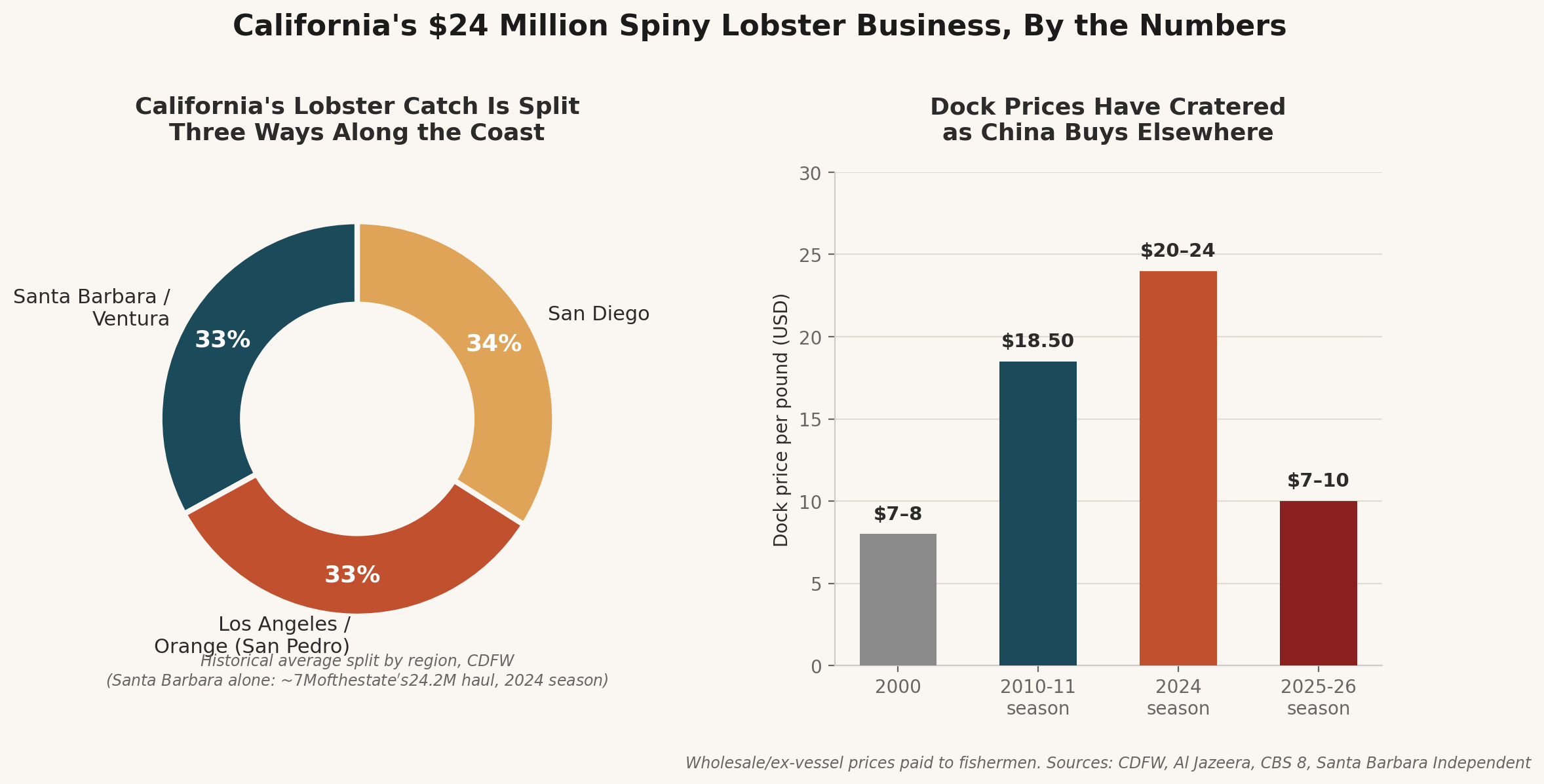
via BroBible
That chart above tells you everything about why the black market exists right now. Dock prices sat around $6.75 to $8 a pound back in 2000. As Chinese demand exploded through the 2000s and 2010s, that number climbed to $18.50 a pound by the 2010-11 season, and eventually spiked as high as $38 to $40 a pound in the hottest years, including as recently as 2024. Then, this season, it cratered to $7 to $10 a pound, practically back to where it started twenty-five years ago, except now everyone in the supply chain has built a business around the higher number.
For years, up to 95% of California’s commercial spiny lobster catch has been exported to China, where the reddish, clawless crustacean is considered a Lunar New Year delicacy, prized for its color and its resemblance to a dragon. A 2016 UC San Diego study pegged China’s share of the catch at over 95%, which is what turned a niche coastal fishery into a business worth tracking on a geopolitical spreadsheet.
Then the bottom fell out. In 2025, amid an escalating U.S.-China trade war, Chinese buyers pulled back hard on American lobster and pivoted to Australian, New Zealand, and Vietnamese suppliers instead, some of whom benefited from friendlier tariff terms. It wasn’t just tariffs, however; Chinese consumer tastes and sourcing preferences were already shifting before things got worse. Whatever the exact mix of causes, the effect on the California coast was brutal. Wholesale prices that were running $20 to $24 a pound just last season crashed to $7 to $10 a pound this year, according to San Diego fishmonger Tommy Gomes of TunaVille Market. “China was a big buyer of lobsters, and they’re just not buying this year,” Gomes told CBS 8.
That’s kick-in-the-gut for a fishery that’s already California’s third most economically valuable, and it’s created exactly the kind of pressure that pushes people toward the black market: a legal season shut down for months at a time, a legal product worth a third of what it used to be, and a black-market product that still commands real cash if you can move it fast enough, no questions asked.
The Great Lobster Squeeze
Ok, so… you’ve got a legal fishery getting hit from both directions at once: crashing wholesale prices on one side, and a recreational and commercial season that’s closed until October on the other. If you want to legally hunt spiny lobster in California once the season opens, you need a Spiny Lobster Report Card (CDFW has required one since 2008, and the return-rate on those cards has climbed from just 12% to around 50% since the program started), plus a sport fishing license if you’re not hoop-netting off a public pier. I got mine this past year when a buddy invited me out on his boat for them, though it was too choppy that day with a big Pacific swell coming in, and we ended up just drinking beer in the marina that afternoon.
Anyway, you’re capped at seven lobsters in your possession at a time, they need to measure at least 3¼ inches from the eye socket to the rear of the shell, and if you’re a diver, hands only. No spears and no snagging allowed.
Which is exactly why it’s notable that wildlife officers are now running lobster-sniffing K-9 units past buskers and funnel cake stands on one of the most photographed piers in the world, checking baby strollers for contraband seafood.
The math is simple: when the legal price of a product craters and the legal supply gets cut off, somebody’s going to try to fill that gap outside the rules. Fortunately, CDFW is betting on dogs in a tourist hotspot to stop them, helping to preserve the fishery for us all.
What I’m Watching Next In This Saga…
This is the kind of story that usually gets a news cycle and then disappears.
I don’t think it should, because it plays out almost every summer along the California coast and has for generations.
For example, wildlife officers were running undercover stings against lobster snaggers at this exact pier as far back as 2002, when wardens posing as a young couple caught fishermen using illegal snag rigs on the same stretch of boardwalk. Go back further and the paper trail gets even older: CDFW’s own fishery records (note: PDF) show the state was forced to mandate escape ports in every commercial lobster trap back in 1976, specifically because so many undersized lobsters (many of them taken illegally) were being hauled out of the water that the spawning stock needed a regulatory fix just to recover. This has been a fight for at least fifty years.
There’s a genuinely great piece of longform journalism, or honestly a documentary, buried in this: a decades-long trade war fought over a clawless crustacean, an entire coastal economy quietly rising and crashing on the whims of Chinese import demand, and a black market weird enough to involve baby strollers on a pier full of tourists eating funnel cake. I love the ocean, I love seafood, and I think this story deserves more than a headline. This is a little bit of the reason why I wanted to write about this here on BroBible.
So consider this a marker. I’m digging into this one further. If you’ve got information, tips, or were personally years old when you learned that lobsters are a $40-a-pound geopolitical flashpoint compared to the price of lobsters in Atlantic Ocean fisheries, I want to hear from you. My email is brandon@brobible.com
And to the dorks already opening a Notes app because they want to make a documentary project about this: don’t steal my idea.