


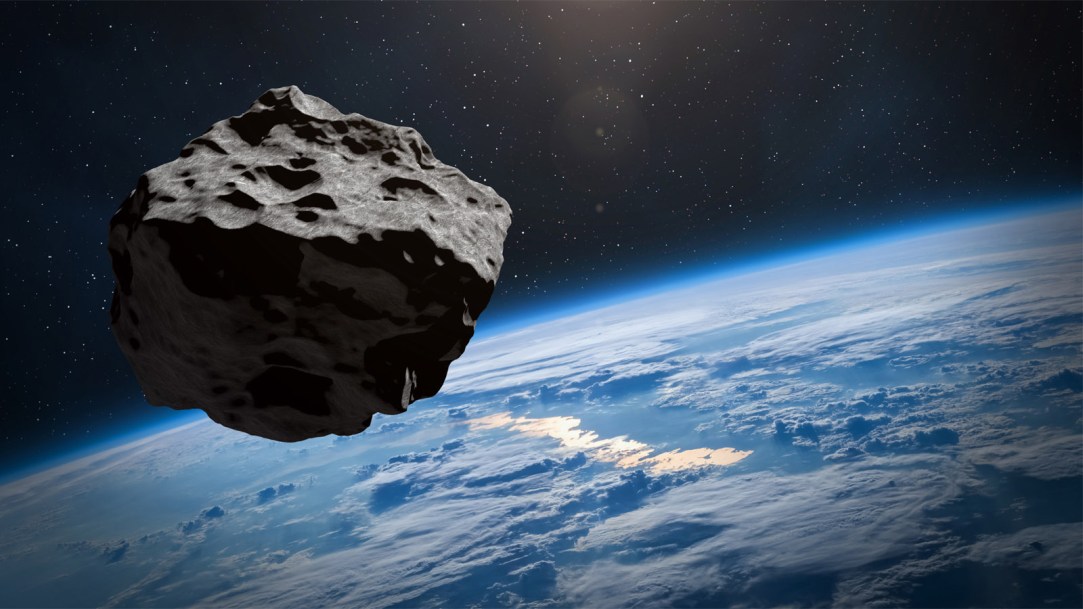
Earth has a second moon now. Unfortunately, it’s not nearly as impressive as the one we’ve been looking at for billions of years.
Astronomers have confirmed that a space rock called 2026 QQ8 has been temporarily captured by Earth’s gravity, making it what scientists call a mini-moon.
The space rock is estimated to be only between three and six feet across, depending on reported size estimates. So it’s not something you’re likely to notice when you look up at the night sky.
According to Space.com, Earth actually captured the asteroid back in April. Nobody discovered it until August. Then, the International Astronomical Union’s Minor Planet Center officially announced its discovery on October 29.
And just like that, Earth has another moon. At least for a little while.
Earth’s New Mini-Moon Was Originally Mistaken For Space Junk
Hungarian astronomer Krisztian Sarneczky first spotted 2026 QQ8 on August 20 while observing the sky from the Piszkesteto Observatory in Hungary.
Initially, scientists weren’t sure whether the object was a natural asteroid or just another piece of discarded rocket equipment. Additional observations using telescopes in Arizona and Hawaii helped researchers determine that the object was most likely a natural space rock.
The Daily Galaxy reports that 2026 QQ8 follows an unusual looping path around Earth, coming no closer than about 353,000 miles. That’s roughly 110,000 miles farther away than our regular Moon.
Scientists believe this space rock approaches Earth approximately once every 10 years. This time, however, it got close enough to become temporarily trapped by our planet’s gravity.
It won’t stay there, though. Researchers expect 2026 QQ8 to escape Earth’s gravitational influence around late December or early 2027 and resume its orbit around the Sun.
Earth Has Had Temporary Moons Before
Despite the interesting nature of the discovery, Earth capturing small asteroids isn’t particularly uncommon. Scientists have actually identified other temporary mini-moons before, including 2020 CD3 and 2024 PT5. Researchers have even suggested Earth could have several tiny mini-moons orbiting it at any given time without anyone noticing.
Meanwhile, humans are still trying to figure out what to do with the much larger Moon that we have had for millennia.
NASA has been developing plans to build a permanent lunar base, and one company has even proposed installing streetlights on the lunar surface. Scientists have also floated the idea of building a doomsday vault on the Moon to preserve biological material in case of a catastrophe on Earth.
As for our newest moon, there’s no need to start making any plans. It’s too small to see without powerful equipment, poses no known threat to Earth, and will be gone before we know it.