



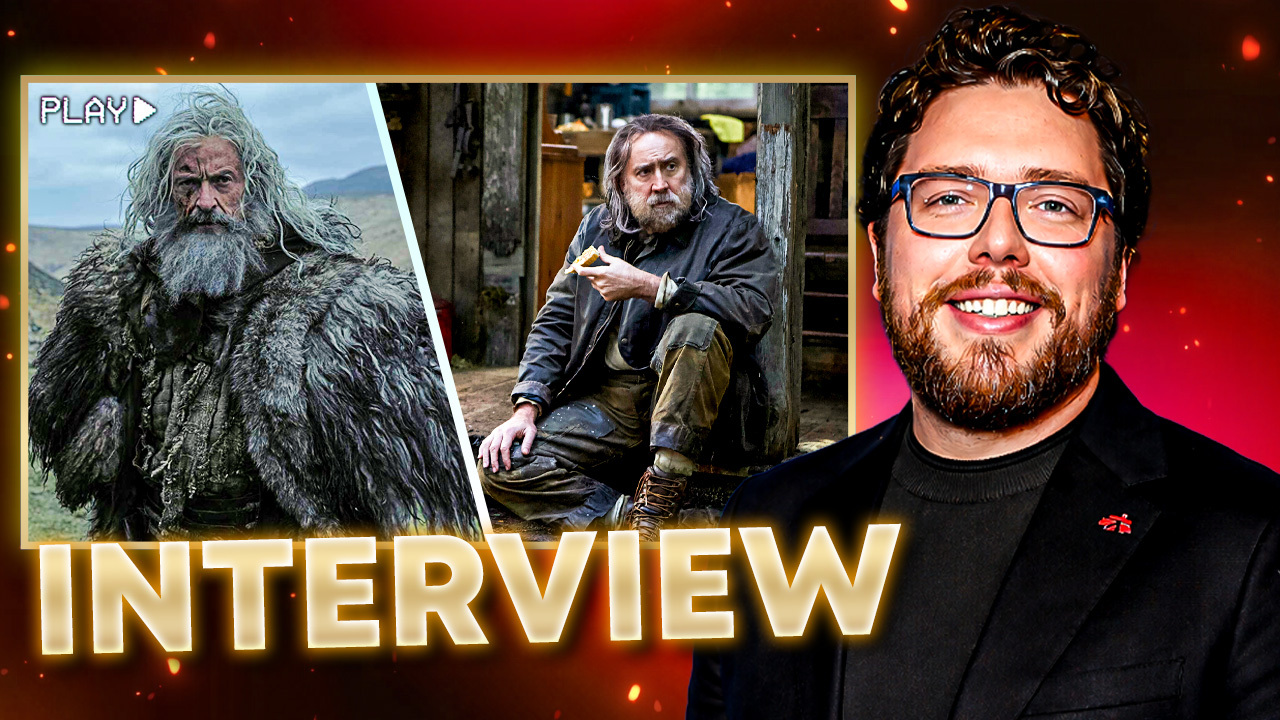
Getty Images/A24/Neon
'Pig' director Michael Sarnoski talks with BroBible about 'The Death of Robin Hood'
Some filmmaker take decades to define their singular thematic style. Writer and director Michael Sarnoski has pulled it off with just three movies.
Between Pig, A Quiet Place: Day One, and his latest film, A24’s The Death of Robin Hood, Sarnoski has established himself as a creative force that not only has something to say, but knows how he wants to say it.
Whether it’s a story of a man reckoning with his grief after the loss of his truffle pig, two strangers navigating the end of the world after an alien invasion or a legendary warrior reckoning with his life as he approaches death, Sarnoski’s films are expertly imbued with a sense of silence, solitude, and stillness, yet are still able to mine thrive in moments of warmth and longing.
Speaking to BroBible’s Post Credit Podcast ahead of the release of The Death of Robin Hood, Sarnoski broke down his affinity for the source material, being the latest director to kill Hugh Jackman, the notion that Pig reinvigorated Nicolas Cage’s career, and his experience working with Oscar winner Lupita Nyong’o.
How he deconstructed the myth of Robin Hood without trivializing the legendary story
Eric Italiano, BroBible: I am thrilled to be joined by the writer and director of THE DEATH OF ROBIN HOOD, which hits theaters on June 19th. Thank you for your time today.
Michael Sarnoski: Thank you for having me.
EI: How do you deconstruct a myth without trivializing it or stripping it of its core parts that made it a myth to start with? And where was that tension found most in this film?
MS: I think the two main ways would be — one, my main goal was just to think about what the life of a medieval bandit outlaw would have been like. What did it feel like to live at that time? What would these spaces feel like, these interactions, this storytelling from their perspective?
And then the other thing was going back to the early Robin Hood ballads. A lot of things we associate with Robin as fundamental to his character were added much later. Even “Steal from the Rich, Give to the Poor,” the Crusades, Richard the Lionheart — a lot of that really didn’t come out until centuries later. So going back to these early brutal ballads — and they were still whimsical in their own way, but these stories were violent. He’s chopping off people’s heads and wearing them into town.
And then you have to think: if those stories came out 300 years after Robin theoretically existed, they would have been romanticized in their own way too. So let’s go back to just the fundamentals. If you read what actually happens in them, it’s like — dang, these are pretty rough.
A lot of it was trying to get back to some of the early authenticity and strip away some of the cultural meaning and get back to the basics of that human being — and then think about what he would feel about these stories that have become grander being told about him.
Why Hugh Jackman was the perfect fit to play a dying Robin Hood
EI: The one tasked with doing that, and who I thought did an absolutely incredible job, is Hugh Jackman. What specifically did he bring to this role that made you want to cast him?
MS: I knew he could do the aggression and the action side — that was a given. And I don’t mean to make light of that. He’s incredible at that stuff, and we couldn’t have shot this movie — we shot it in 30 days — without him being so on top of it. But for me, it was actually his intelligence and curiosity that struck me.
The first time I sat down with him, when he talks to you, he makes his entire world about you. He’s observing you, and it comes from a very warm human place. But I think he managed to use that as a weapon for Robin. Robin is constantly assessing everyone around him — assessing them for lies, assessing them to see if they’re believing his lies. He needs to be the sharpest person in the room. And then when he meets the prioress, he kind of meets his equal. They see through each other in ways they’ve never been seen through before.
I really needed to feel like he was clocking all of that, and that was something I was genuinely impressed by. He brought it to the character in a way I had hoped for, but beyond what I ever could have imagined.
How to maintain suspense and tension in a story when the audience knows where it’s going
EI: Was THE DEATH OF ROBIN HOOD always the title?
MS: Yes, always. It’s a nod to the original ballad — “Robin Hood’s Death” — but there’s a book I had as a child where that chapter was called ‘The Death of Robin Hood.’ It just stuck with me. That came before the first page.
EI: When you start from that title — that endpoint — how do you build suspense and subvert expectation when the audience knows not just where this is going in plot, but probably in theme too?
MS: It really becomes a movie about the *how*. Yes, he’s going to die — but how is that going to happen, and what’s it going to mean to the characters and to the audience?
It also becomes a question of Robin’s character. At the beginning of the movie, he’s asking the same questions the audience is. He wants his “right death” — to die in battle, through violence, the way he’s lived. And then it becomes this journey of discovery: maybe his right death is different than what he expected. As we take the audience through that journey, he’s going through it too.
What interested me so much about the original ballad as a kid was: you read all these grand adventures of Robin Hood, and then you get to this story of a human being’s death that is so quiet and simple. And it’s like — wait, how did we get from there to here? How does this man of violence die in such a quiet, sensitive way? That paradox was what I wanted to explore.
That’s part of why I was excited about the beginning being so violent. Let’s take it as far as we can in that direction — and then see how far we can go in the other direction and still make it feel natural to this character. Start brutal, dark, rough — then get as quiet and sensitive and serene as possible and make that transition work. It was the fun challenge of the writing, and on a deeper level, it was the thing I wanted to make sense of as a child.
The sense of solitude, stillness, and surprising warmth that defines his films so far
EI: Across all three of your films there’s a real atmosphere of silence, solitude, and stillness. And I find that although there’s loneliness and anguish in them, there’s also a warmer sense of serenity. What’s up with that?
MS: [Laughs] I think I’m interested in diving as deeply as possible into the dark side of life, into the bleakness. I don’t want to shy away from that, because that’s something we all have to deal with. We all die, our loved ones all die. But we have to find a way to get through those things — not by ignoring them, but by integrating them with the beautiful side of life.
Part of what appealed to me about Robin’s world was that I could explore that through this specific moment in time. How connected to nature people were back then — it gave them access to both this intense brutality and violence of nature, and a deep, transcendent spirituality. Two sides of the same coin.
I want to find ways to encourage people to look at others, look inside themselves, find empathy and connection. There are ways to get through the darkness without discounting it — and still find the beauty in it. I think that’s something we all want and need to do.
What it means to him that Nicolas Cage crediting PIG with reinventing his career
EI: PIG — the ending is one that pops into my head a few times a year. When I interviewed Nicolas Cage, he said unprompted that he calls you “Archangel Michael” because you were — and I’m quoting him — “the person he was waiting for who was going to bring something along and reinvent” him. What was the thought process behind casting him, and what does that legacy mean to you — both the fact that Nick and film fans at large seem to identify *Pig* as the project that brought him back?
MS: I’m honored and really happy we could do something like that together. But I think it would have happened one way or another eventually. He’s an incredible actor who’s gone through so many cycles — if it wasn’t PIG, some movie would have reminded people: oh yeah, he can be a really quiet, serious actor.
The intention was never to reinvent Nick Cage’s career. It was just: let’s find an actor who connects to this character deeply and understands them. We sent him the script on a whim — is he even going to want to do something like this? And he responded to it on such a deep soul level and had so much more to bring to that character. It was just an obvious choice.
I never write scripts for actors. I want to make the character feel full and then find someone who understands it deeply. That was just Nick, 100%, on that project.
If you try to make art from the other side — let’s intentionally subvert something, let’s create some meta-narrative around it — that’s not fun, because you don’t have that much control over it, and I think people can see through it. You have to do it from an authentic place of love and wanting to explore something creatively.
EI: The ending of PIG is one of my favorites of the last ten-odd years. What do you remember most about shooting it?
MS: That movie we shot in 20 days, so we only had time to do like two takes. You’re trying to do this paced-out, gradual ending — quiet and emotional — and you’ve only got two days to shoot in this cabin. You’re always against the gun.
What I remember is being so nervous about getting it done, and then seeing Nick do it — and this hush coming over set. This moment of: *oh, this is why we do it.* That’s the incredible thing about actors who are such pros and have been doing it for so long. Among the chaos, once that camera starts rolling, they find this peace and this focus.
Watching Nick take his boots off and do his thing — telling him to take his time — and seeing him find this quiet emotional thing among the chaos. On the day, I was just blown away. Like: okay. *It’s okay.* We’ll get our stuff done. This is what it’s about.
His experience working with Lupita Nyong’o on A Quiet Place: Day One
EI: You’re three for three with world-class actors. We spoke about Hugh, we spoke about Nick — I’d love to ask about Lupita and what your experience working with her was like.
MS: Lupita was incredible. What I most remember is her intense commitment to the physicality of the character. Yes, we’re making this invasion movie where we’re running around in the streets — but there was always this honest conversation about: this is a *dying* person. And she leaned so hard into that. Constant pain and weakness while still finding this deep, profound strength in the character.
Tracking her deterioration, and also the weird opening up of the spiritual and emotional side of the character as she’s physically deteriorating — that’s a really hard thing to do when you’re shooting out of order with set pieces flying at you. She had such profound focus on that.
And a lot of it came from how studious she is. She goes through the script in so much detail, asks so many good questions, and if you don’t have a good answer, she will call you out. “No — that doesn’t track.” She held my feet to the fire on understanding where Sam was throughout. I love an actor who’s going to ask the questions they need and won’t take the easy answers. She was incredible, focused, and so smart.