



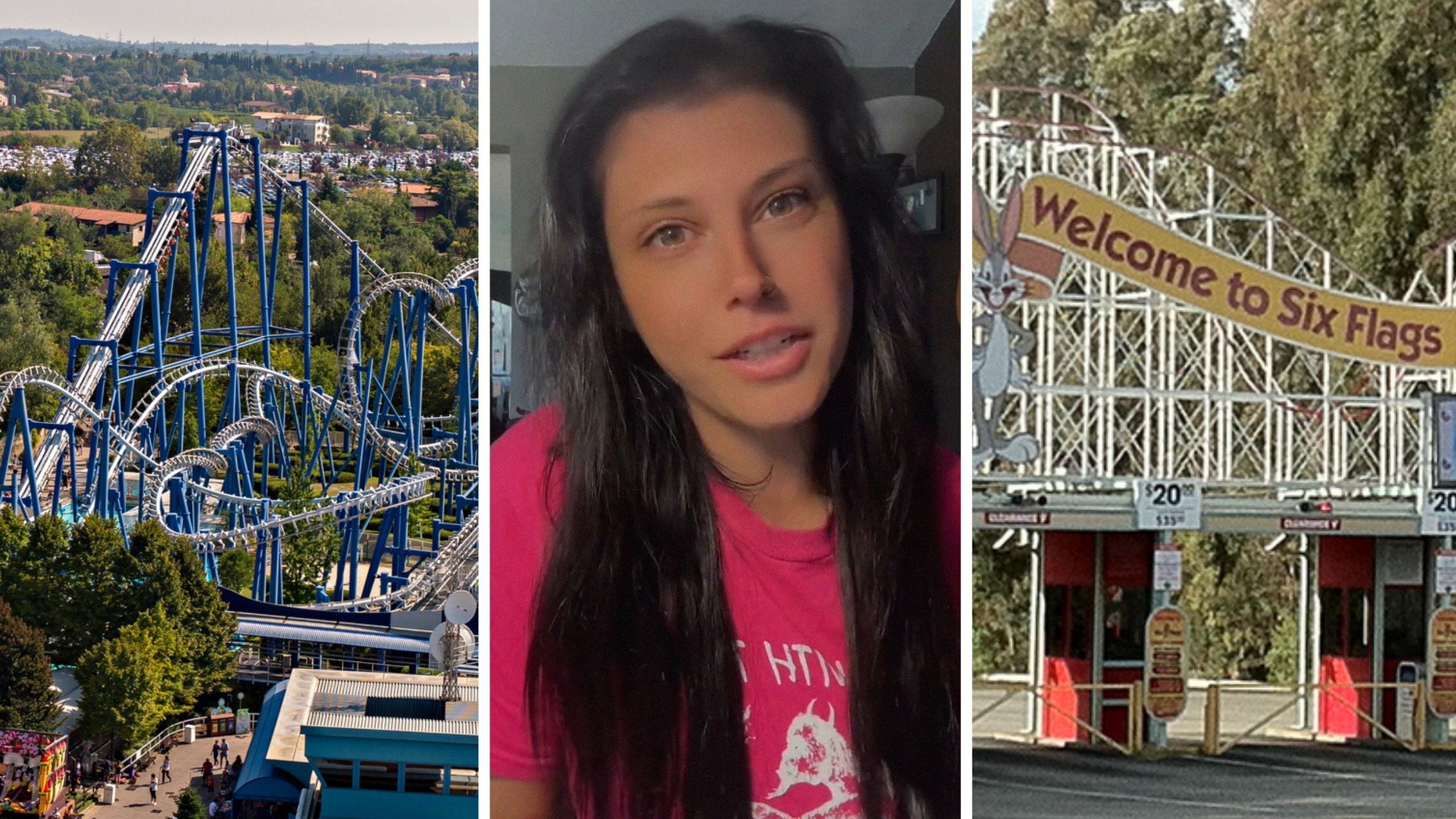
Via iStockphoto / @officialkarlyc TikTok
A former Six Flags worker says she has a theory about what could have cause the ejection and death of a rider.
On Oct. 12, 2026, a man died after being ejected from a roller coaster at Six Flags Over Georgia.
According to the Cobb County Police Department, Hassan Jihad Ibn Kariem, 42, was riding a coaster named Goliath when he was somehow ejected from his cart. He struck other passengers before landing underneath the attraction, eventually passing away from his injuries.
The exact cause of Kariem’s ejection is unknown. However, many are speculating about whether the ride’s restraint system may have played a role.
One former Six Flags worker says that she has her own theory.
Former Six Flags Employee Offers Insight
In a video with over 3.1 million views, TikTok user Karly (@officialkarlyc), who says she previously worked at Six Flags Great Adventure in New Jersey, explains why she’s uncertain about whether the restraint opened during the ride.
“I have seen the picture going around of that man falling out of Goliath with some pretty insensitive comments,” she starts. “So I’m going to give you my two cents on what happened.”
In her video, Karly says that she recalls going through roller coaster safety training while working at Six Flags. During this training, she says she learned something concerning about roller coaster safety mechanisms.
“There’s a locking mechanism, and as long as the restraint is locked—not secure, locked—that ride will leave the station,” she says. “Everything will show an ‘All clear,’ and the train will go to the lift hill, go to the launch, whatever it is.”
“It doesn’t see that there is a heavy person on this ride. It just knows that all the lap bars are locked, and it’s ready to go,” she continues.
How The Restraint System Works
According to Karly, a roller coaster’s restraint can lock into different positions depending on the size of the passenger. However, just because a passenger is locked in, that doesn’t mean they are secure. In fact, she says that she personally saw instances where someone was in a seat but took effort to be correctly restrained.
“I have been at the park many times where it has taken two or three attendants of the ride jumping on either the over restraint or the lap bar to get it on the very first click,” she recounts. “Just because it clicked doesn’t mean that you are restrained correctly.”
Karly notes that she is not sure whether Kariem was “too big” to ride the roller coaster.
“I don’t know. I wasn’t there,” she starts. “My guess is he was on the very, very, very last click before that sucker wasn’t locking.”
If he was not properly secured, even minor airtime—which can be found on several points during Goliath—could have presented an opportunity for Kariem to be ejected.
“I don’t think the seat flew open. I think he flew out, and where the seat was was where it was locked,” she shares.
Karly reiterates that this is simply a theory based on her observations and personal experience. Still, she notes that if you suspect something is amiss, you should have no qualms about leaving.
“If you need two or three people to get you locked in, get off the ride,” she says. “I don’t care if it clicked. Get off the ride.”
Can A Roller Coaster Restraint Be Locked But Not Secure?
Amusement park safety experts consulted in the wake of this tragedy agree that improper restraint fit is a real concern.
Speaking with the Atlanta Journal-Constitution, University of Florida professor and amusement ride safety expert Brian Avery said that rider size restrictions ensure restraints fit correctly. However, he says that these restrictions are not always enforced, adding that it’s “an uncomfortable conversation [for employees] to have when a person presents themselves and they might be overweight.”
However, a former Goliath operator named Brycen Whatley also alleged that the ride’s restraints will only give an “all clear” if they have reached “at least three clicks.” This doesn’t necessarily negate Karly’s theory, though it does complicate it. It could be that the restraint failed. Alternatively, it could be that the restraint was locked in a position that was not secure enough to keep Kariem in his seat.
Could The Restraint Have Opened?
Some eyewitness accounts point to the idea that the restraint may have malfunctioned in some way.
People reports that one passenger aboard the ride said the restraints were making strange noises.
“We all lock down our things, and he makes the comment that it’s clicking weird,” the woman said, referring to her partner. She added that the restraint “kept clicking like it was unlocking and re-locking.”
The Associated Press spoke with a woman named Erica Billups, who says her children rode Goliath approximately an hour before Kariem’s death. Billups claims that, when boarding the coaster, her son encountered a restraint that repeatedly became unlocked. He was eventually moved to another seat.
For the time being, what exactly happened is a mystery. Six Flags has shut down several coasters nationwide in the aftermath. The company also offered a statement to CBS News, with a spokesperson saying that the “park team and local authorities responded immediately, and we are cooperating fully with local authorities as they complete their investigation.”
“We are deeply saddened by the guest incident at our park today,” the spokesperson said. “Our thoughts and heartfelt condolences are with the guest’s family, friends, and loved ones. We are also providing support to the guests and team members affected.”
@officialkarlyc I could be wrong… #sixflags #goliath #rollercoaster
BroBible reached out to Karly via email and Instagram direct message and Six Flags via email.