



iStockphoto / Raymond Carlin III-Imagn Images
The Florida State baseball team lost in the quarterfinal round of the ACC Tournament to Pitt on Friday. That defeat could have a significant impact on postseason seeding.
The Seminoles were fighting for a Top 8 national seed, providing an opportunity to host an NCAA Super Regional in Tallahassee. They may be on the outside looking in after a one-and-done showing in Charlotte.
FSU blew a ninth-inning lead by allowing a three-run homer in the final Pitt at-bat. That bomb came after Panthers coach Mike Bell argued ball and strikes with his team down to its final out.
Pitt received a favorable call on the ensuing pitch, leading to walk and the subsequent go-ahead homer.
Was Florida State baseball robbed of a win?
Pitt’s Mike Bell bullied umpire into giving a make up call.
Saved Pitt’s season. pic.twitter.com/YLBWEODJFB
— 11Point7 College Baseball (@11point7) May 23, 2026
Pitt outfielder Lorenzo Carrier faced a 3-1 count with two outs and a runner on in the top of the ninth inning. The Panthers trailed 6-5 at the time.
He took a called strike on the fifth pitch of the at-bat. His manager quickly came out to object that ruling. It may or may not have influenced the next call.
Carrier took another borderline pitch in a 3-2 count. It was ruled a ball, giving the Panthers another baserunner. Kai Wagner then gave Pitt the lead with a three-run blast.
Down to their last strike…
HOLY PITT! 😳 pic.twitter.com/h4p3M6OPbj
— Rob Friedman (@PitchingNinja) May 23, 2026
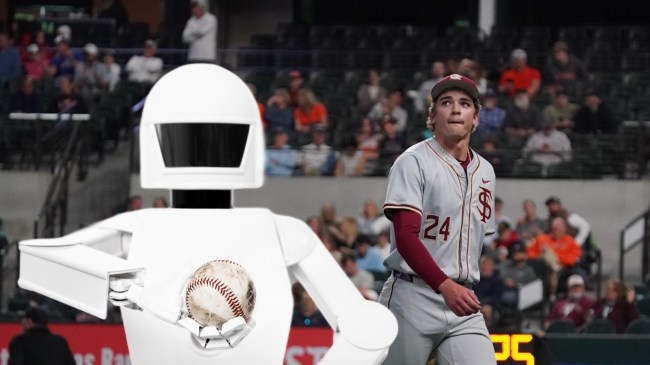
The ACC didn’t use an automated ball/strike system.
That decision differed from the rival SEC. The Southeastern Conference announced its decision to test ABS in its baseball tournament this May.
While it has created some confusion at times, it’s also provided more accuracy behind the plate while giving teams an opportunity to challenge missed calls.
Automated ball-strike systems are new to college baseball. They were recently introduced to the MLB level following test runs in the minor leagues.
The SEC’s implementation could accelerate the process of getting ABS into the NCAA permanently.
The ACC chose not to utilize the automated ball-strike system in its tournament. Had it done so, controversy might’ve been avoided.
Mike Bell could’ve simply challenged the initial strike rather than confront the umpire. It would’ve removed any speculation of a makeup call on the next delivery.
For what it’s worth, I think the umpire got the final ball call correct. The pitch was low. I also think Bell was justified in arguing the 3-1 strike, though it might’ve clipped the bottom of the zone.
Regardless, ABS could’ve prevented any debate. The calls could’ve been made correctly without a doubt. There would be no questions surrounding the legitimacy of Pitt’s comeback win.
Both teams will be impacted by the outcome.
FSU probably won’t earn a national seed.
The most recent D1 Baseball projection puts Florida State as the No. 11 overall seed. That means the Seminoles would host a regional in Tallahassee but likely be forced to travel for the second round should they advance.
The top eight seeds will not leave home unless they reach the final round of the NCAA Tournament. That can be a major factor in College World Series pursuits. Playing at home up through Omaha is a clear advantage.
The ‘Noles likely needed to beat Pitt to have a chance of securing a Top 8 seed. They didn’t, even if the final result was controversial.
On the flip side, the victory might be just enough to get the Panthers into the field. D1 Baseball currently rates Pitt as the 64th and final team in the tournament.