



iStockphoto / Denis Poroy-Imagn Images
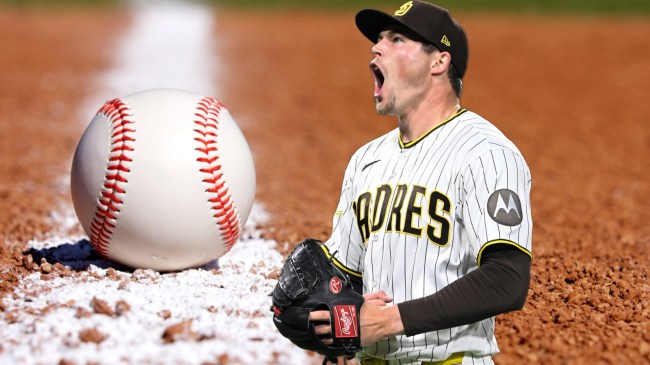
Mason Miller made San Diego history with a scoreless streak that lasted nearly 35 innings. He will not go down in the MLB record book.
The pitcher was stripped of the opportunity following a controversial fair ball ruling. He responded with disagreement after the Padres win.
Was the right call made? That’s up for debate.
Mason Miller’s scoreless streak came to an end.
Miller is in just his fourth big-league season after being picked in the third round of the 2021 MLB Draft. He debuted two years later with the A’s, starting six games while posting a 3.78 ERA.
The pitcher was traded to San Diego last season. He’s since made 50 appearances in late relief. This year, he leads the National League with 10 saves.
Miller’s numbers jump off the page. His ERA with the Padres is 0.96. He’s struck out 28 batters in just 14.1 innings. The stuff is electric.
The reliever allowed two runs in his second appearance with San Diego in 2025. He then pitched 34 scoreless frames across 33 games.
It came to an end in the ninth inning on Monday.
Controversy surrounds the streak.
why was this called a fair ball pic.twitter.com/AvraYJs66F
— Jomboy Media (@JomboyMedia) April 28, 2026
Cubs hitter Matt Shaw chopped a groundball down the third base line in Chicago’s final at-bat. Infielder Ty France let the ball roll foul… or so he thought.
The ball trickled outside the chalk. There was no contact with the baseline. It was ruled fair.
That ruling sparked an immediate rules debate online. What is a fair ball?
Many deemed the ball foul upon first look. It was not touching the baseline. Clear-cut, right?
Maybe not. An argument swirled around the spherical shape of the baseball. In this case, there was at least some portion of the ball hanging over the chalk in the eyes of the umpire. That, he determined, made it fair.
To further illustrate that line of thinking, we can use the base as a reference. The MLB defines a fair ball as follows:
Any batted ball that first contacts a fielder while the ball is in fair territory is considered fair. If not touched by a fielder, any batted ball that first contacts the field in fair territory beyond first or third base — with the foul lines and foul poles counting as fair territory — is considered fair. Batted balls that first contact the field between home plate and first or third base are considered fair if they subsequently bounce over or directly contact either base, or otherwise pass either base while in fair territory. They are also considered fair if they settle in fair territory between home plate and first or third base, including instances in which they bounce off home plate.
The key sentence in this argument is, “Batted balls that first contact the field between home plate and first or third base are considered fair if they subsequently bounce over or directly contact either base.”
Even if a batted ball, similar to the one hit by Shaw, is not in direct contact with the chalk, it is fair should it touch any part of the bag. It goes back to the spherical shape.
Any ball within home plate and third base could (should?) be ruled in the same manner, in theory.
Had this ball continued to roll in a direct straight line towards third base, the umpire believes it would’ve contacted the bag. Fair ball in his eyes!
Mason Miller disagreed.
Padres closer Mason Miller on the call at third base and end of his scoreless innings streak@FriarTerritory pic.twitter.com/FEKhQBiJdq
— Marty Caswell (@MartyCaswell) April 28, 2026
The MLB did, too.
The league admitted its mistake according to Ben Verlander.
🚨OFFICIAL RULING FROM MLB🚨
I reached out to MLB since there is a lot of confusion regarding this play:
“In our Umpire Manual, here is the definition of a fair ball:
FAIR BALL Definitions of Terms: When in contact with the ground, a ball must be in contact with fair…
— Ben Verlander (@BenVerlander) April 28, 2026
The umpire’s manual states that “when in contact with the ground, a ball must be in contact with fair territory and not merely hanging over fair territory in order to be adjudged fair.”
Hanging over the chalk is not the determining factor. Contact must be made with the chalk. Miller was snubbed, and he might’ve lost his scoreless streak as a result.