



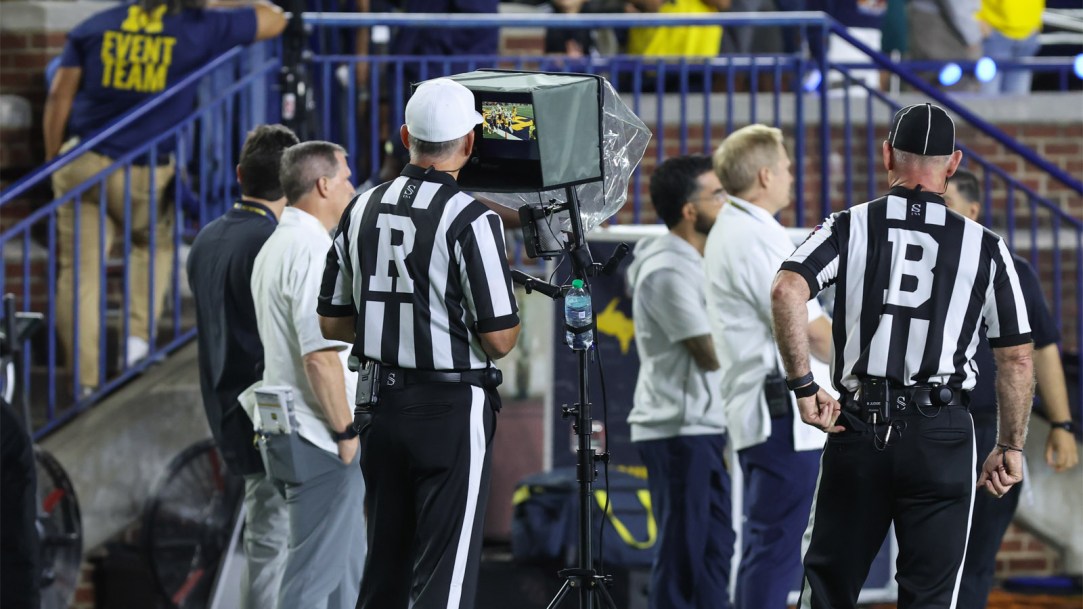
After Michigan’s controversial Week 1 victory over Western Michigan, the NCAA has instituted a new timekeeping protocol. Under the new “standard timing protocol,” Western Michigan would have won Saturday’s game 12-7.
Under the new protocol, according to a memo from Ron Snodgrass, the NCAA national coordinator of officials, the in-stadium game clock will display the official time for all college football games.
The embedded game clock in the program feed will be the basis for the replay official’s decision if a replay review calls for time to be restored or otherwise modified. The replay official will use the game-clock graphic shown in the broadcast feed if the broadcaster cannot provide an embedded game clock.
“This timing protocol should be followed consistently at all institutions and game sites,” he wrote, according to ESPN.
NCAA basically admits Western Michigan should have won the game
Because the NBC broadcast clock showed 0:00 when Michigan quarterback Bryce Underwood’s first Hail Mary pass fell incomplete, the game would have been over under the new protocol. Instead, because Big Ten replay officials ruled that Western Michigan safety Micah Davis had touched the ball with one second left, J.J. Buchanan was able to score the game-winning 47-yard touchdown on a second Hail Mary.
“It was determined [Davis] started his jump from an established out-of-bounds position [left foot] and made contact with the ball with one second remaining on the clock,” the Big Ten said in a statement two hours after the game. “A side-by-side view of the play and the game clock, using a direct shot of the game clock in the stadium, was used to determine the final ruling.”
On Monday, the MAC claimed in a statement that it was “evident that replay protocol was not properly followed in determining whether time remained on the game clock at the conclusion of the Western Michigan vs. Michigan football game.”
Jon A. Steinbrecher, the commissioner of MAC, asked on Tuesday that the NCAA reverse the outcome and acknowledge the Broncos as the “actual winner” in “its evaluation and deliberations.”
However, the NCAA said in an email to ESPN that it cannot reverse a game’s outcome under its current football regulations. Furthermore, the FBS oversight committee “does not have the authority” to change the outcome of a game.