


ESPN
The upstart Anaheim Ducks took a 3-1 series lead over the two-time defending Western Conference champion Edmonton Oilers on Sunday night in their first round playoff series.
But it didn’t come without controversy.
Ducks’ center Ryan Poehling, in his first year with the organization, scored the game-winning goal just 2 minutes and 29 seconds into overtime. But now fans are wondering if the puck ever fully crossed the goal line.
THE DUCKS BEAT THE OILERS IN OVERTIME 🔥
The reigning back-to-back western conference champions are now facing elimination 👀 pic.twitter.com/zHpwmc3yw5
— ESPN (@espn) April 27, 2026
NHL Awards Ducks Game-Winning Goal Without Clearn And Obvious Evidence
Poehling’s goal game on a wrap-around attempt after Edmonton goaltender lost sight of the puck. The only problem is, the referees appeared to lose sight of the puck as well before ultimately ruling that it went in the net.
However, the play immediately went to review.
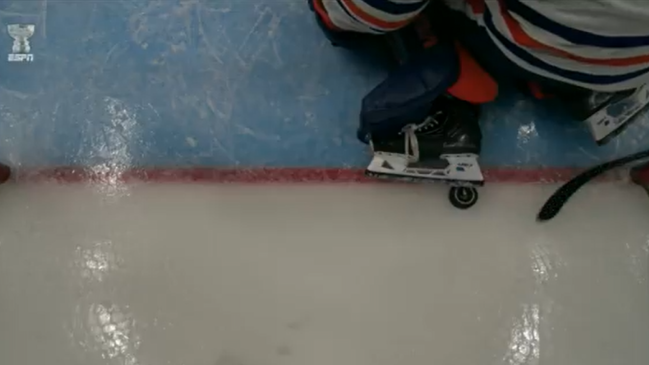
Upon review, the camera placed above the goal line seemed to show the puck just barely cross entirely over the goal line. But none of the camera angles showed a clear and decisive angle of the puck over the line because it was partially covered by Jarry’s skate blade.
Eventually, the call on the ice was upheld because there was not enough evidence to overturn it. However, had the call on the ice been “no goal,” it’s likely that the game would have continued.
That has people wondering, how on earth can the NHL not have the same goal-line technology that is used in soccer?
I once again note there’s no reason the NHL can’t put a chip in the puck and sensors in the goal posts. We should have goal line technology. https://t.co/fXwQTqje7e
— Russ Joy (@JoyOnBroad) April 27, 2026
The NHL is the only league that I know that doesn’t have goal line technology
It wouldn’t be hard to implement. Bettman cannot leave soon enough https://t.co/aHr0u2Oxes
— MySakuKoivu 2.0 (@HabsDepression) April 27, 2026
You will never see a better reason for goal line technology to be implemented into the NHL https://t.co/Hz7eCodMiJ
— Cam (@TheCamMoore) April 27, 2026
Which begs the question…
Why Doesn’t The NHL Use Goal-Line Technology
It seems like a simple enough thing for the league to do. And it in moments like this, it seems like it’s necessary for the NHL to have goal-line technology.
But thanks to Arthur Staple of The Athletic, we have a better idea of why it’s yet to be implemented.
“The puck-tracking cameras are in the ceiling at NHL arenas. That means the current tech would be useless for things aside from seeing a puck over the line that could also benefit from tracking,” Staple reported in 2023 when asking league sources about the matter.
Additionally, the “cameras can be blocked by bodies and equipment. That’s a hard one to believe, but it’s true.”
I’m not sure those reasons are good enough not to have the technology just for instances like this. But that’s the NHL’s answer, and it’s sticking to it.