




Kirby Lee / IMAGN IMAGES via Reuters Connect
The first-ever Enhanced Games took place in Las Vegas last weekend with former Olympians competing across Sprinting, Swimming, and Weightlifting. What seemed to be borne from an old Twitter joke about wanting to see the world’s top athletes on steroids compete against one another to see what humans are truly capable of became a reality, but the results suggested that being ‘enhanced’ did not, in large part, yield to superhuman results.
In the aftermath of the inaugural Enhanced Games, much has been written about how the event fell short of expectations. As of the time of writing, $ENHA stock is down 45%. Comparative analytics showed regression among the ‘enhanced’ athletes compared to their most recent performances and that seems to have led many to viewing this experiment as an abject failure but from the sidelines, I cannot help but view the results as a good thing for sports.
Opinion: Enhanced Games Athletes Underperforming Was Good For Sports

Kirby Lee / IMAGN IMAGES via Reuters Connect
Going into the Enhanced Games, there were two major camps among the interested parties: those who wanted to see enhanced athletes, the athletes who had taken FDA-approved substances banned by USADA/WADA to improve performance, and those who wanted to see them fail.
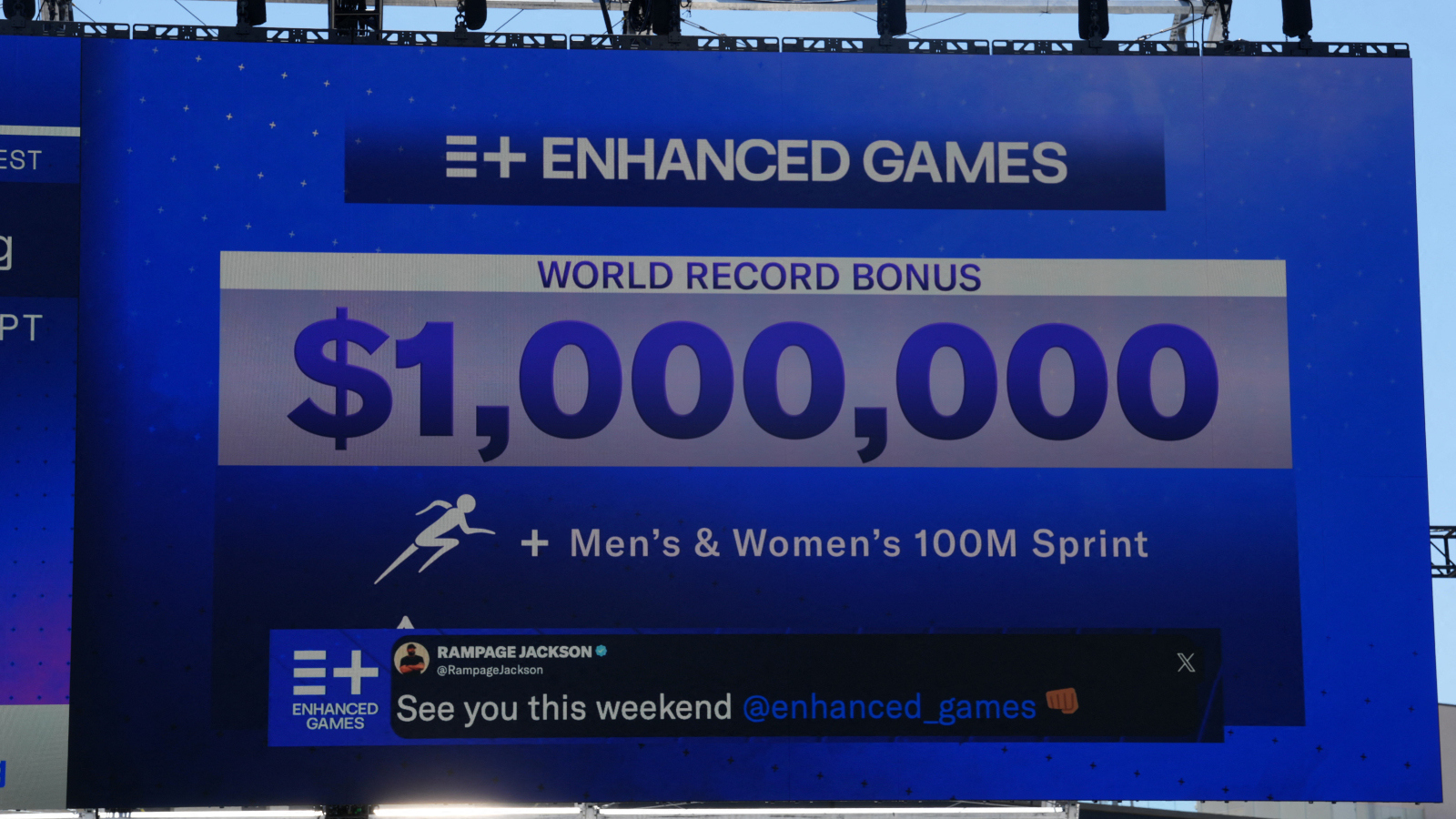
In the end, both got their way. Swimmer Kristian Gkolomeev eclipsed the existing world record in the Men’s 50M Freestyle with a time of 20.81 seconds. He earned a $1 million bonus for besting a world record and $250,000 for winning the event.
A $1,000,000 WORLD RECORD SWIM!
Kristian Gkolomeev wins the Men’s 50m Freestyle in 20.81s and takes home $1,000,000 bonus + $250,000 first place prize and reclaims his 50M Freestyle world record. pic.twitter.com/A9XApwrYPS
— Enhanced Games (@enhanced_games) May 25, 2026
Those rooting for the enhanced athletes to smash records saw this as a massive win.
On the flip side, author Steve Magness shared this table showing results of the Enhanced Games sprinters with their results last weekend in Las Vegas compared side-by-side with their most recent non-enhanced results. The two 100-meter Sprint winners (men’s and women’s) were both non-enhanced and submitted to USADA testing before the race.
Of the 11 sprinters, only one improved. The ‘clean’ sprinters beat the field but also ran slower than their best. Here are those results:
How bad were the enhanced games at enhancing?
They somehow took near world-class sprinters, doped them, and made them slower…
Not just from their PRs, but from last season…and in most cases, slower than a good HS runner…
Here's the details: pic.twitter.com/MZw8ysZodA
— Steve Magness (@stevemagness) May 25, 2026
Purists see this as a huge win. Those same purists also celebrated all-natural swimmer Hunter Armstrong prevailing over the ‘enhanced’ athletes by winning the Men’s 50M Backstroke.
The 2020 Olympic Gold Medalist in the 4×100 M medley took home $250,000 for beating his ‘enhanced’ competition and many saw it as proof that performance-enhancing substances were not needed, as all of the competitors were elite athletes and former Olympians, with the primary difference between them being a cocktail of PEDs banned in competitions outside of the Enhanced Games.
Everyone Got Their Way
IMAGN IMAGES via Reuters Connect
Following the first-ever Enhanced Games, the group of curious individuals who approached this as a social experiment and wanted to see what the best-of-the-best would look like if they were given performance-enhancing substances got to see what that would look like. The actual events were limited. Swimming being held to just 50 meters in the pool was clearly more a test of strength than aerobic fitness. The same is true on the track and in weight lifting.
Those who viewed the Enhanced Games as an affront to competition can also claim a victory. As pointed out above, 10 out of the 11 sprinters all performed worse than their most recent competition. Nobody in the weightlifting competition was able to eclipse existing world records despite weightlifting being the discipline that seemed most poised to see a record broken.
Looking back at the weekend’s competition, what we learned is banned substances are not necessary to break world records. It’s that simple. These were all elite athletes, given free reign to take performance-enhancing substances that are banned in competition such as HGH and Testosterone, and nearly across the board they did not outperform themselves when they were clean.
Parents and coaches with kids who compete in travel ball or D1 sports can point to the Enhanced Games as an example of where trying to gain a competitive advantage through PEDs is not worth it. How much of an edge do these banned substances give an athlete over dedicated training? You could make the argument, given the Enhanced Games results, that the only competitive advantage gained is the ability to hang onto elite status several years past one’s prime. Beyond that, the Enhanced Games showed that dedicated training blocks and diet outperforms shortcuts.
It should obviously go without saying but the enhanced athletes would now be banned from any competition requiring USADA/WADA testing because they have taken banned substances. Hunter Armstrong is sitting the prettiest among all the athletes as he earned $250K, beat the juiced up swimmers, and was clean for competition.
Was it a cash grab?
In hindsight, it shouldn’t be surprising that the Enhanced Games website is now selling a lot of banned substances. The ‘Live Enhanced’ tab on the website is a virtual store with link to purchase various peptides, forms of testosterone, GLP-1s, and more. It seems spreading the ‘enhanced’ lifestyle was always a major component of the business plan.
And there is ultimately nothing wrong with that. These are all FDA approved substances. Nothing ‘illegal’ was allowed in the competition, only FDA-approved substances that were banned in athletic competition.
Millions were on the line at the inaugural Enhanced Games with $1 million being offered to any world record beaten. Winners of each event took home $250K, $100K for 2nd, $75K for 3rd, $50K for 4th, $30K for 5th, and $20K for 6th-8th places. That is a LOT of money for these athletes who don’t compete in traditional spectator sports.
But that money had to come from somewhere, and the Enhanced Games stock is way down today. On top of that, there has been no announcements as of yet about a second Enhanced Games being held. It is possible this was a one-and-done competition.
From where I’m standing, this is great for sports as a whole. We got to see what elite athletes do on banned substances and competing against clean athletes (who largely won). This can now be used as an example of why taking banned substance is not worth risking an athlete’s career. And we can all go back to our lives now that we’ve seen this experiment play out.
What do you think? Was this good for sports overall? Hit me with your answers down below in the all-new BroBible comments section!