


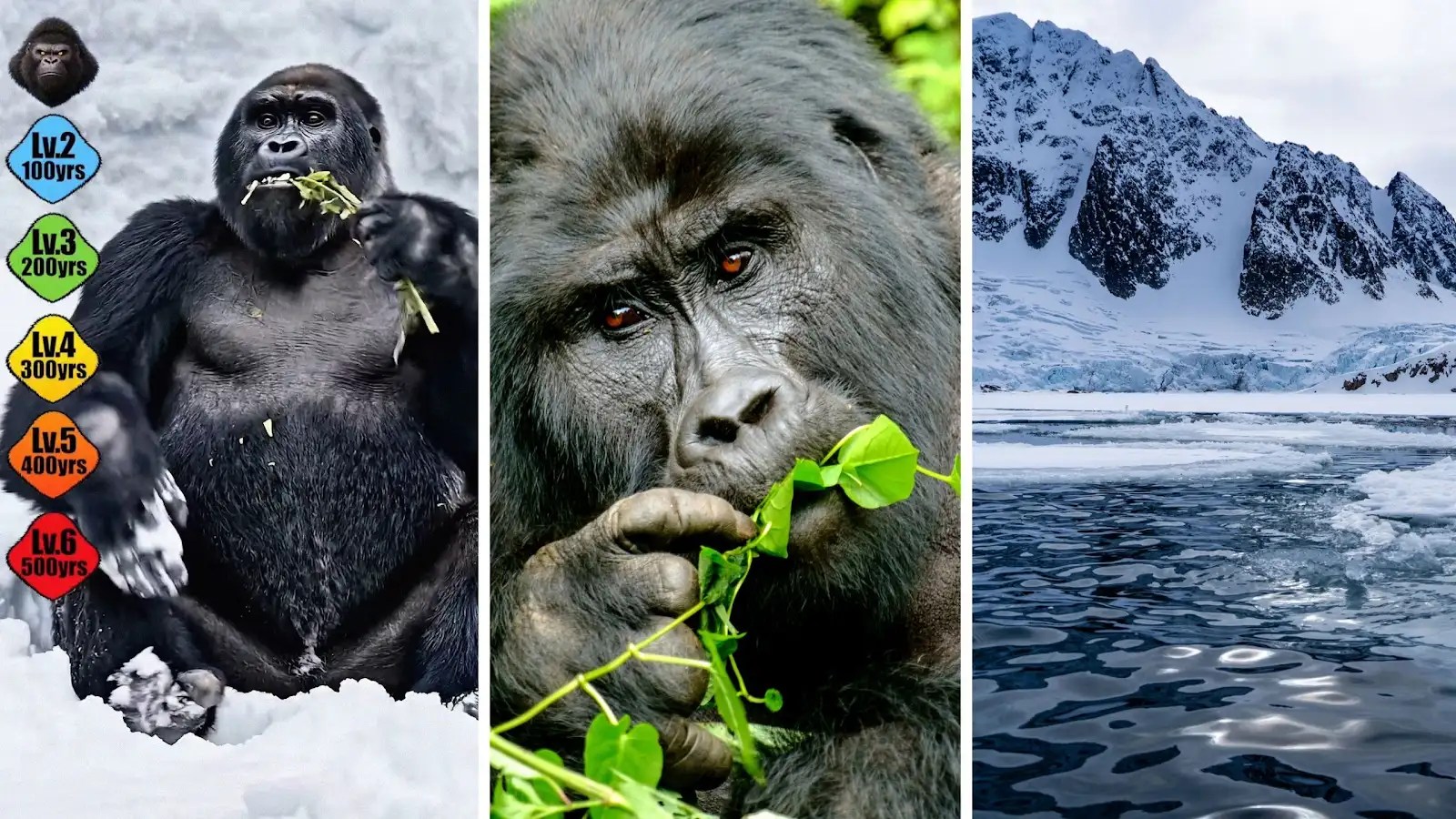
Wonder what the arctic would be like if polar bears weren’t the apex predators? A viral Instagram account uses AI to imagine what it would be like if an African Silverback evolved to thrive in the sub-freezing habitat.
In an Instagram Reel with over 1.1 million views, Alpha.Class.Animals imagines what it would be like if a silverback gorilla was placed in the Arctic with aging turned off. The account has several viral videos that explore how other animals would evolve if placed in a different environment. It has garnered over 16,000 followers as of April 2026.
By the time 500 years pass, the gorilla is almost unrecognizable. But how accurate is the account’s prediction?
What Happens If You Put An African Silverback In The Arctic?
The account shows a gorilla marching around a “geothermal cave system” with warm water and mossy plants at the 100-year mark.
“Cold is not the enemy. Hunger is. He eats moss, algae, cave plants, and small animals. He becomes 50% carnivore,” the video says. In real life, silverback gorillas are primarily herbivores, with only small bugs as a non-plant source of food.
The account predicts that at the 200-year mark, a high iron diet would turn the silverback red. At this point the gorilla would be “70% carnivore.” At this point, the account suggests that the gorilla would venture out of the cave to hunt larger animals.
Fast-forward another 100 years, and the account suspects that the gorilla would be 100% carnivorous, showing an AI clip of the Silverback diving after a seal. The carnivore diet makes the gorilla twice as strong, and the UV rays turn its hair gray.
Polar bears and gorillas don’t face off until the 500-year mark. The account predicts that the silverback would dominate the bear as the new apex predator of the arctic. At this point, the gorilla more closely resembles a “snow yeti.”
Could Apes Actually Live In The Arctic?
The viral Instagram Reel isn’t the first time science lovers have speculated about an arctic ape. On the r/SpeculativeEvolution subreddit, others discuss what it would actually look like for an ape to live in the freezing temperatures.
“Arctic animals tend to be larger than non-Arctic species, i.e. Polar Bear vs Grizzly Bear. I would imagine that with an appropriate amount of time Gorillas, or another ape, could speciate into a cold adapted, mostly carnivorous species,” one says, suggesting that the Reel might not be too far off.
Others point out that there are real-life apes that live in snowy environments, such as the Japanese macaque. However, these small monkeys still primarily eat plants, with the occasional exception of bird eggs and crabs.
And backtracking to 52 million years ago, primate relatives did indeed live in the arctic. However, the Arctic, during that period, was much warmer than today. “These creatures are the first and only primate relatives known to make it to the Arctic,” Kristen Miller, a representative for the University of Kansas, told NewScientist about the tree dwellers.
Do Viewers Agree With The Prediction?
Commenters on the Reel argue about the accuracy of the AI prediction for an arctic silverback gorilla.
“That’s not how evolution works,” a viewer says.
Another suggests, “Aint no world where a polar bear is losing to a gorilla.”
“So YETI is silver back gorilla thrown into artic,” a third adds.
Others point out that the animal’s evolution would take much longer than 500 years.
“This would take hundreds of thousands of years not 500,” one remarks.
“Bro fundamentally misunderstood evolution , and yet nothing we’ve ever studied is immortal so there’s no rule saying it’s not possible,” a second writes.
BroBible reached out to Alpha.Class.Animals via Instagram for further comment. We will update the story when they reply.