



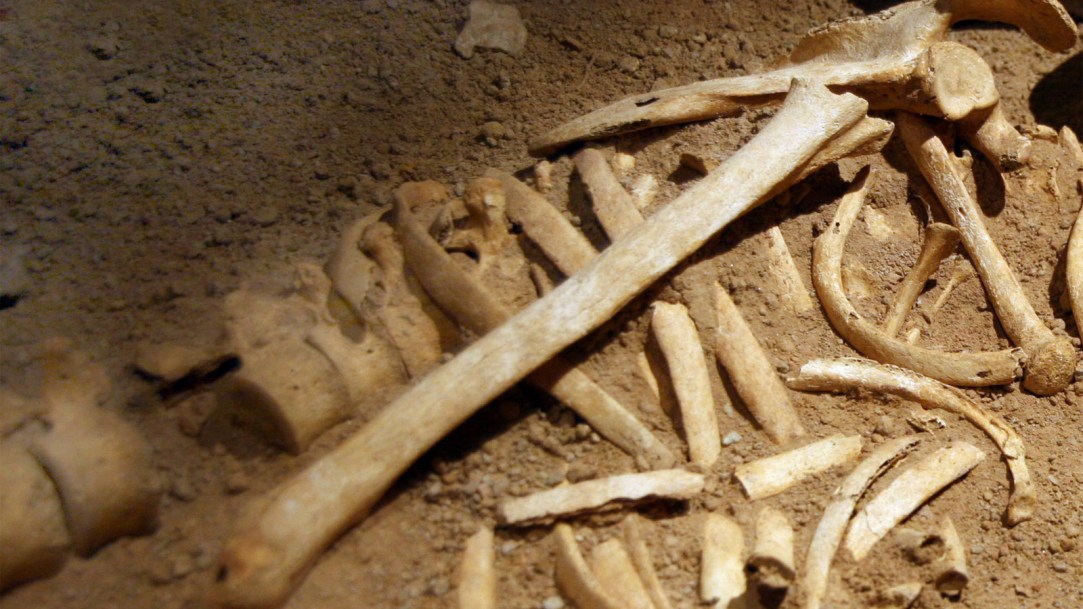
Archaeologists cannot explain why people in Stone Age Slovakia removed the heads of dozens of human skeletons before burying them in a ditch. The researchers found the human remains lying randomly on and next to each other in Vrable, a sizable farming community that flourished between roughly 5250 and 4950 BC.
Researchers believe the practice was part of a complicated burial process more than 7,000 years ago, rather than a violent mass murder. Even though the bones show cut marks that indicate decapitation, they believe someone probably beheaded them after they died.
“The features clearly exhibit an intentional manipulation of the bodies. First analyses suggest, above all, that violent ‘decapitations’ were not conducted here, but rather skillful removal of the skulls,” study co-author Katharina Fuchs, a biological anthropologist at Kiel University in Germany, said in a statement.
The large Neolithic settlement at Vráble is one of the most important excavation sites of the so-called Linear Pottery culture (LBK) in Central Europe, according to the archaeologists.
There appeared to be no consistent orientation among the remains. While some were face down, others were on their backs, and several appeared twisted or were overlapping. Other human bones were also strewn throughout.
Of the people found in the ditch, 77 were headless. The excavators discovered only one child’s skeleton with a preserved skull. According to preliminary data, there was not much time between these people’s deaths and their burials.
Why were all of these people decapitated?
According to the researchers, one theory is that people might have deliberately kept the heads apart, as this phenomenon has been seen in other contexts, but has not yet been directly verified for Vrable.
Numerous prehistoric societies, including the LBK, have documented similar human-body-related interventions. The specifics of the practices, however, vary substantially.
Moreover, the accumulation of corpses or body parts in settlement ditches is not a singular occurrence. However, it is noteworthy that numerous archaeological sites at the end of the LBK contain mass graves, deposits in settlement ditches, and evidence of body manipulation.
Researchers have often seen this phenomenon as evidence of a crisis, such as during violence or conflict. However, archaeologists at this site believe there may have been another reason for the practice.
“The deposition of bodies and body parts may have been part of more complex, meaningful and recurring practices,” stated co-author Dr. Nils-Muller-Scheessel.
“We must assume that these practices were embedded in completely different contexts of meaning than those of modern societies,” Furholt added. “This is what makes an interpretation of them so challenging.”