



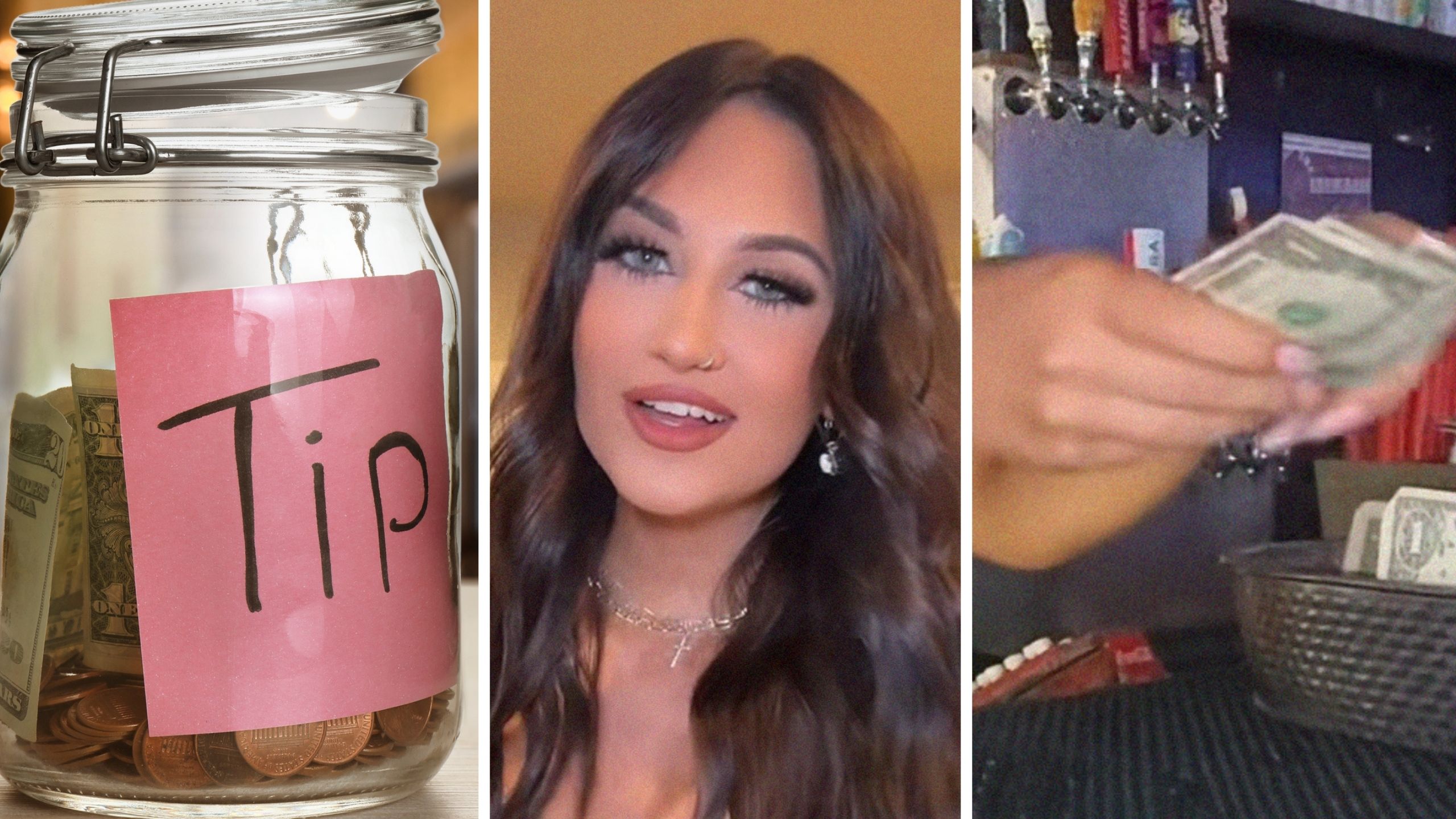
A bartender shared her hack for getting more tips: seeding the jar.
Chloe Hoffman (@chloehofmannn) posted a no-viral video showing off the practice in question.
As it turns out, there are plenty of bartenders and food service workers who do the exact same thing.
Visual Cues
Chloe begins her clip by standing behind the bar. A metal tray rests on the top of the bar, and she films herself tossing dollar bills inside of it. “Adding my fake tips so I make real tips cause I’m a #youngho,” she writes in the text overlay of her video.
In a caption, she ponders why this trick seems to encourage people to tip. But in the comments section of her post, it would seem that there are mixed opinions on whether or not this tactic is actually effective.
As one TikTok user replied, “Me in my head: oh you already having a good night I don’t need to [tip].”
“This is why I do the opposite as a barista. I take out the cash and only leave a single dollar or the coins. Leave enough so people see the cash tip jar but take it out so it doesn’t look like we’ve already gotten plenty,” a bartender shared.
Another bartender shared, “I put a $20 on my own birthday pin so people know to give me money.” Chloe called this tactic “genius” in a response.
Someone else wrote that they are distrustful of flowing tip jars. “Only the rookie customers fall for that. That trick is old. When I see that I make sure I don’t tip,” another said.
But there were other folks who said that this method is a surefire way to increase gratuities. “We call that salting the tip jar at my bar… and it works because of peer pressure,” another wrote.
It’s Called The Tip Jar Effect
As it turns out, this phenomenon has been studied as a pattern in “behavioral economics,” according to Profit.co. The outlet writes that this conduct often “occurs when an initially empty jar is ‘seeded’ with some money.”
Usually, this function is performed by a business or employees of that business as a means of establishing a visual cue. As the website writes, “This small amount of money acts as social proof, suggesting that tipping is a common and socially accepted behavior. Observing money in the jar, customers are more inclined to leave a tip themselves, believing that others have done the same.”
So, when folks step into a bar or cafe and see a tip jar with some money in it, they’re led to think that this is a rule of the establishment. This sends a mental signal for reciprocity. And Profit.co notes this is par for the course for not just restaurants and cafes but also street performers, charitable donations, and other business settings.
Psychologists Have Something To Say About It, Too
Psychology Today wrote about the “tip jar effect” as well, stating that the food service “industry relies on social proof, nudging, and watching us as we tip.” In its article, the site directly references “seeding the tip jar” and says that customers who “see an empty tip jar sitting on the counter … use this information to conclude that nobody else is tipping.” With this data, consumers may be reluctant to leave a hefty gratuity for workers.
But there are other tactics businesses use in order to try and implicitly suggest consumers should cough up more of their money for tips. For example, a restaurant may make the default gratuity recommendations on tablets have higher tipping options. The author of the Psychology Today piece writes that they’ve “noticed how some businesses hack … this principle by changing the options to 20 percent, 25 percent, and 30 percent.”
They note that while many shoppers do have the choice to enter a custom tip amount, it’s still a scheme that helps push people in the direction of leaving more cash. “This tactic relies on a concept called ‘nudge,’ demonstrating that changing default options has a powerful influence on our decisions,” the post says.
Also, there’s a convenience factor involved, too, as many shoppers “don’t want to hassle with clicking extra buttons to leave a custom tip.”
Lastly, the article also says that social pressure can play a role in getting folks to tip more, too. When a server is hovering around the table as you sign your check, guests may be compelled to toss a few extra dollars their way.
Other Tip Jar-Boosting Strategies
Toast shared some ideas of how service workers can get more tips through tip jars. Among the list were putting a whimsical joke on the jar, adding a QR code to the front, or placing two in front of guests and turning the jars into “competition and voting tip jars.”
@chloehofmannn Can someone actually explain the science behind this #bartok #pnw
BroBible has reached out to Hoffman via email for further comment.