



iStockphoto / Photobank2/MOZCO Mateusz Szymanski
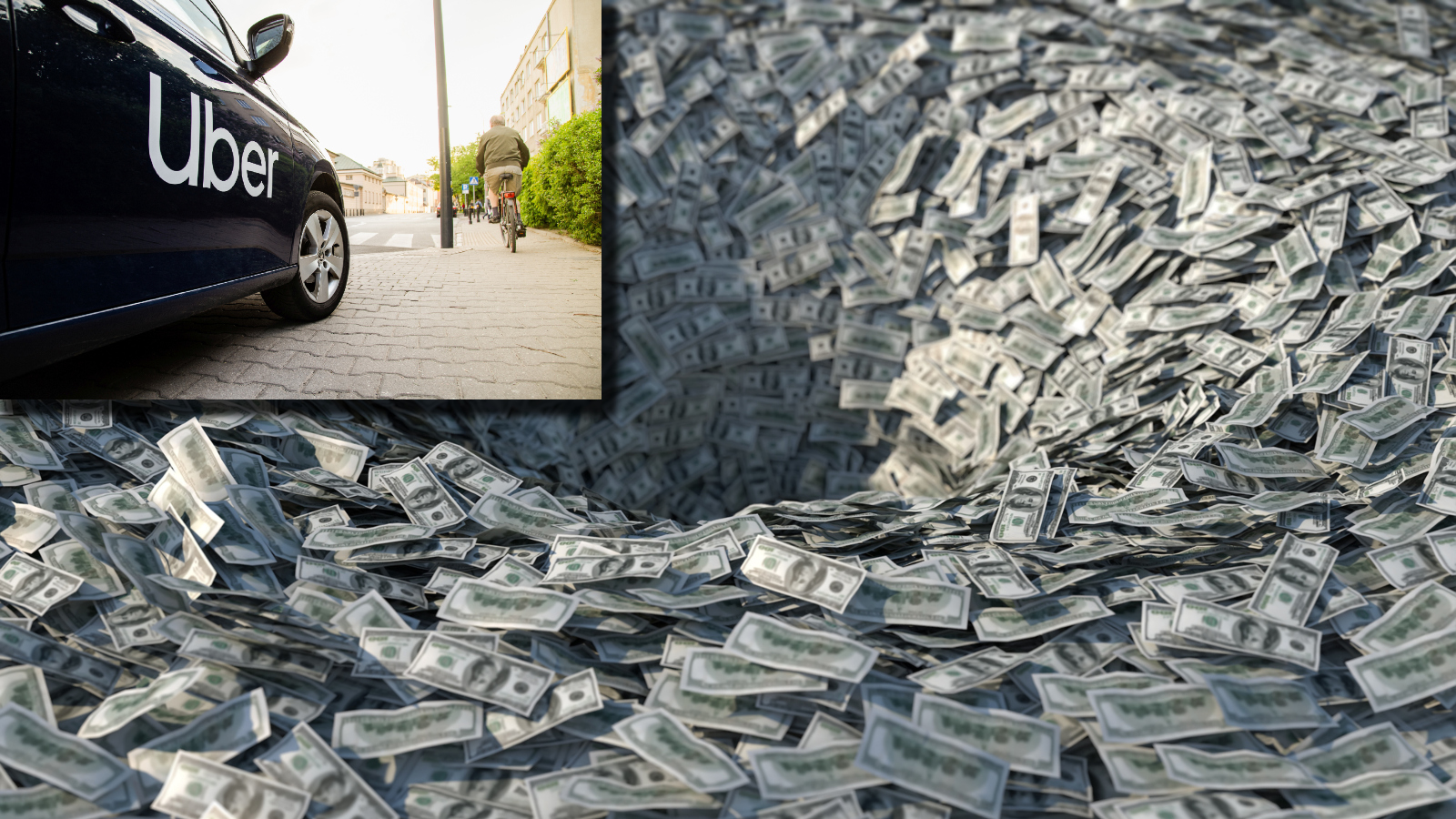
Uber rideshare vehicle next to a money pit vortex
Most folks that rely on Uber for rides recognize fluctuation in charges is just part of the game. It gets chalked up to surge pricing, rides taking longer due to traffic, some regions of the country being more expensive than others, etc. But A More Perfect Union recently published an investigation that shows something going on that every Uber rider should be aware of.
The short explanation is that Uber claims commercial car insurance fees account for around 20% of fares. The investigation discovered those fees can vary by over $35 for the exact same ride… Same driver, same rider, same route, same time of day. The same ride.
Investigation Into Uber Charges Turns Up Concerning Results
This is not the first time that More Perfect Union has looked into Uber’s practices and this time around they made mention of that in their video title, ‘We Investigated Uber Again. It’s Worse Than Last Time.’ Speaking with one driver who drove the same trip, over and over and over, they investigated why the corporate car insurance fees ranged from $13.75 to $50 for the exact same ride.
This drive in particular estimated that around $20,000 of his annual fares went toward commercial car insurance fees. Tracking all of it in a spreadsheet, that data was passed to Len Sherman who has a PhD in Economics from the Massachusetts Institute of Technology and is an Executive in Residence at Columbia Business School. He points out that Uber holds the title of “having lost more money than any company in history until Open AI came along.” Sherman also points out that Uber has now become a “money making machine.”
His takeaways from the spreadsheet on commercial car insurance fees being charged on Uber fares is the fees for insurance “varied even more than the price and pay that the drivers and riders are experiencing.” As he points out, that is not how insurance should ever work.
In his words “people with essentially the same type of risk profile should be charged the same amount of premiums.” That is how insurance is supposed to work. He found the year of the trip, day of the week, time of day, and service type did not impact the fee charged.
So what gives? He found the only two factors that impacted the price of the insurance fees were (1) the price of the trip and (2) the driver pay of the trip. Based on the data, the insurance fees were determined entirely based on price, not risk. Is that really how insurance is supposed to work? No… No it is not.
The video here picks up right after that discussion:
Going deeper into the investigation, they found that around the time of Uber’s IPO driver’s pay was slashed by 30-35% “almost overnight.” At this time, Uber went from raking in around 15% per fare to nearly 40%. The investigation points out that Uber is now taking over 50%. So half of what riders pay goes to Uber, not the driver.
Uber says otherwise. According to the investigation, Uber still claims their take rate is around 20% which is a heck of a lot less than 50%.
Can you see where this is all headed?
According to Consumer Watchdog president Jamie Court, Aleka Insurance is a wholly owned subsidiary of Uber. In his words, “its sole purpose is to self-fund Uber’s insurance system. It is nothing more than a department of Uber, if you look at it that way.”
A ‘Captive Insurer’ is an insurance company that is wholly owned by one company to service that company’s insurance claims. This one, based in Hawaii, has a board of directors consisting entirely of former Uber executives. And according to the investigation, 95% of the insurance premiums paid on fares “stay inside of Uber.”
They then question “why does an insurance fee set by the company collecting it seemingly track price and not risk?” Unfortunately, Aleka does not have to release its data because it’s only customer is Uber. And in a statement to More Perfect Union, Uber claims their fee “tracks risk and includes factors like origin city, distance, duration, time of day, and weather.”
Uber told them that by running their own insurance it allows them to decrease the cost of the insurance and associated fees. The investigation then turns to SB 371, an insurance law passed in California. Previously, if an uninsured driver hits you Uber was responsible for up to $1 million. Now? It’s just $60,000, a 94% decrease. Meanwhile, Uber has cited the “rising cost of insurance” as necessary reason for the law but without every citing they were paying themselves the insurance fees.
They then point out that in Uber’s Proxy Statement, executives were paid specifically for the passage of SB 371. The words “passage of SB 371” are in there.
Did any of this change the cost of fares? They point out that in California, insurance costs have dropped around 20% after the change in liability but rider’s fares have increased 3% and driver pay has only rise 1%. Cheaper insurance, more expensive rides. That’s the takeaway from the investigation. Give that video above a watch for the full rundown.